
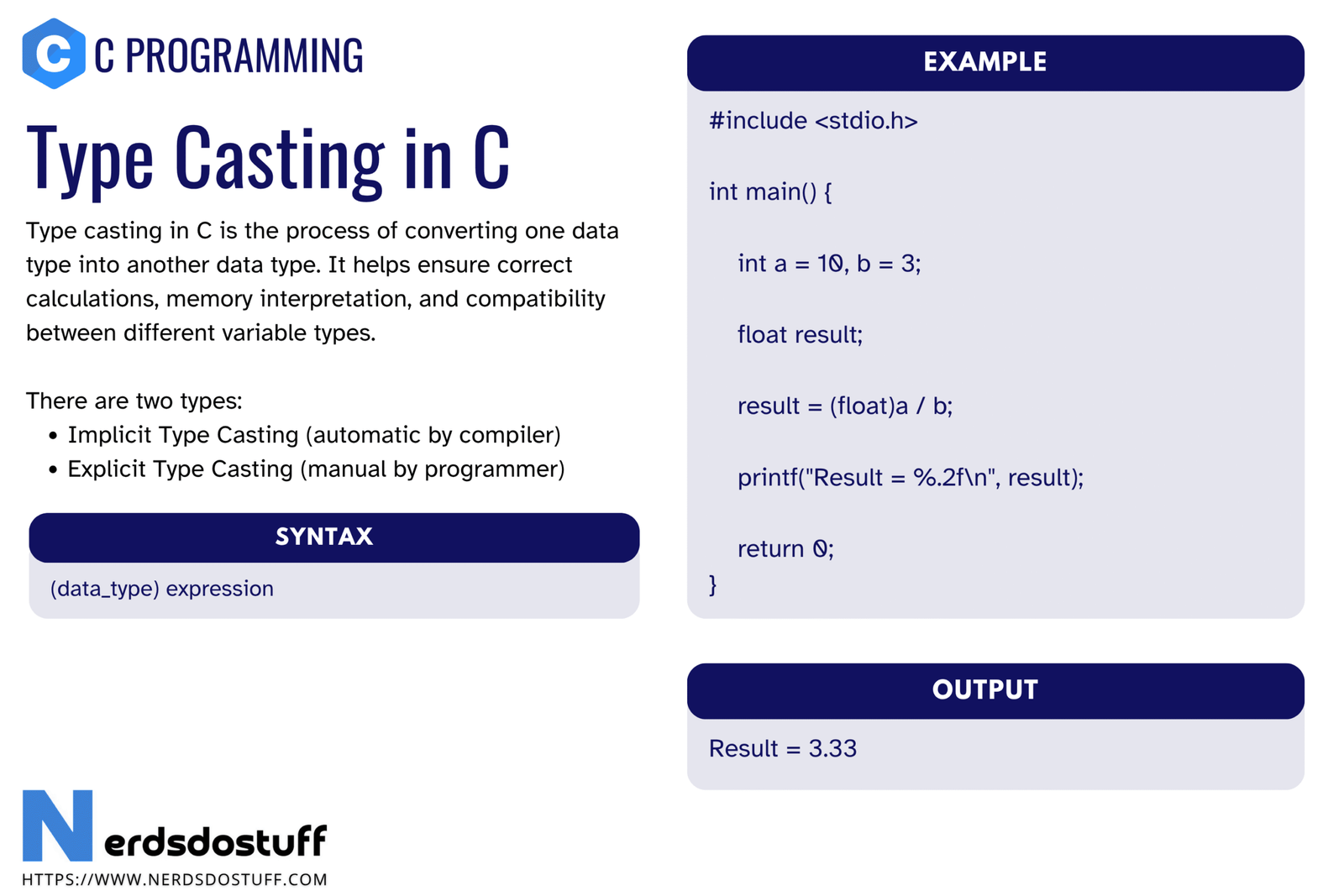
Type casting in C means converting a value from one data type to another. This is a very common operation in C programming because different expressions, variables, functions, and calculations often involve more than one type. Sometimes the conversion happens automatically by the compiler, and sometimes the programmer does it explicitly.
Understanding type casting clearly is important because conversions can change the result of calculations, remove the fractional part of numbers, increase range, reduce range, or even cause data loss if used carelessly. In this article, we will understand type casting in C, the difference between implicit and explicit conversion, examples, risks, and best practices.
What is Type Casting in C?
Type casting in C is the process of converting a value or expression from one data type to another.
Type casting changes how a value is interpreted or stored by converting it from one type to another.
This conversion may happen automatically or may be requested directly by the programmer.
Why Type Casting is Needed in C
- to make arithmetic results behave as expected
- to convert between integer and floating-point types
- to match function parameter types
- to control how memory values are interpreted
- to avoid unwanted integer division or truncation
Without understanding type casting, it is easy to get wrong output even when the code looks correct.
Types of Type Casting in C
There are two main forms of type conversion in C:
- implicit type conversion
- explicit type casting
Implicit Type Conversion in C
Implicit conversion happens automatically by the compiler when needed.
int a = 10;
float b = a;
Here the integer value is automatically converted to a floating-point value.
Explicit Type Casting in C
Explicit type casting happens when the programmer forces the conversion using a cast operator.
Syntax:
(type_name) expressionExample:
float x = 5.75f;
int y = (int)x;
Here x is explicitly converted to int, so the fractional part is removed and y becomes 5.
Integer to Float Type Casting in C
Converting an integer to a float is usually straightforward and does not lose information for small values.
int a = 12;
float b = (float)a;
The value becomes 12.0.
Float to Integer Type Casting in C
Converting a float to an integer removes the fractional part. This is truncation, not rounding.
float pi = 3.99f;
int n = (int)pi;
After conversion, n becomes 3, not 4.
Type Casting and Integer Division in C
This is one of the most important practical uses of type casting.
If both operands are integers, C performs integer division:
int a = 5, b = 2;
float result = a / b;
The result becomes 2.0, not 2.5, because the division happened as integer division first.
To get a floating-point result, cast one operand:
float result = (float)a / b;Now the result becomes 2.5.
Widening and Narrowing Conversion in C
Type conversions can be understood in two broad categories.
- widening conversion: moving to a type with a broader range, such as
inttofloat - narrowing conversion: moving to a type with a smaller range or less precision, such as
floattoint
Narrowing conversions are more dangerous because they may lose information.
Data Loss in Type Casting in C
Type casting can lead to data loss when the destination type cannot represent the original value fully.
| Conversion | Possible Risk |
|---|---|
float to int | Fractional part lost |
double to float | Precision loss |
int to char | Range loss |
| Large integer to smaller type | Overflow or truncation behavior |
This is why casting should be done with a clear understanding of the source and destination types.
Type Casting with Characters in C
Characters in C are closely related to integer values through ASCII or implementation character encoding.
char ch = 'A';
int code = (int)ch;
Here the character is converted into its integer code value.
Type Casting with Pointers in C
Pointer casting also exists in C, but it should be used carefully because it changes how memory is interpreted.
Example:
void *vp;
int x = 10;
vp = &x;
int *ip = (int *)vp;
This kind of cast is common with void *, but careless pointer casting can easily create bugs.
Common Mistakes with Type Casting in C
- forgetting that integer division happens before assignment
- assuming float to int conversion rounds instead of truncates
- casting large values into smaller types without checking range
- using pointer casts without understanding memory layout
- adding unnecessary casts that hide real type issues
| Mistake | Problem | Better Practice |
|---|---|---|
| Casting after integer division | Wrong arithmetic result | Cast before division when needed |
| Assuming cast means rounding | Unexpected truncation | Remember float to int removes fraction |
| Blind pointer casting | Memory interpretation bugs | Cast pointers only with clear reason |
Best Practices for Type Casting in C
- Use explicit casting only when there is a clear reason.
- Be careful with narrowing conversions.
- Cast before arithmetic if the operation itself must use a wider type.
- Avoid unnecessary casts that make code noisy or hide warnings.
- Be extra careful with pointer type casting.
FAQs
What is type casting in C?
Type casting in C is the conversion of a value or expression from one data type to another.
What is the difference between implicit and explicit type casting in C?
Implicit conversion happens automatically by the compiler, while explicit casting is forced by the programmer using a cast operator.
Does float to int casting round in C?
No. It truncates the fractional part.
Why is type casting used in division in C?
It is used to force floating-point division when integer division would otherwise remove the fractional part.
Can type casting cause data loss in C?
Yes. Narrowing conversions can lose precision, range, or fractional information.
Is pointer casting in C safe?
It can be safe in some controlled cases, but careless pointer casting is risky because it changes how memory is interpreted.
Continue learning C in order
Follow the topic sequence with the previous and next lesson.