
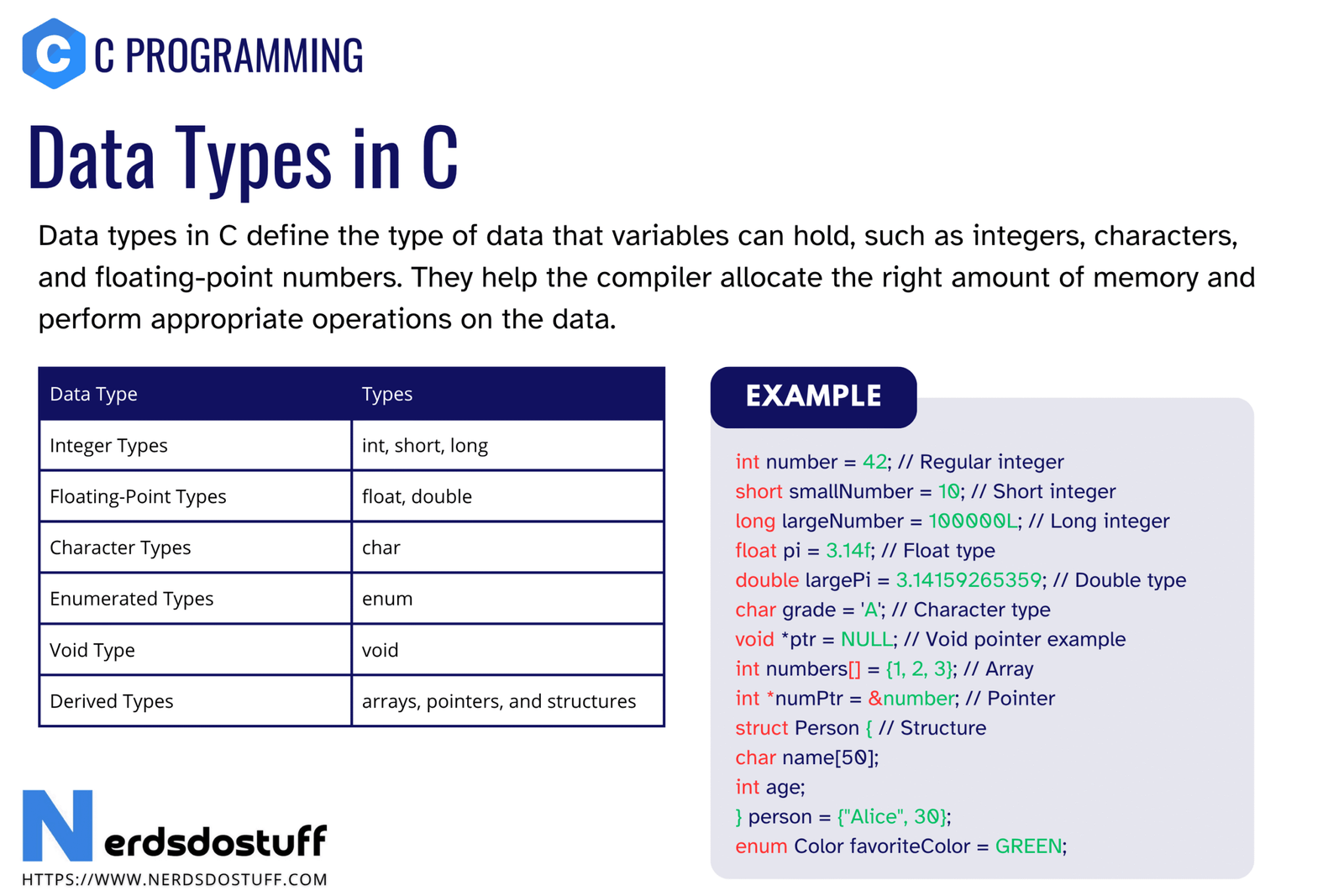
Data types in C define the kind of value a variable can store. They are one of the most important parts of the language because they affect memory usage, valid operations, input and output formatting, and the overall behavior of a program. If variables tell the compiler where data is stored, data types tell it what kind of data is stored there.
For beginners, this topic is not just about memorizing names like int or float. It is about understanding how C represents numbers, characters, and other values in memory. In this article, we will cover what data types in C are, why they matter, how they are classified, the common built-in types, size-related behavior, type modifiers, format specifiers, and the mistakes beginners often make.
What are Data Types in C?
A data type in C tells the compiler what type of value a variable, expression, or function result will hold. This allows the compiler to allocate an appropriate amount of memory and apply the correct rules when the value is read, written, or processed.
For example, an integer value such as 25 is handled differently from a decimal value such as 25.75. In the same way, a single character such as 'A' is treated differently from a full string such as "Hello". C needs these distinctions to generate correct machine-level behavior.
Why Data Types are Important in C
- They determine how much memory is reserved for a value.
- They influence the range of values a variable can represent.
- They affect which operations are valid or meaningful.
- They control how input and output should be formatted.
- They help the compiler detect type-related mistakes early.
If data types are chosen carelessly, a program may waste memory, lose precision, print incorrect output, or behave unpredictably. That is why good C programming depends on selecting the right type for the job.
Classification of Data Types in C
Data types in C are often grouped into a few major categories. This classification helps beginners understand how the language grows from simple values to more complex structures.
Basic or Primary Data Types
These are the fundamental built-in types used to store the most common kinds of values. The main primary types are char, int, float, and double.
Void Type
The void type represents the absence of a value. It is commonly used with functions that do not return anything, and it also appears in cases such as generic pointers.
Derived Data Types
Derived types are built from basic types. Arrays, pointers, and functions fall into this category. For example, an array of integers and a pointer to a character are both derived forms based on simpler underlying types.
User-Defined Data Types
C also allows the programmer to define more meaningful data structures. Structures, unions, enumerations, and typedef names are common examples of user-defined types or type-related constructs.
Basic Data Types in C
char
The char type is used to store a single character. In C, characters are represented internally by integer codes such as ASCII values. A char occupies exactly one byte, but whether plain char behaves as signed or unsigned depends on the compiler and target platform.
int
The int type is used to store whole numbers such as counts, indexes, and ages. It is one of the most frequently used types in C because so many program tasks involve integer operations. The exact size of int is implementation-dependent, but on many modern systems it is commonly 4 bytes.
float
The float type is used for decimal values with single precision. It is useful when fractional values are needed, such as temperature readings, averages, or sensor measurements. On many systems, a float is commonly 4 bytes.
double
The double type is also used for decimal values, but it generally provides more precision than float. It is preferred when calculations require greater numeric accuracy. On many systems, double is commonly 8 bytes.
| Type | Common Size (bytes) | Used For | Example Value |
|---|---|---|---|
char | 1 | Single character data | 'A' |
int | 4 | Whole numbers | 120 |
float | 4 | Decimal values | 12.5f |
double | 8 | Higher-precision decimal values | 12.5 |
Type Modifiers in C
C allows type modifiers that adjust the size or signedness of certain basic types. These modifiers help programmers represent data more precisely when the default form is not the best fit.
signedindicates that both positive and negative values are allowed.unsignedindicates that only zero and positive values are stored, which increases the positive range.shortrequests a shorter integer form than the defaultint.longrequests a larger integer form than the defaultint.long longprovides an even wider integer type on standard-compliant compilers.
These modifiers are most commonly used with integer types. For example, unsigned int, short int, and long long int are all valid type forms in C.
| Modified Type | Common Size (bytes) | Meaning | Typical Use |
|---|---|---|---|
unsigned int | 4 | Non-negative integer values | Counters, sizes, flags |
short int | 2 | Smaller integer form | Memory-sensitive integer storage |
long int | 4 or 8 | Larger integer form | Bigger integer ranges |
long long int | 8 | Very large integer form | Large counters and file sizes |
Typical Size of Data Types in C
This is where many beginners get confused. C does not guarantee the same byte size for every type on every platform. The language defines minimum requirements, but actual sizes can vary depending on the compiler, operating system, and processor architecture.
The table below shows common sizes on many modern systems, not universal guarantees. The only always-true statement here is that char is one byte, while the rest may vary by implementation.
| Data Type | Common Size (bytes) | Important Note |
|---|---|---|
char | 1 | Always one byte by definition |
short int | 2 | At least 16 bits |
int | 4 | Often 4 bytes, but not guaranteed everywhere |
long int | 4 or 8 | Depends on platform model |
long long int | 8 | At least 64 bits |
float | 4 | Single precision |
double | 8 | Double precision |
long double | 10, 12, or 16 | Implementation-dependent |
Example of Data Type Declarations in C
A beginner should be comfortable reading and writing declarations using the common data types. The following example shows several valid variable declarations in one place.
char grade = 'A';
int age = 21;
unsigned int count = 150;
float temperature = 36.5f;
double average = 92.875;
long long population = 7800000000LL;
These declarations do not only differ in syntax. They also differ in how much memory is typically used, which values are valid, and how calculations involving them may behave.
Using sizeof with Data Types
The safest way to check the size of a type on your own system is to use the sizeof operator. This is far better than assuming that every compiler follows the same layout.
#include <stdio.h>

int main(void)
{
    printf("char: %zu bytes\n", sizeof(char));
    printf("int: %zu bytes\n", sizeof(int));
    printf("float: %zu bytes\n", sizeof(float));
    printf("double: %zu bytes\n", sizeof(double));
    return 0;
}
This approach makes your understanding more accurate because it reflects the actual compiler and architecture you are using.
Signed and Unsigned Data Types
Signed types can represent both negative and positive values. Unsigned types use the available range entirely for non-negative values. This often allows a larger positive range than the signed version of the same size.
For example, an unsigned int cannot store negative numbers, but it can usually store larger positive values than a regular signed int of the same size. Choosing between signed and unsigned should be based on the real meaning of the data, not on habit.
Format Specifiers and Data Types in C
When values are printed or read using standard input and output functions, the correct format specifier matters. A mismatch between a data type and its format specifier can lead to incorrect output or undefined behavior.
| Data Type | Common Size (bytes) | Common Format Specifier |
|---|---|---|
char | 1 | %c |
int | 4 | %d |
unsigned int | 4 | %u |
float | 4 | %f |
double | 8 | %lf in scanf, %f in printf |
long int | 4 or 8 | %ld |
long long int | 8 | %lld |
This topic becomes especially important when working with user input, because the wrong specifier can produce bugs that are difficult for beginners to trace.
How to Choose the Right Data Type
- Use
intfor ordinary whole-number calculations unless you have a clear reason to use another integer type. - Use
charfor single characters, not for full words or sentences. - Use
floatordoublewhen decimal precision is required. - Use unsigned types only when negative values do not make sense for the data.
- Use
sizeofand compiler documentation when exact storage matters.
The right type is the one that matches the meaning of the data, gives enough range, and keeps the code clear to the next person reading it.
Common Mistakes with Data Types in C
- Assuming every type has the same size on every computer
- Using
intwhen a decimal type is needed - Using signed and unsigned values together without understanding the result
- Printing values with the wrong format specifier
- Ignoring the difference between
floatanddouble
These are common beginner issues, and they are worth correcting early because data-type mistakes spread into almost every other topic in C.
FAQs
What are data types in C in simple words?
Data types in C tell the compiler what kind of value a variable stores, such as a character, whole number, or decimal value.
What are the basic data types in C?
The main basic data types in C are char, int, float, and double. The language also uses void for cases where no value is represented.
Is the size of int always 4 bytes in C?
No. On many systems int is commonly 4 bytes, but the C language standard does not guarantee that exact size for every platform.
What is the difference between float and double in C?
double generally provides more precision than float, which makes it better for calculations where numeric accuracy matters more.
What is void in C?
void represents the absence of a value. It is often used for functions that do not return anything and in some pointer-related contexts.
Continue learning C in order
Follow the topic sequence with the previous and next lesson.