
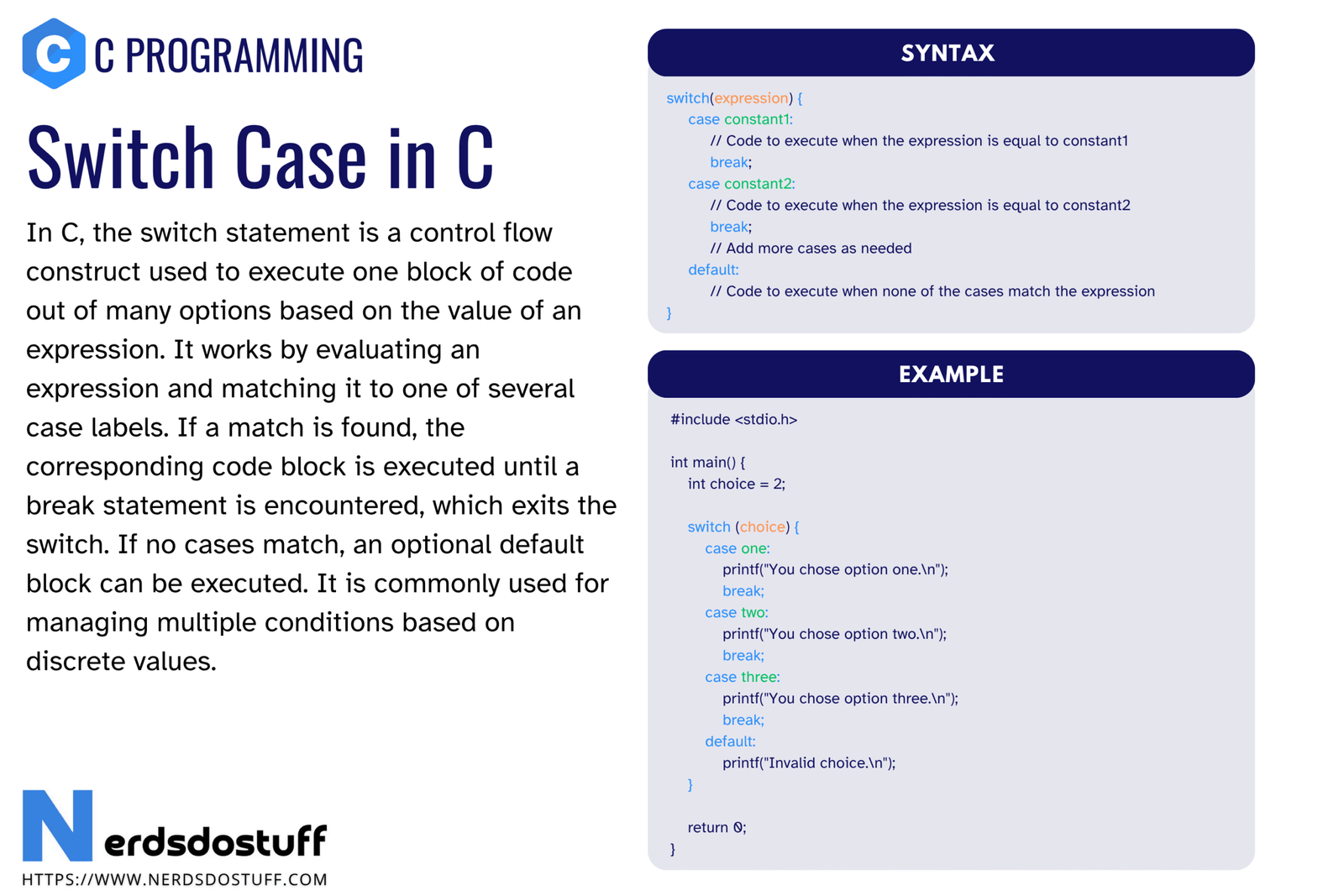
The switch case in C is a multi-way decision-making statement used when a program needs to choose one block of code from several possible options. Instead of writing a long chain of if else conditions for fixed values, a switch statement compares one expression against different case labels and jumps to the matching block.
This makes many programs easier to read, especially when the choice depends on menu options, character commands, status codes, or small integer values. But switch case is not a magical replacement for every condition. It has specific rules, supports only certain data types, and can create bugs if break is forgotten. In this article, we will understand switch case in C, its syntax, working, rules, examples, fall-through behavior, common mistakes, and best practices.
What is Switch Case in C?
The switch case in C is a conditional control statement that checks the value of one expression and matches it against multiple constant case labels. If a matching case is found, the statements inside that case execute. If no case matches, the default block runs if it exists.
The switch statement is especially useful when the program must choose among many fixed alternatives instead of testing a wide variety of unrelated logical conditions.
Use switch case in C when one expression must be compared against several constant values in a clear and structured way.
Syntax of Switch Case in C
The basic syntax is:
switch (expression)
{
    case constant1:
        /* statements */
        break;
    case constant2:
        /* statements */
        break;
    default:
        /* statements */
}| Part | Meaning |
|---|---|
switch | Evaluates one expression |
case | Defines a constant value to match |
break | Stops execution from falling into the next case |
default | Runs when no case matches |
Each case label must be a constant integral expression. Variables cannot be used directly as case labels.
How Switch Case Works in C
- The expression inside
switchis evaluated once. - The result is compared with each
caselabel. - If a match is found, execution starts from that case.
- If a
breakstatement appears, the switch block ends. - If no
breakappears, execution continues into the next case. This is called fall-through. - If no case matches, the
defaultblock runs if it exists.
This means switch case checks the expression once, then selects the correct branch. That is different from an if else if ladder, which may evaluate separate conditions one by one.
Simple Example of Switch Case in C
The following program prints the name of a weekday based on a number:
#include <stdio.h>
int main(void)
{
    int day = 3;
    switch (day)
    {
        case 1:
            printf("Monday\n");
            break;
        case 2:
            printf("Tuesday\n");
            break;
        case 3:
            printf("Wednesday\n");
            break;
        case 4:
            printf("Thursday\n");
            break;
        default:
            printf("Invalid day\n");
    }
    return 0;
}
Since the value of day is 3, the program enters case 3 and prints Wednesday.
Flow of Switch Case in C
The control flow of a switch case is easy to understand if you separate matching from execution.
- First, C evaluates the switch expression.
- Then it looks for a matching case label.
- If a match exists, execution starts there.
- Execution continues until a
breakor the end of the switch block. - If no match exists,
defaultruns if present.
Because execution can continue into later cases, switch case is not just a match-and-stop structure. The presence or absence of break changes behavior significantly.
Role of break in Switch Case
The break statement ends the current switch block immediately. Without it, execution falls into the next case even if that next case does not match the expression.
#include <stdio.h>
int main(void)
{
    int value = 1;
    switch (value)
    {
        case 1:
            printf("Case 1\n");
        case 2:
            printf("Case 2\n");
        default:
            printf("Default\n");
    }
    return 0;
}
This program prints all three lines because there is no break after case 1. That behavior is called fall-through.
In most beginner programs, break should be used after each case unless fall-through is intentionally required.
What is default in Switch Case?
The default label defines the block that runs when none of the case labels match the switch expression. It acts like the final fallback path.
The default case is not mandatory, but it is strongly recommended in most real programs. It helps catch unexpected input or values outside the intended range.
| Situation | What Happens |
|---|---|
| A case matches | Execution starts from that case |
No case matches but default exists | default block runs |
No case matches and no default | Switch block ends without running any case body |
Multiple Cases with Same Block in C
Switch case in C allows multiple case labels to share one block of statements. This is useful when several values should produce the same result.
#include <stdio.h>
int main(void)
{
    char ch = 'a';
    switch (ch)
    {
        case 'a':
        case 'e':
        case 'i':
        case 'o':
        case 'u':
            printf("Vowel\n");
            break;
        default:
            printf("Not a vowel\n");
    }
    return 0;
}
All vowel cases share the same output block. This is cleaner than repeating the same printf() statement in every case.
Fall-Through Behavior in Switch Case
Fall-through happens when one case matches and there is no break, so execution continues into the next case block. This is not always a bug. Sometimes it is intentional, but it must be used carefully.
- Unintentional fall-through usually causes wrong output.
- Intentional fall-through can help group behavior across related cases.
- If you use it intentionally, make the code obvious and easy to read.
Many beginners think switch case automatically stops after the matching case. That is only true when break or another control transfer statement such as return is used.
Data Types Allowed in Switch Case
Switch case in standard C works with integral expressions. This includes integer types, character types, and enumeration values.
| Allowed | Not Allowed Directly |
|---|---|
int | float |
char | double |
enum | strings |
| other integral integer types | most non-integral expressions |
Case labels must also be constant integral expressions. That means values such as 1, 'A', or enum constants are valid, but ordinary runtime variables are not.
Switch Case vs If Else in C
Both switch case and if else are decision-making structures, but they solve slightly different problems.
| Point | Switch Case | If Else |
|---|---|---|
| Main use | One expression compared against fixed constant values | General-purpose conditions and logical comparisons |
| Readability | Usually cleaner for menus and fixed options | Better for ranges and complex logic |
| Data support | Integral expressions only | Any valid conditional expression |
| Fall-through issue | Possible if break is omitted | Not applicable in the same way |
If the decision depends on ranges like marks >= 90 or multiple logical tests, if else is usually better. If the decision depends on exact fixed values, switch case is often cleaner.
Nested Switch Case in C
A switch statement can be written inside another switch statement. This is called nested switch case. It is valid, but it should be used only when it makes the logic clearer.
#include <stdio.h>
int main(void)
{
    int group = 1;
    int option = 2;
    switch (group)
    {
        case 1:
            switch (option)
            {
                case 1:
                    printf("Group 1, Option 1\n");
                    break;
                case 2:
                    printf("Group 1, Option 2\n");
                    break;
                default:
                    printf("Invalid option\n");
            }
            break;
        default:
            printf("Invalid group\n");
    }
    return 0;
}
Nested switch blocks are useful in some menu systems, but too much nesting can reduce readability quickly.
Common Mistakes in Switch Case in C
- forgetting
breakand causing accidental fall-through - trying to use non-constant values in case labels
- using floating-point or string expressions directly in
switch - forgetting
defaultwhen invalid input should be handled - writing switch where
if elseis more suitable for ranges or complex logic
| Mistake | Problem | Better Practice |
|---|---|---|
Missing break | Runs into later cases unexpectedly | Add break unless fall-through is intentional |
| Case label uses variable | Compilation error | Use constants or enum values |
| Using switch for range checks | Logic becomes awkward or impossible | Use if else for ranges |
| No default handling | Unexpected values may be ignored | Add default in most practical cases |
Best Practices for Switch Case in C
- Use switch case when one expression is compared against fixed constant values.
- Add
breakafter each case unless fall-through is deliberate. - Include a
defaultblock for unexpected values. - Keep grouped cases readable when several labels share one block.
- Prefer
if elsewhen the logic depends on ranges, inequalities, or complex boolean expressions. - Use enum constants when they make case labels clearer.
FAQs
What is switch case in C?
Switch case in C is a multi-way decision statement that compares one expression with several constant case labels and executes the matching block.
Why is break used in switch case in C?
break is used to stop execution after a case block. Without it, execution falls into the next case.
Is default mandatory in switch case?
No, default is not mandatory, but it is strongly recommended in most practical programs.
Can we use float in switch case in C?
No. Standard C switch statements do not support floating-point expressions directly.
Can we use strings in switch case in C?
No. Standard C does not allow strings directly in switch case. Use if else with string comparison functions instead.
When should I use switch case instead of if else?
Use switch case when one expression must be matched against a set of fixed constant values. Use if else for ranges or more complex conditions.
Continue learning C in order
Follow the topic sequence with the previous and next lesson.