
Static in C is one of those topics that looks simple at first because it is only a single keyword, but its effect is very important. The static keyword changes how long data stays in memory and, in some cases, who can access it. Because of that, static is used in counters, state tracking, helper functions, internal file-level data, and many other practical C programs.
Many beginners memorize that static variables keep their values, but that is only one part of the story. The real understanding comes from knowing where static is used and what it changes in that context. In this article, we will understand what static in C means, where it can be used, how it affects storage duration and linkage, how static local variables differ from ordinary local variables, how static global variables and static functions behave, and the mistakes beginners should avoid.
What is Static in C?
Static in C is a keyword used to modify the behavior of variables and functions. Its meaning depends on where it is used.
- When used with a local variable inside a function,
staticmakes that variable keep its value between function calls. - When used with a global variable at file scope,
staticlimits its visibility to the same source file. - When used with a function at file scope,
staticmakes that function accessible only inside that source file.
So the keyword does not do only one thing. It mainly affects storage duration and linkage, depending on the declaration.
In C,
staticusually means one of two things: keep the storage for the whole program, or restrict visibility to the current source file.
Why Static is Important in C
- It allows a function to remember values between calls.
- It helps hide file-level data from other source files.
- It reduces accidental external access to helper functions.
- It is useful in embedded systems and state-based programming.
- It helps control program structure more carefully in multi-file projects.
If you understand static well, you understand an important part of how C manages memory and program organization.
How Static Changes Behavior in C
Where static is used | Main effect | Typical purpose |
|---|---|---|
| Inside a function with a local variable | Value is preserved between calls | Counter, state retention, one-time setup logic |
| With a global variable at file scope | Visible only inside the same source file | Private shared data for that file |
| With a function at file scope | Callable only inside the same source file | Private helper function |
This table is the quickest way to avoid confusion. Always ask: where is static being used? The answer determines what it does.
Static Local Variable in C
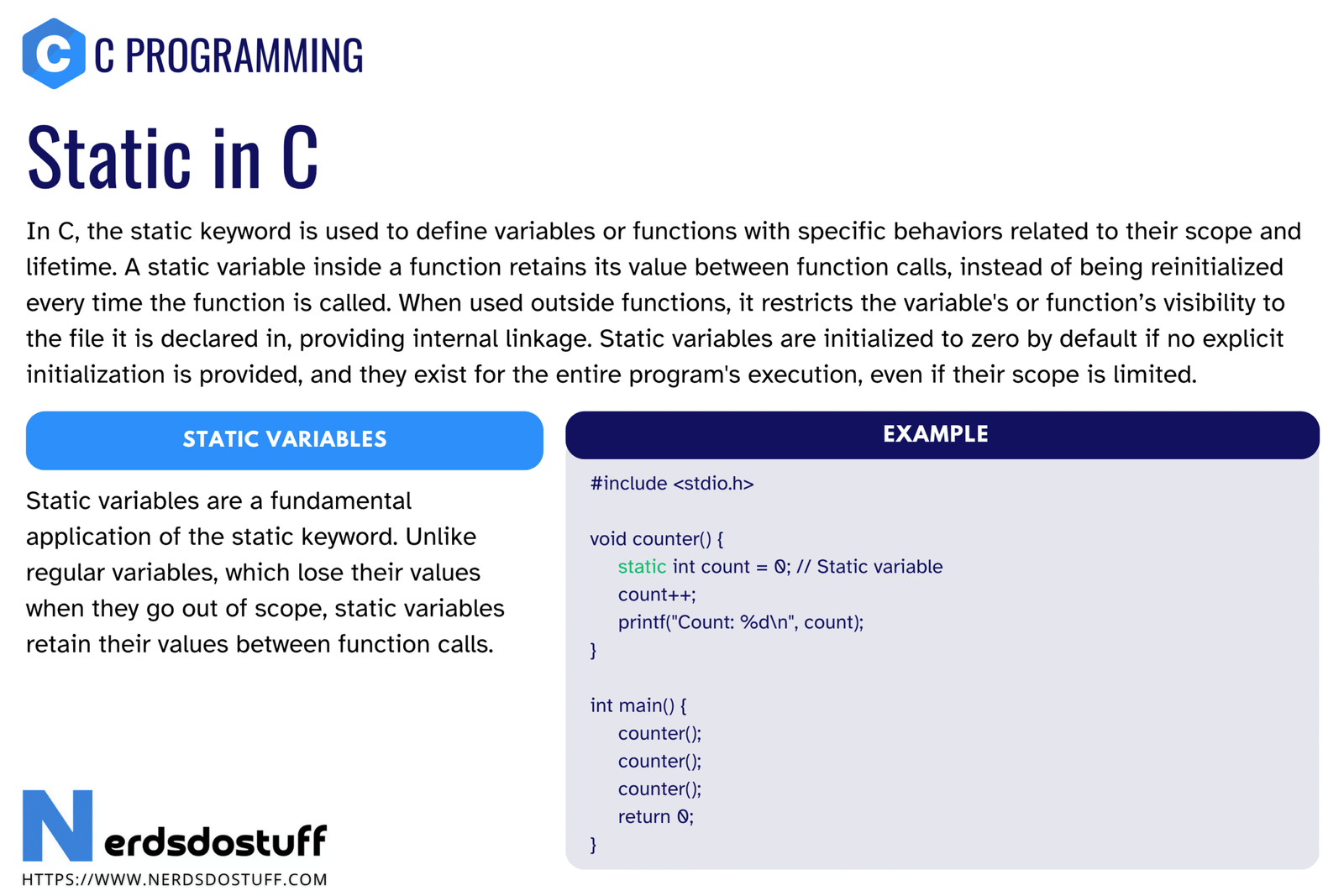
A static local variable is declared inside a function using the static keyword. Its scope remains local to that function, but its lifetime becomes the entire program. That means it is created only once and it keeps its value between calls.
This is the most common use of static taught to beginners. It is useful when a function must remember some previous state without using a global variable.
#include <stdio.h>
void counter(void)
{
    static int count = 0;
    count++;
    printf("Count = %d
", count);
}
int main(void)
{
    counter();
    counter();
    counter();
    return 0;
}
Output:
Count = 1
Count = 2
Count = 3
The variable count is local to counter(), so no other function can access it directly. But because it is static, it is not recreated every time the function runs.
Ordinary Local Variable vs Static Local Variable
| Feature | Ordinary local variable | Static local variable |
|---|---|---|
| Scope | Inside the function only | Inside the function only |
| Lifetime | Only during the function call | Entire program execution |
| Value after function ends | Lost | Retained |
| Initialization | Usually each call if assigned | Done only once |
This difference is why static local variables are excellent for counters, call tracking, and simple internal state machines.
Static Global Variable in C
When a variable is declared at file scope, outside all functions, it is often called a global variable. If such a variable is declared with static, it still has program lifetime, but now its visibility is restricted to the same source file.
This is important in multi-file programs. A normal global variable can be accessed from other files using extern. A static global variable cannot. That makes it private to the current file.
static int total_requests = 0;
void log_request(void)
{
    total_requests++;
}
Here, total_requests can be used by functions inside the same file, but another source file cannot access it directly. This improves encapsulation and reduces accidental misuse.
Static Function in C
A function declared with static at file scope can only be called within the same source file. This is useful when a function is only a private helper and should not become part of the external interface of that file.
static int square(int x)
{
    return x * x;
}
int area_of_square(int side)
{
    return square(side);
}
In this example, square() is a private helper function. Other source files can call area_of_square() if it is declared externally, but they cannot call square() directly.
Does Static Affect Initialization?
Yes. Static variables are initialized only once, not every time execution reaches the declaration. If a static variable is not explicitly initialized, it is automatically initialized to zero.
static int x;becomes0static float y;becomes0.0static char ch;becomes'\0'
This is different from ordinary automatic local variables, which are not automatically zeroed and may contain garbage values if not initialized.
Scope, Lifetime, and Linkage in Static Declarations
To understand static deeply, you should separate three ideas:
- Scope: where the name can be used in the code
- Lifetime: how long the object exists in memory
- Linkage: whether the name can be referred to from another source file
| Declaration | Scope | Lifetime | Linkage |
|---|---|---|---|
int x; inside a function | Local | During the call | None |
static int x; inside a function | Local | Entire program | None |
int x; at file scope | File scope | Entire program | External by default |
static int x; at file scope | File scope | Entire program | Internal |
static void func(void) | File scope | Entire program | Internal |
This table captures the real technical meaning of static better than memorizing only one sentence.
Common Uses of Static in C
- Counting how many times a function has been called
- Retaining simple state between function calls
- Keeping file-private helper data
- Hiding internal helper functions in multi-file projects
- Tracking initialization status in embedded systems
- Preserving internal configuration without exposing it globally
In embedded and systems programming, static is especially useful because it gives predictable storage duration without requiring dynamic memory allocation.
Common Mistakes with Static in C
- Thinking static always means global
- Forgetting that a static local variable keeps its old value
- Using static data where a function parameter would make code clearer
- Assuming static variables are recreated every function call
- Not understanding that static at file scope changes linkage
- Overusing static and making code harder to test or reuse
| Mistake | Problem | Better understanding |
|---|---|---|
| “static means variable cannot change” | Wrong meaning in C | Static affects lifetime or linkage, not mutability |
| “static local variable is global” | Scope becomes misunderstood | It is still local in scope, but its lifetime is extended |
| “static global variable is available everywhere” | Wrong linkage assumption | Static global variables stay inside the same file |
The best way to master static is to test each case separately and observe what changes: scope, lifetime, or visibility across files.
Best Practices for Using Static in C
- Use static local variables only when a function really needs memory between calls.
- Use static global variables to keep internal file-level data private.
- Mark helper functions as static when they are not part of the file’s external interface.
- Document the reason when static state affects program behavior.
- Do not use static just to avoid proper function design.
Good use of static improves clarity. Bad use of static hides program state in ways that confuse debugging. The keyword is useful, but it should be used with intention.
FAQs
What is static in C?
Static in C is a keyword that changes the storage duration or linkage of variables and functions, depending on where it is used.
What happens when a local variable is declared static in C?
A static local variable keeps its value between function calls while remaining accessible only inside that function.
What is the difference between static local and static global variable in C?
A static local variable has local scope but program lifetime. A static global variable has file scope, program lifetime, and internal linkage limited to that file.
Can a static variable in C be changed?
Yes. Static does not mean read-only. It only affects lifetime or linkage. A static variable can still be modified unless it is also declared const.
Why are static functions used in C?
Static functions are used to keep helper functions private to the current source file and prevent unnecessary external visibility.
Continue learning C in order
Follow the topic sequence with the previous and next lesson.