
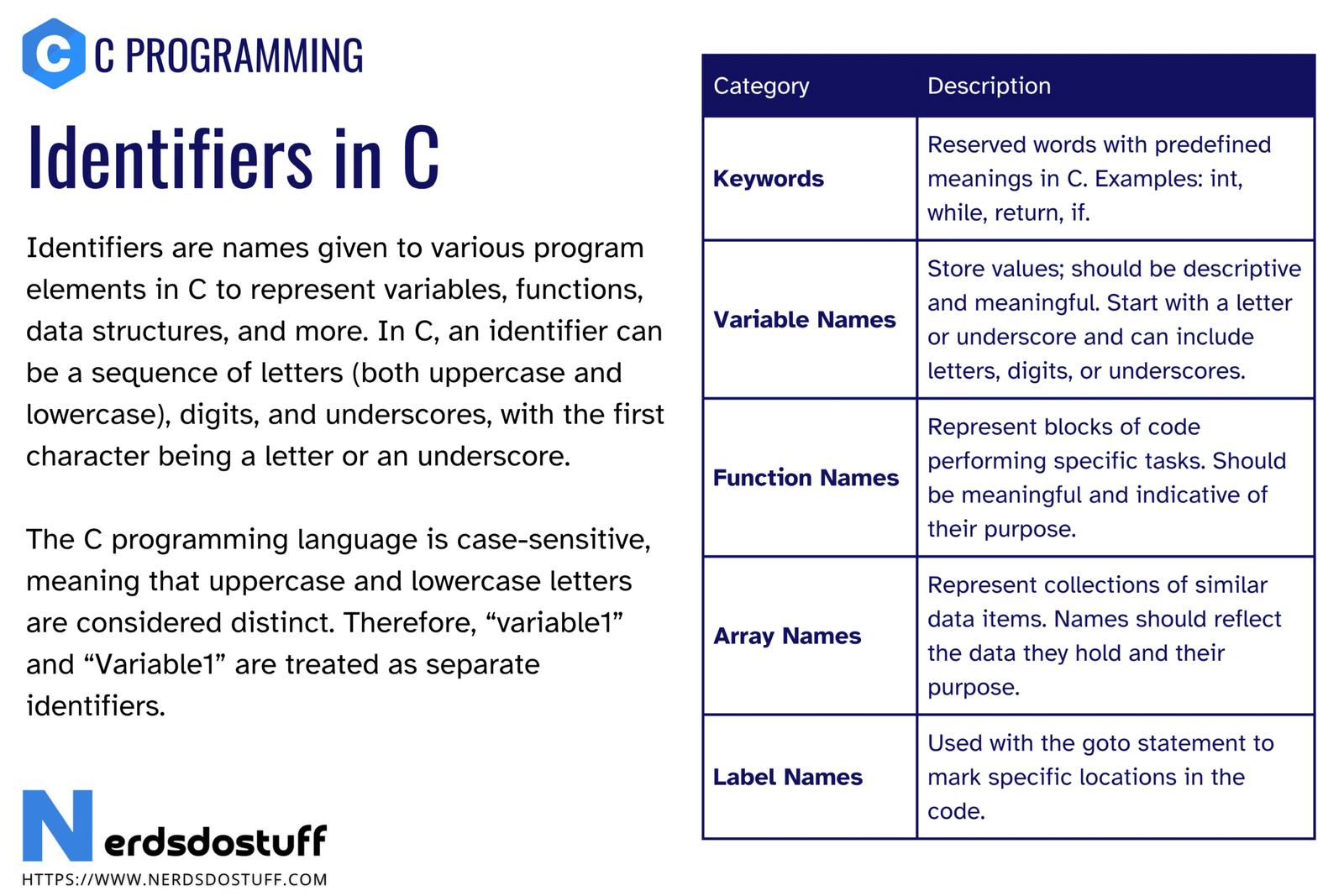
Identifiers in C are the names used by the programmer to identify different elements of a program. They are used for variables, functions, arrays, structures, labels, and many other user-defined parts of the code. In simple words, identifiers are the names you create so that the compiler and the reader can understand what each program element represents.
This topic is more important than many beginners realize. Good identifiers improve readability, reduce confusion, and make programs easier to maintain. Poor identifiers make even small programs harder to understand. In this article, we will learn what identifiers in C are, the rules for naming them, the difference between identifiers and keywords, valid and invalid examples, best practices, and common mistakes beginners make.
What are Identifiers in C?
An identifier in C is a name given to a user-defined element in a program. When you create a variable such as marks, a function such as addNumbers, or an array such as scores, those names are identifiers.
The compiler uses identifiers to distinguish one program element from another. Without identifiers, writing meaningful code would be nearly impossible because there would be no clear names for stored values, functions, or data structures.
Where Identifiers are Used in C
- Variable names
- Function names
- Array names
- Structure and union names
- Enumeration names and enumerators
- Typedef names
- Labels used with
goto
This means identifiers appear almost everywhere in C programming. Once you start writing actual programs, you are constantly creating and using them.
Rules for Identifiers in C
C follows specific rules for valid identifiers. These rules are strict because the compiler needs a predictable naming system.
- An identifier can contain letters, digits, and underscores.
- The first character must be a letter or an underscore.
- It cannot start with a digit.
- Spaces are not allowed.
- Special characters such as
@,#,$, and%are not allowed in normal identifiers. - Keywords cannot be used as identifiers.
- C is case-sensitive, so names with different letter cases are considered different identifiers.
These are the basic rules every beginner should remember. If a name breaks any of them, the compiler will reject it.
| Identifier | Valid or Invalid | Reason |
|---|---|---|
total | Valid | Contains only letters |
student_age | Valid | Uses letters and underscore |
marks2 | Valid | Digit is allowed after the first character |
2marks | Invalid | Starts with a digit |
total marks | Invalid | Contains a space |
float | Invalid | It is a keyword |
price$ | Invalid | Contains a special character |
Identifiers vs Keywords in C
Beginners often confuse identifiers and keywords, but they are not the same thing.
| Term | Meaning | Examples |
|---|---|---|
| Identifier | User-defined name created by the programmer | sum, temperature, main |
| Keyword | Reserved word with a fixed meaning in the language | int, return, while |
For example, in int total;, the word int is a keyword, while total is an identifier. This distinction matters because a keyword cannot be reused as a custom name.
Case Sensitivity of Identifiers in C
C is case-sensitive. That means uppercase and lowercase letters are treated as different characters. Because of that, identifiers such as value, Value, and VALUE are all different names.
This is useful, but it can also cause mistakes if you are not careful. A beginner may declare totalMarks and later accidentally write totalmarks, which the compiler will treat as a different identifier.
Examples of Identifiers in C
The following example shows different identifiers used in one simple program.
#include <stdio.h>

int addNumbers(int firstValue, int secondValue)
{
    int result = firstValue + secondValue;
    return result;
}

int main(void)
{
    int total = addNumbers(10, 20);
    printf("%d\n", total);
    return 0;
}
In this example, addNumbers, firstValue, secondValue, result, and total are identifiers. The words int and return are not identifiers because they are keywords.
Meaningful Names and Readability
Technically valid identifiers are not always good identifiers. A name such as x may be valid, but in many cases it does not explain the role of the variable. A name such as studentCount or averageMarks gives much more information to the reader.
Readable code depends heavily on naming quality. If identifiers are meaningful, the structure of the program becomes easier to understand even before reading every line closely.
| Poor Identifier | Better Identifier | Why It Is Better |
|---|---|---|
x | studentCount | Explains what the value represents |
a1 | totalMarks | Improves readability |
t | temperature | Removes ambiguity |
Naming Conventions for Identifiers in C
The C language itself does not force one naming style, but programmers usually follow conventions for clarity and consistency.
- Use descriptive names whenever practical.
- Keep the naming style consistent across the program.
- Use lowercase or lowercase with underscores for variables in many C codebases.
- Use function names that describe the action they perform.
- Avoid names that are too short unless the meaning is obvious, such as loop counters.
For example, names such as calculateAverage, fileCount, and isValid are much easier to understand than vague names such as a, b, or temp1.
Can Identifiers Start with an Underscore?
Yes, the language rules allow an identifier to start with an underscore. However, this is an area where beginners should be careful. In real-world C programming, many names beginning with underscores are reserved for the implementation, standard library, compiler internals, or system headers.
So while a name such as _count may be accepted by the compiler, it is usually better for beginners to avoid leading underscores in normal application code unless they understand the surrounding rules and coding standards.
Scope and Identifiers in C
An identifier does not exist everywhere in the program automatically. Its visibility depends on scope. A variable declared inside a function is usually only visible inside that function. A global identifier declared outside all functions has wider visibility.
This means the same identifier rules apply everywhere, but scope determines where that identifier can actually be used. Good naming and good scope control work together to make C programs easier to manage.
Common Mistakes with Identifiers in C
- Using a keyword as an identifier
- Starting an identifier with a digit
- Using spaces or special characters in the name
- Mixing letter case carelessly
- Choosing names that are too vague to understand
- Using different naming styles without consistency
Many beginner errors are simple syntax issues, but vague naming is also a real problem because code quality is not only about compiling successfully. It is also about being readable later.
Best Practices for Identifiers in C
- Choose names that reflect the actual purpose of the element.
- Keep names simple and readable.
- Do not use keywords as identifiers.
- Avoid misleading short names unless they are standard loop variables.
- Use one naming style consistently in the project.
- Avoid leading underscores unless the coding context clearly allows them.
These habits improve code quality and make your programs easier to debug, extend, and share with others.
FAQs
What are identifiers in C?
Identifiers in C are user-defined names used for variables, functions, arrays, structures, labels, and other program elements.
Can an identifier start with a number in C?
No. An identifier cannot start with a digit. The first character must be a letter or an underscore.
Can keywords be used as identifiers in C?
No. Keywords are reserved words in the language, so they cannot be used as identifiers.
Are identifiers case-sensitive in C?
Yes. C is case-sensitive, so value, Value, and VALUE are treated as different identifiers.
What characters are allowed in identifiers in C?
Identifiers in C can contain letters, digits, and underscores. They cannot contain spaces or most special characters.
Continue learning C in order
Follow the topic sequence with the previous and next lesson.