
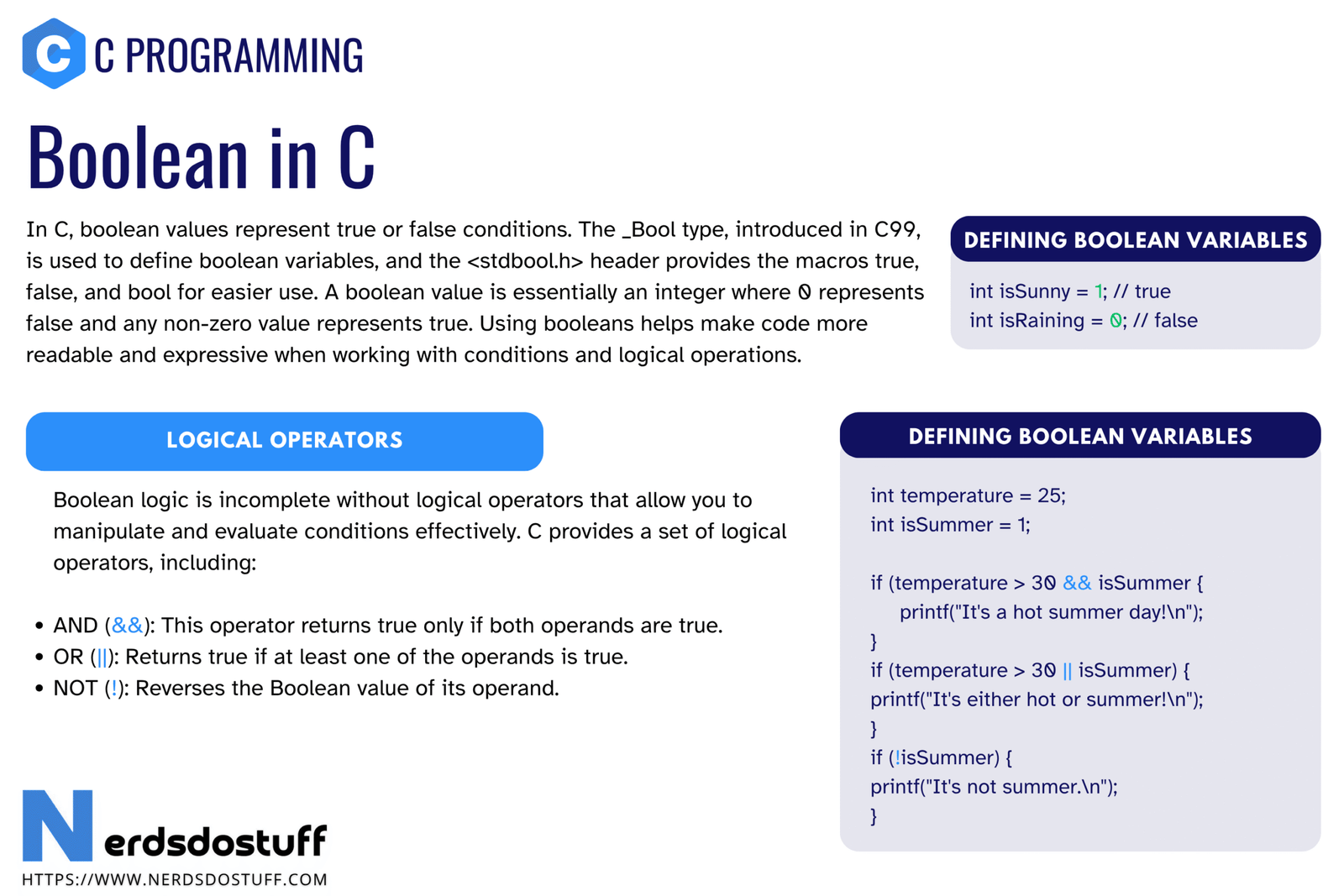
Boolean in C is the idea of representing truth values such as true and false inside a program. This topic is important because conditions, decisions, loops, comparisons, and logical expressions all depend on boolean behavior. Even though C was originally designed before the modern bool style became common, it still supports boolean logic very effectively.
Many beginners think boolean in C is confusing because they see both integer-style truth values and the newer bool type from stdbool.h. The confusion disappears once you understand the rule clearly: in C, 0 is false and any non-zero value is true in a condition. On top of that, modern C also provides a proper boolean type through _Bool and the bool macro. In this article, we will understand what boolean in C means, how true and false work, how _Bool and stdbool.h are used, and the mistakes beginners should avoid.
What is Boolean in C?
Boolean in C refers to values that represent logical truth, usually true or false. These values are used in conditions such as if, while, and for, and they appear in the results of comparison and logical expressions.
Historically, C did not start with a dedicated bool keyword the way some newer languages do. Instead, it used integers for logical behavior.
0means false- Any non-zero value means true
Later, C introduced the built-in type _Bool, and the header file stdbool.h provided the more readable forms bool, true, and false.
Why Boolean is Important in C
- It controls decision-making in programs.
- It is used in
if,else, loops, and logical expressions. - It helps represent yes/no, on/off, pass/fail, and true/false states.
- It makes conditions easier to read when used properly.
- It is essential for writing correct program logic.
Without boolean logic, a program would not be able to choose between two paths or check whether a condition is satisfied.
How True and False Work in C
In a C condition, the language checks whether an expression evaluates to zero or non-zero.
| Value | Boolean meaning in a condition |
|---|---|
0 | False |
1 | True |
-1 | True |
25 | True |
This means C does not require the value to be exactly 1 in a condition. Any non-zero value counts as true.
#include <stdio.h>
int main(void)
{
    if (5)
    {
        printf("This block runs because 5 is true in C.
");
    }
    if (0)
    {
        printf("This block will not run.
");
    }
    return 0;
}
This behavior explains why boolean logic in C is often described through integers.
The _Bool Type in C
Modern C provides a built-in boolean type named _Bool. A variable of type _Bool stores logical values. When a value is assigned to it, C converts the value to either 0 or 1.
#include <stdio.h>
int main(void)
{
    _Bool a = 0;
    _Bool b = 7;
    printf("a = %d
", a);
    printf("b = %d
", b);
    return 0;
}
Here, a becomes 0 and b becomes 1. That is because any non-zero value assigned to _Bool is converted to true.
Using stdbool.h in C
To make boolean code more readable, C provides the header file stdbool.h. This header lets you use:
boolinstead of_Booltrueinstead of1falseinstead of0
#include <stdio.h>
#include <stdbool.h>
int main(void)
{
    bool is_ready = true;
    bool has_error = false;
    printf("is_ready = %d
", is_ready);
    printf("has_error = %d
", has_error);
    return 0;
}
This style is usually better for readability because the program expresses intent more clearly.
Boolean Expressions in C
Boolean results commonly come from comparison operators and logical operators.
| Expression | Meaning | Typical result |
|---|---|---|
a == b | Equal to | 1 if true, otherwise 0 |
a != b | Not equal to | 1 if true, otherwise 0 |
a > b | Greater than | 1 if true, otherwise 0 |
a < b | Less than | 1 if true, otherwise 0 |
a && b | Logical AND | True if both are true |
a || b | Logical OR | True if at least one is true |
!a | Logical NOT | Reverses true/false |
These expressions are the practical source of most boolean values in C.
#include <stdio.h>
int main(void)
{
    int a = 10;
    int b = 20;
    printf("a < b = %d
", a < b);
    printf("a == b = %d
", a == b);
    printf("!(a < b) = %d
", !(a < b));
    return 0;
}
Boolean in if Statements and Loops
Boolean values are especially visible in conditions.
#include <stdio.h>
#include <stdbool.h>
int main(void)
{
    bool login_success = true;
    if (login_success)
    {
        printf("Access granted.
");
    }
    else
    {
        printf("Access denied.
");
    }
    return 0;
}
You can also write conditions with integer values, but using bool often makes intent clearer in beginner code and larger programs.
Difference Between Integer Truth Values and bool in C
| Feature | Integer-style boolean use | bool from stdbool.h |
|---|---|---|
| Representation in conditions | 0 = false, non-zero = true | Still follows the same rule internally |
| Readability | Can be less clear | More readable |
| Type style | Often plain int | Uses boolean intent directly |
| Beginner friendliness | Can feel indirect | Easier to understand |
Both approaches are valid in C, but bool is often a cleaner choice when the variable is meant to represent only true or false.
Common Uses of Boolean in C
- Checking whether a condition is true or false
- Representing flags such as
is_ready,is_valid, orhas_error - Loop control
- Decision-making in menus and login checks
- State tracking in embedded and control programs
In embedded systems, boolean values are frequently used to track states such as button pressed, sensor active, motor enabled, or communication complete.
Common Mistakes with Boolean in C
- Thinking only
1is true in every condition - Forgetting that any non-zero value counts as true
- Using
=instead of==in a condition - Not including
stdbool.hwhen usingbool,true, andfalse - Assuming C behaves exactly like languages with a built-in strict boolean keyword
| Mistake | Why it is wrong | Correct idea |
|---|---|---|
if (2 == true) | true is represented as 1, but conditions check zero vs non-zero | Use if (2) or compare with the value you really mean |
if (a = b) | This assigns instead of compares | Use if (a == b) for comparison |
Using bool without the header | The identifiers may not be defined | Include <stdbool.h> |
One of the most important habits in C is reading conditions carefully. Small mistakes in boolean logic can completely change program behavior.
Best Practices for Boolean in C
- Use
boolwhen a variable truly represents a yes/no state. - Use clear names such as
is_valid,has_data, orerror_found. - Write readable conditions instead of overly clever expressions.
- Remember that comparisons and logical operators return integer-style boolean results in C.
- Treat compiler warnings seriously, especially for assignment inside conditions.
Readable boolean logic makes programs easier to debug, test, and maintain.
FAQs
What is boolean in C?
Boolean in C refers to logical truth values used in conditions, where 0 means false and non-zero means true. Modern C also provides _Bool and bool through stdbool.h.
Does C have a bool data type?
Yes. C has the built-in type _Bool, and stdbool.h provides the more readable alias bool.
What is the value of true and false in C?
In conditions, 0 means false and any non-zero value means true. When using bool or _Bool, values are normalized to 0 or 1.
Why do we use stdbool.h in C?
We use stdbool.h to write more readable boolean code with bool, true, and false.
Is 1 the only true value in C?
No. In a condition, any non-zero value is treated as true. However, a _Bool or bool variable stores the normalized result as 0 or 1.
Continue learning C in order
Follow the topic sequence with the previous and next lesson.