
C programming is one of the most important starting points for understanding how software actually works. It is not just another language used to build applications. C teaches how data is stored, how memory is accessed, how source code becomes machine instructions, and how programs interact with hardware and the operating system. That is why C remains one of the most respected languages in computer science, embedded systems, and systems programming.
Many modern languages hide low-level details to make development faster and easier. C takes the opposite path. It gives the programmer more direct control over data, execution, and memory. That control is exactly what makes C both powerful and educational. In this article, we will understand what C programming is, why it still matters, where it is used, what its core features are, and which concepts you will learn as you move deeper into the language.
What is C Programming?
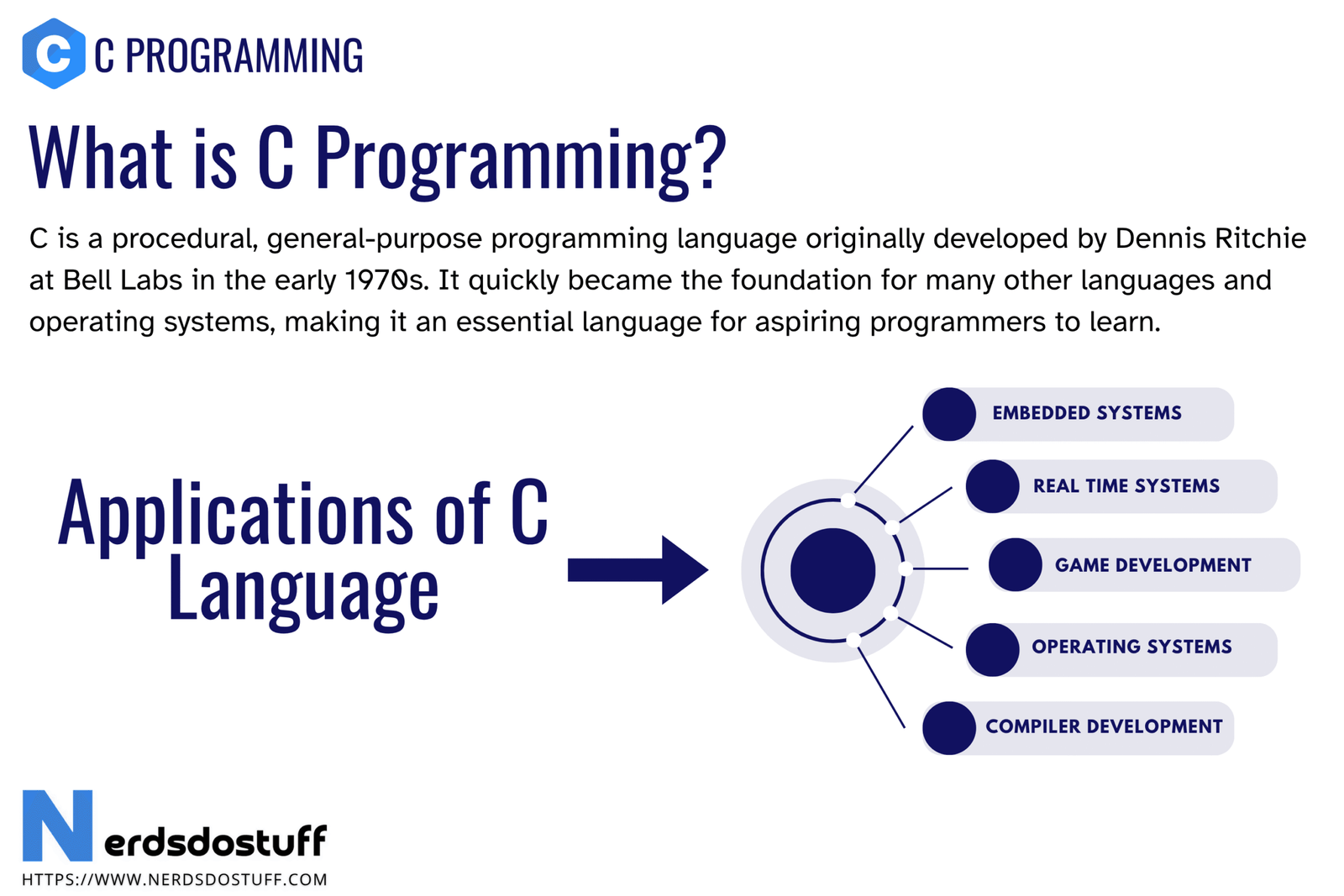
C programming means writing software using the C language, a compiled and procedural programming language developed by Dennis Ritchie at Bell Labs in the early 1970s. C became widely known because it played a central role in the development of Unix and because it offered an excellent balance between low-level control and high-level structured programming.
C is often described as a middle-level language. This does not mean it is average or limited. It means C can work close to hardware like a low-level language while still giving the programmer structured features such as functions, loops, and conditionals. Because of this, C is used in areas where efficiency, control, and predictability matter.
Why C Programming is Still Important
Some beginners think C is only a historical language and that modern programming should start elsewhere. That view misses the main strength of C. C teaches core programming ideas without hiding the machine too much. When you write C, you must think about variable types, memory layout, function calls, addresses, compilation, and program flow. This builds strong technical understanding instead of just surface-level syntax familiarity.
- C builds a strong foundation in programming fundamentals.
- C is still widely used in embedded systems and firmware.
- C is highly relevant for operating systems, compilers, and system utilities.
- C helps programmers understand memory and pointers clearly.
- C makes it easier to learn other languages such as C++, Java, Rust, and even Python at a deeper level.
Where C Programming is Used
C programming is not limited to classroom exercises. It is used in many real engineering domains because of its speed, efficiency, and direct hardware access.
| Area | Why C is used there | Examples |
|---|---|---|
| Operating systems | Direct control over memory and hardware resources | Unix and major parts of Linux ecosystems |
| Embedded systems | Low runtime overhead and precise hardware control | Microcontrollers, sensors, control units |
| Compilers and interpreters | Efficient execution and close-to-machine behavior | Language runtimes and toolchains |
| Device drivers | Interaction with peripherals and kernel interfaces | Display, storage, and communication drivers |
| Networking software | Fast packet handling and efficient system calls | Servers, protocol stacks, utilities |
| Native libraries | Reusable high-performance code | Math, compression, graphics libraries |
Main Features of C Programming
- Compiled language: C source code is translated into machine code before execution, which usually gives good performance.
- Procedural programming: Programs are organized around functions and step-by-step logic.
- Direct memory access: Pointers allow programs to work directly with memory addresses.
- Portability: C programs can often be adapted across systems with limited changes.
- Rich operators: C offers arithmetic, relational, logical, assignment, and bitwise operators.
- Small core language: The language itself is compact, which helps in learning the essentials clearly.
- Library support: Standard libraries make input, output, string handling, math, and file operations practical.
Basic Structure of a C Program
A C program usually has a simple and well-defined structure. Even a very small program teaches several important ideas.
- Preprocessor directives such as
#include - Global declarations if required
- The
main()function - Statements inside the function body
- A return value from
main()
#include <stdio.h>
int main(void)
{
    printf("Hello, World!\n");
    return 0;
}
This small program already shows the role of the standard library, the main function, a function call, and a return value. That is why Hello World in C is an important early topic, not just a formality.
How C Code Becomes an Executable Program
One of the biggest strengths of learning C is that it makes the build process visible. A C program does not simply run after being written. It passes through multiple stages.
- Preprocessing: Handles directives like
#includeand#define. - Compilation: Translates source code into lower-level code.
- Assembly: Converts assembly output into object code.
- Linking: Combines object files and libraries into the final executable file.
This is why topics such as Compilation in C, Header Files in C, and Preprocessor in C matter so much. They are not side details. They are part of how a C program actually comes to life.
Core Concepts You Learn Through C Programming
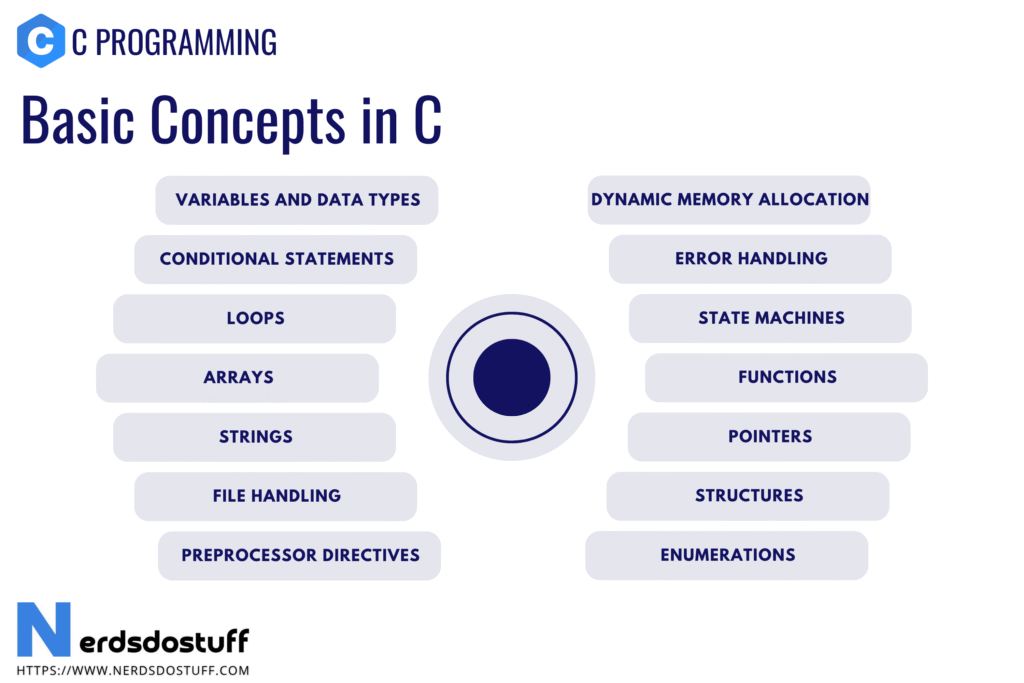
Variables and Data Types
In C, every variable has a type. The type determines the kind of value stored, how much memory is reserved, and how the compiler interprets the data. This is where topics such as Variables in C and Data Types in C become essential.
Operators and Expressions
C offers arithmetic, logical, relational, assignment, and bitwise operators. These operators are used to form expressions, perform calculations, compare values, and control decisions inside a program.
Conditional Statements and Loops
Statements such as if, else, and switch help a program make decisions. Loops such as for, while, and do while make repeated execution possible. These form the core of program flow control.
Functions
Functions break large programs into smaller reusable units. They improve readability, make debugging easier, and help build structured programs.
Arrays, Strings, and Pointers
Arrays store multiple values of the same type, strings are typically represented as character arrays, and pointers allow direct work with memory addresses. These concepts are where many beginners start to understand why C is considered powerful.
Structures, Unions, and Enums
C also supports user-defined ways to organize data. Structures group related values together, unions share memory between members, and enums provide readable names for integral constants.
Files and Memory Management
Real programs often need to read files, write files, and manage memory dynamically. C allows all of this, but it expects the programmer to handle it carefully.
Advantages of C Programming
- High performance: C programs are usually fast and efficient.
- Strong foundation language: It teaches how programs and memory actually behave.
- Excellent for embedded systems: C is widely used with microcontrollers and resource-constrained devices.
- Portable and widely supported: C compilers exist for many platforms and architectures.
- Fine-grained control: The programmer can work closely with hardware, memory, and low-level interfaces.
Limitations of C Programming
C is powerful, but that power comes with responsibility. The language does not protect the programmer from many common mistakes, so discipline matters.
- No built-in garbage collection
- No built-in string type like many high-level languages
- Memory misuse can cause crashes or undefined behavior
- Manual handling is often required for low-level tasks
- Larger projects need careful structure, naming, and testing
These limitations are not reasons to avoid C. They are reasons to use it seriously and learn it properly.
Who Should Learn C Programming?
C is especially valuable for students, electronics learners, embedded developers, systems programmers, and anyone who wants to understand what happens beneath high-level software. If your interests include microcontrollers, firmware, operating systems, compilers, or efficient native code, C is worth learning in depth.
What You Should Learn After This Topic
This article is the entry point to the C track. The best next topics are the basic building blocks that make the language practical.
- Hello World in C
- Compilation in C
- Variables in C
- Data Types in C
- Keywords in C
- Identifiers in C
- Operators in C
- Comments in C
- Format Specifiers in C
Once these are clear, the rest of the language becomes much easier to understand step by step.
FAQs
What is C programming in simple words?
C programming means writing software in the C language, which is a compiled language known for speed, efficiency, and close interaction with system resources.
Is C programming good for beginners?
Yes. C is good for beginners who want a strong technical foundation, especially if they want to understand memory, compilation, and low-level program behavior.
Why is C called a middle-level language?
C is called a middle-level language because it combines low-level capabilities such as direct memory access with high-level structured programming features such as functions and loops.
Where is C used today?
C is used in embedded systems, firmware, operating systems, device drivers, compilers, networking tools, and high-performance native libraries.
What should I learn first after C programming basics?
You should learn how a simple program is written and compiled, then move into variables, data types, operators, input and output, and control flow.
Continue learning C in order
Follow the topic sequence with the previous and next lesson.