
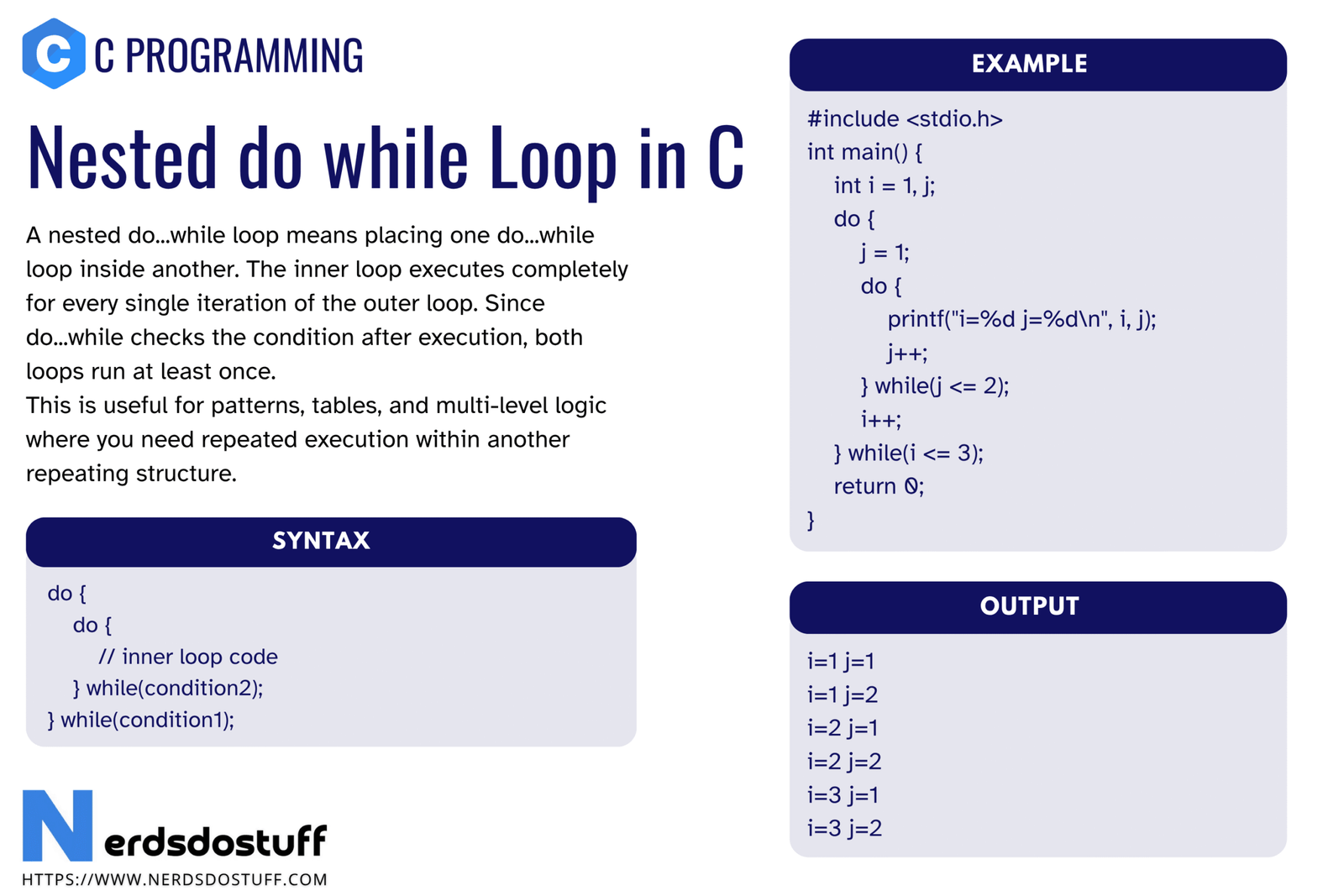
A nested do while loop in C means a do while loop written inside another do while loop. This structure is used when repetition happens inside repetition and both levels are designed to execute at least once before their conditions are checked. It is useful in grouped menu logic, repeated block processing, pattern-style output, and situations where both outer and inner actions must happen before the loop decides whether to continue.
Many learners already find one do while loop slightly unusual because the condition comes at the end. When one do while loop is placed inside another, the control flow can look confusing unless you trace it carefully. The good news is that the core idea is still simple: the outer body runs, the inner loop completes its cycle, then conditions are checked in their respective places. In this article, we will understand what a nested do while loop in C is, how it works, when it should be used, common mistakes, and best practices.
What is Nested do while Loop in C?
A nested do while loop in C is a looping structure in which one do while loop appears inside another do while loop. The outer loop controls the larger repetition, and the inner loop controls the repetition that happens inside each outer cycle.
do
{
    do
    {
        /* inner statements */
    } while (inner_condition);
} while (outer_condition);
Since both loops are of the do while type, each loop body executes at least one time before its condition is checked.
In a nested do while loop, the inner loop completes its required cycle within each outer iteration, and both loops guarantee at least one execution.
Why Nested do while Loop is Used in C
- It handles repetition inside repetition when both levels need first execution.
- It is useful in repeated menu and submenu logic.
- It can model grouped retry operations.
- It works for block-based processing where an initial execution is mandatory.
- It helps express post-condition looping at two levels.
Nested do while loops are less common than nested for loops, but they are still useful when the logic naturally depends on exit-controlled repetition at both levels.
Syntax of Nested do while Loop in C
The general syntax is:
do
{
    /* outer statements */
    do
    {
        /* inner statements */
    } while (inner_condition);
} while (outer_condition);| Part | Role |
|---|---|
| Outer do while loop | Controls the larger repetition |
| Inner do while loop | Runs inside each outer cycle |
| Inner condition | Controls repetition of the inner block |
| Outer condition | Controls repetition of the outer block |
Both loops end with their own while (condition); line, so missing a semicolon or mixing the conditions can easily create bugs.
How Nested do while Loop Works in C
The control flow can be traced step by step.
- The outer loop body starts running immediately.
- The inner do while loop starts and runs at least once.
- The inner condition is checked to decide whether the inner loop repeats.
- After the inner loop finishes, control returns to the rest of the outer body.
- The outer condition is checked to decide whether the outer loop repeats.
This means the inner loop completes its cycle before the outer loop decides whether another outer cycle is needed.
Simple Example of Nested do while Loop in C
The following example shows the basic structure clearly.
#include <stdio.h>
int main(void)
{
    int i = 1;
    do
    {
        int j = 1;
        do
        {
            printf("i = %d, j = %d\n", i, j);
            j++;
        } while (j <= 2);
        i++;
    } while (i <= 3);
    return 0;
}
Here, the outer loop runs for i = 1 to 3. For each outer iteration, the inner loop runs for j = 1 to 2. The inner loop always runs at least once before its condition is checked.
Resetting the Inner Variable in Nested do while Loop
A common requirement in nested loops is resetting the inner loop variable properly before the inner loop begins for the next outer iteration.
int i = 1;
do
{
    int j = 1;
    do
    {
        printf("%d %d\n", i, j);
        j++;
    } while (j <= 2);
    i++;
} while (i <= 3);
If the inner variable is not reset correctly, the inner loop may not behave as intended in later outer iterations.
Nested do while Loop for Pattern-Style Output
Nested do while loops can also be used for pattern-style output. This is less common than nested for loops, but it still demonstrates the logic well.
#include <stdio.h>
int main(void)
{
    int i = 1;
    do
    {
        int j = 1;
        do
        {
            printf("* ");
            j++;
        } while (j <= i);
        printf("\n");
        i++;
    } while (i <= 4);
    return 0;
}
The outer loop controls rows, and the inner loop controls how many symbols are printed in the current row.
Menu and Submenu Style Use of Nested do while Loop
A practical use case is a main menu with a submenu. Both may need to be shown at least once.
do
{
    show_main_menu();
    read_main_choice();
    do
    {
        show_submenu();
        read_sub_choice();
    } while (sub_choice != 0);
} while (main_choice != 9);
This is a conceptual example, but it shows why nested do while loops are useful when the outer and inner logic are both post-condition driven.
Difference Between Nested do while Loop and Nested while Loop
| Point | Nested do while loop | Nested while loop |
|---|---|---|
| Condition check | After execution at both levels | Before execution at both levels |
| Minimum executions | Both loops run at least once | Either loop may run zero times |
| Best fit | Mandatory first execution at both levels | Condition-based entry at both levels |
If the logic requires first execution before checking, nested do while loops are appropriate. If the logic should depend on the condition from the start, nested while loops are usually safer and clearer.
Common Mistakes in Nested do while Loop
- forgetting semicolons after the
while (condition)parts - forgetting to reset the inner variable
- using the wrong inner or outer condition
- expecting either loop to skip its first execution
- creating accidental infinite loops by missing updates
| Mistake | What happens | Better approach |
|---|---|---|
| Missing semicolon | Syntax error | Always close each do while correctly |
| Inner variable not reset | Inner loop behavior becomes incorrect in later outer cycles | Reset the inner variable before each inner run |
| Missing update | Loop may become infinite | Check how both conditions can become false |
Nested do while loops require more discipline than a simple single loop because both levels guarantee first execution. That makes it even more important to think carefully about termination.
Best Practices for Nested do while Loop in C
- Use nested do while loops only when first execution is genuinely required at both levels.
- Keep outer and inner logic clearly separated.
- Reset inner loop variables in the correct place.
- Make sure both loops have clear termination paths.
- Avoid making both loop bodies too complex at the same time.
- Trace small examples manually when debugging.
This kind of nested loop should feel justified by the problem. If a nested while or nested for loop expresses the logic more cleanly, use the clearer option.
FAQs
What is nested do while loop in C?
A nested do while loop in C is a do while loop written inside another do while loop.
Why do we use nested do while loop in C?
It is used when repetition inside repetition is needed and both levels should execute at least once before checking conditions.
Does nested do while loop always run at least once?
Yes. Both the outer and inner do while loop bodies execute at least one time before their conditions are checked.
What is the difference between nested do while and nested while loop?
Nested do while loops check conditions after execution, while nested while loops check conditions before execution.
Can nested do while loop become infinite?
Yes. If the inner or outer condition never becomes false because of bad update logic, the loop may run forever.
Where is nested do while loop used in C?
It can be used in grouped menus, repeated post-condition tasks, and situations where both loop levels require first execution.
Continue learning C in order
Follow the topic sequence with the previous and next lesson.