
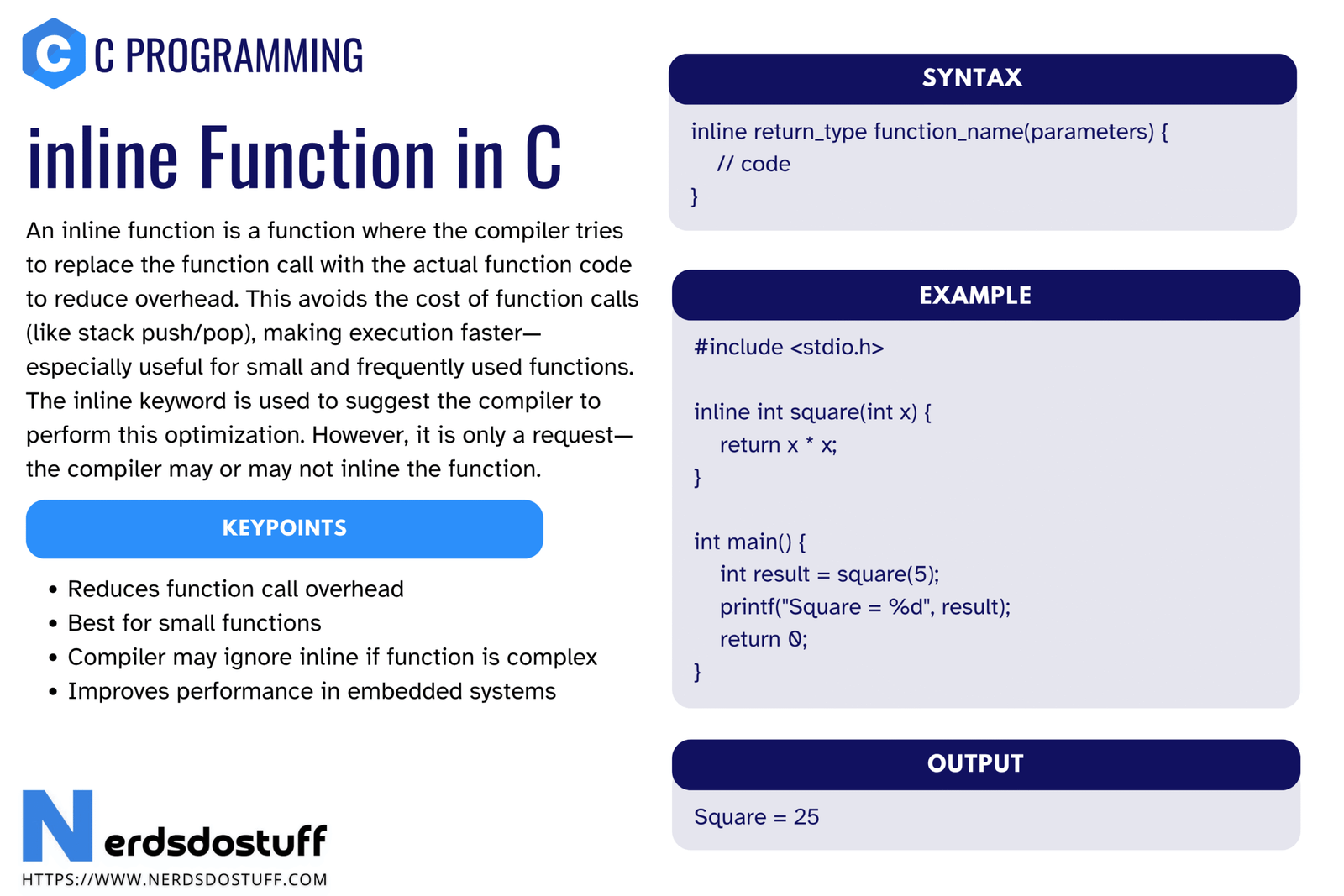
An inline function in C is a function that suggests to the compiler that the function body should be expanded directly at the place where the function is called, instead of performing a normal function call. The purpose of this idea is usually to reduce function call overhead for very small and frequently used functions.
Many beginners hear that inline functions are always faster, but that is not the correct way to think about them. The inline keyword is only a request or hint to the compiler, not an absolute command. Whether the compiler actually inlines the function depends on several factors such as optimization level, function complexity, and compiler decisions. In this article, we will understand what an inline function in C is, how it works, its syntax, when it is useful, its limitations, and common mistakes.
What is Inline Function in C?
An inline function in C is a function declared with the inline keyword. It suggests that the compiler may replace the function call with the actual function body during compilation.
inline int square(int x)
{
    return x * x;
}
If the compiler chooses to inline this function, a call like square(5) may be replaced internally with the function body logic rather than a normal call-and-return sequence.
The
inlinekeyword is a suggestion to the compiler, not a guaranteed instruction.
Why Inline Functions are Used in C
- to reduce function call overhead for very small functions
- to improve readability without always paying the cost of a normal call
- to replace some macro use cases with type-aware functions
- to keep short utility logic reusable and cleaner
Inline functions are most useful when the function is small, simple, and called many times.
Syntax of Inline Function in C
The basic syntax is straightforward:
inline return_type function_name(parameters)
{
    /* statements */
}| Part | Meaning |
|---|---|
inline | Requests inline expansion if the compiler chooses it |
| Return type | Type of value returned by the function |
| Function name | Identifier used to call the function |
| Parameters | Input values accepted by the function |
| Function body | Statements that define the operation |
The syntax of the function itself remains almost the same as a normal function. The difference is the addition of the inline keyword.
How Inline Function Works in C
Normally, a function call involves passing control to the function, managing parameters, and returning control to the caller. Inline expansion tries to avoid that normal function call path by inserting the function logic directly where it is used.
- The compiler sees the inline function definition.
- The function is called somewhere in the program.
- The compiler may replace the call with the function body logic.
- If it does not inline the function, it may still use a normal function call.
This means inline behavior is decided during compilation, not during program execution.
Simple Example of Inline Function in C
The following example shows a small inline function.
#include <stdio.h>
inline int square(int x)
{
    return x * x;
}
int main(void)
{
    int result = square(5);
    printf("%d\n", result);
    return 0;
}
This is a common kind of function that may be suitable for inlining because it is small and simple.
Inline Function vs Normal Function in C
| Point | Inline function | Normal function |
|---|---|---|
| Compiler intention | May expand function body at call site | Uses regular function call structure |
| Call overhead | May be reduced if inlined | Regular call overhead remains |
| Best use case | Small and frequently used functions | General-purpose functions of any size |
| Guarantee | No guarantee of inlining | Always behaves as a normal function call |
The most important thing to remember is that inline functions are not guaranteed to behave differently from normal functions unless the compiler chooses to inline them.
Inline Function vs Macro in C
Inline functions are often compared with macros because both can avoid some function-call overhead in certain cases. But they are not the same.
| Point | Inline function | Macro |
|---|---|---|
| Type checking | Yes, because it is a real function | No type checking in the same way |
| Debugging | Usually easier to debug | Can be harder to debug |
| Syntax safety | Safer than many macros | Can lead to unexpected expansions |
| Typical use | Small reusable function logic | Preprocessor text substitution |
In many cases, an inline function is a cleaner and safer choice than a macro for simple reusable operations.
#define SQUARE(x) x * x
inline int square(int x)
{
    return x * x;
}
The inline function version behaves more predictably and is easier to reason about than many macro definitions.
When to Use Inline Function in C
- when the function is very small
- when the function is called many times
- when you want cleaner code than a macro
- when a utility operation should stay readable and reusable
Typical examples include small math helpers, comparison helpers, flag checks, and compact utility logic.
When Inline Function is Not a Good Choice
- when the function is large or complex
- when the function contains heavy control flow
- when code size growth matters more than minor call overhead
- when you expect the keyword alone to force optimization
Inlining a large function can increase code size and may not improve performance at all.
Advantages of Inline Function in C
- may reduce function call overhead
- keeps code reusable and readable
- safer than many macros
- useful for short repeated operations
Limitations of Inline Function in C
- compiler may ignore the inline request
- large inline functions may increase code size
- performance gain is not guaranteed
- wrong expectations can lead to poor design decisions
Common Mistakes in Inline Function in C
- assuming inline always makes code faster
- using inline for large functions
- expecting inline to force compiler behavior
- confusing inline functions with macros
- ignoring readability and using inline unnecessarily
| Mistake | Problem | Better approach |
|---|---|---|
Treating inline as a command | Compiler may still choose normal call behavior | See it as a hint, not a guarantee |
| Inlining large functions | May increase code size | Reserve inline for short functions |
| Choosing inline without reason | Adds noise without real benefit | Use it only where it helps clarity or performance intent |
The best way to think about inline is as a tool, not as magic optimization.
Best Practices for Inline Function in C
- Use inline only for small and simple functions.
- Prefer inline functions over risky macros when suitable.
- Do not assume the compiler will always inline the function.
- Keep code clarity more important than forced micro-optimization.
- Measure performance if optimization really matters.
A good inline function is short, clear, and useful even if the compiler ends up treating it as a normal function.
FAQs
What is inline function in C?
An inline function in C is a function declared with the inline keyword to suggest possible inline expansion by the compiler.
Does inline guarantee faster execution in C?
No. The compiler may or may not inline the function, so faster execution is not guaranteed.
What is the difference between inline function and macro in C?
An inline function is a real function with type-aware behavior, while a macro is preprocessor text substitution.
When should I use an inline function in C?
Use it for very small, simple, and frequently used functions where inline expansion may be helpful.
Can the compiler ignore the inline keyword in C?
Yes. The compiler can ignore the request if it decides not to inline the function.
Are inline functions always better than normal functions?
No. Normal functions are often the better choice for larger or more complex logic.
Continue learning C in order
Follow the topic sequence with the previous and next lesson.