
Variables in C are named memory locations used to store data. A C program works with values, and variables provide a practical way to store, update, and reuse those values while the program runs. Without variables, most real programming tasks would become difficult or impossible to manage clearly.
For beginners, variables are one of the first major ideas in the language because many later topics depend on them. Input, output, calculations, conditions, loops, and functions all make heavy use of variables. In this article, we will understand what variables in C are, why they matter, how to declare and initialize them, how scope affects them, and what mistakes beginners should avoid.
What are Variables in C?
A variable in C is a name given to a memory location where a value is stored. Instead of referring to a raw address directly, the programmer uses a meaningful name such as age, marks, or total.
Every variable has a data type. The data type tells the compiler what kind of value the variable will hold and how it should generally be handled in memory. For example, integer variables store whole numbers, character variables store individual characters, and floating-point variables store decimal values.
Why Variables are Needed in C
- They store user input.
- They keep results of calculations.
- They make comparisons and conditions possible.
- They allow data to move through functions and program logic.
- They improve readability because values can be referred to by meaningful names.
If variables did not exist, a program would have no convenient way to remember changing data. That is why variables are one of the foundation concepts in C programming.
Declaration of Variables in C
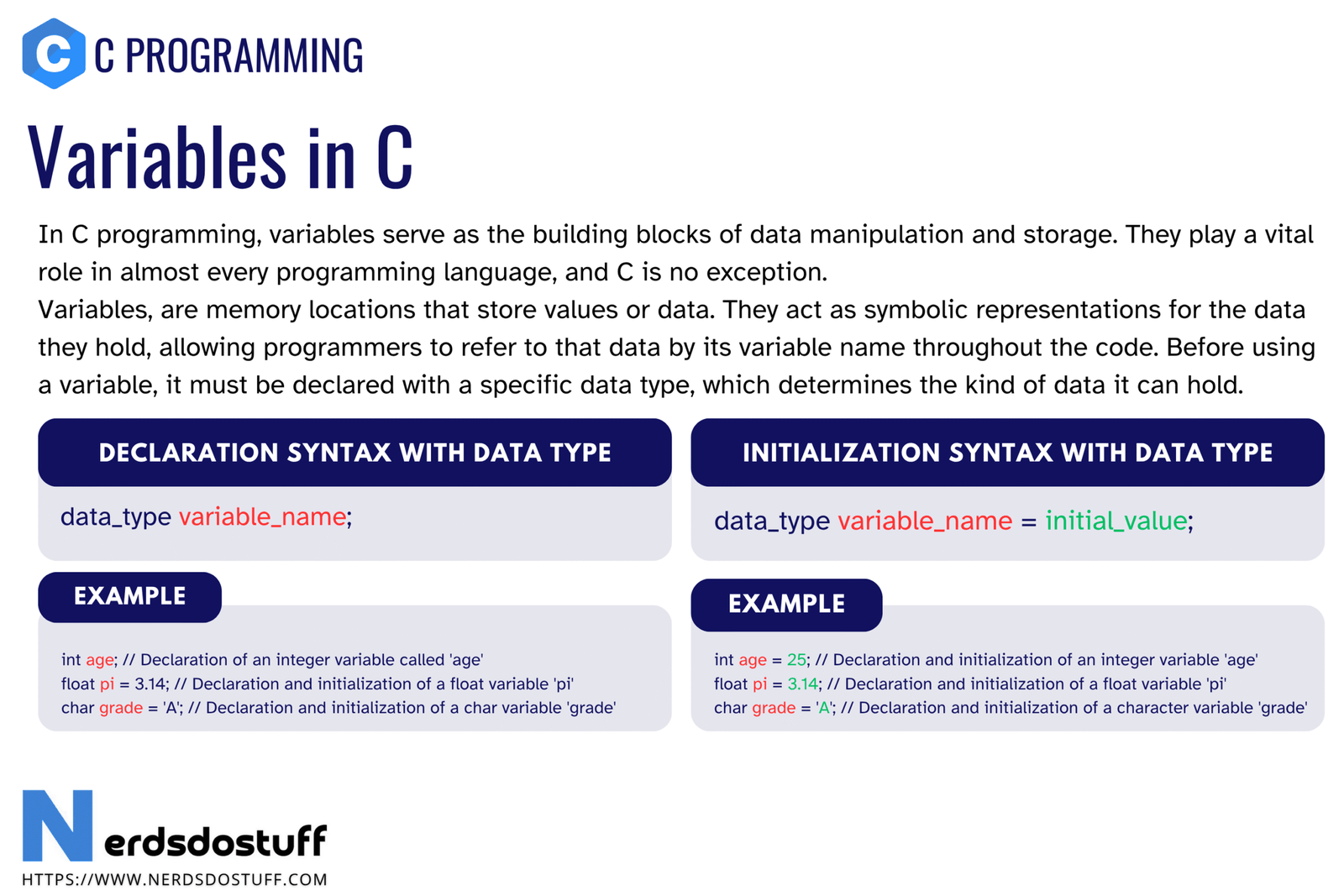
Before using a variable, it should be declared. A declaration tells the compiler the variable name and the data type associated with it.
The general idea is simple: choose the correct data type and then give the variable a valid name. A declaration such as int age; tells the compiler that a variable named age will be used to store an integer value.
| Example | Meaning |
|---|---|
int age; | Declares an integer variable |
char grade; | Declares a character variable |
float price; | Declares a floating-point variable |
double ratio; | Declares a double-precision variable |
Initialization of Variables in C
Initialization means assigning a starting value to a variable. This can be done at the same time as declaration or later in the program.
- Declaration only: the variable is introduced, but no starting value is assigned yet.
- Declaration with initialization: the variable is introduced and given its first value immediately.
For beginners, initializing variables early is usually safer because it reduces the chance of reading an undefined value by mistake.
Rules for Naming Variables in C
- A variable name can contain letters, digits, and underscores.
- It cannot begin with a digit.
- Spaces are not allowed.
- Special characters such as
@or#are not valid in normal variable names. - C is case-sensitive, so
valueandValueare different names. - Keywords such as
int,float, andreturncannot be used as variable names.
Good variable names improve readability. Names such as student_age or total_marks are more useful than vague names such as x or n when the purpose of the variable matters.
Scope of Variables in C
The scope of a variable defines where that variable can be accessed in the program.
- Local variable: declared inside a function and used only there.
- Global variable: declared outside all functions and available more broadly.
- Block variable: declared inside a block such as an
ifstatement or loop body and used only in that block.
Understanding scope is important because two variables can have similar names but different visibility depending on where they are declared.
Lifetime of Variables in C
Lifetime tells how long a variable exists in memory while the program executes. Local automatic variables normally exist only while the function or block is active. Global variables usually exist for the full execution of the program.
Scope and lifetime are related but not identical. Scope tells where a variable is visible. Lifetime tells how long it stays alive in memory.
Uninitialized Variables in C
One common beginner mistake is using a variable before assigning a meaningful value to it. A local variable that has not been initialized can contain an unpredictable value, which may lead to incorrect output or bugs.
This is why careful initialization is such an important habit in C programming.
Variables and Data Types
Variables and data types are closely connected. A variable does not just store some data. It stores a value of a specific type. That type affects memory usage, valid operations, and how input or output should be handled.
| Data Type | Typical Use |
|---|---|
int | Whole numbers such as counts and ages |
char | Single characters such as grades |
float | Decimal values with moderate precision |
double | Decimal values with higher precision |
Choosing the correct type is important because a poorly chosen type can waste memory or produce incorrect results.
Input and Output with Variables
Variables are constantly used with input and output functions. When a user enters data, the program stores it in variables. When the program displays results, it often prints values stored in variables.
This is why variables are involved in almost every practical C program, even very small ones.
Common Mistakes with Variables in C
- Using a variable before initialization
- Choosing the wrong data type
- Using invalid names
- Confusing variable names because of case sensitivity
- Using unclear names that make the code harder to understand
Many of these mistakes are simple, but they are common enough that beginners should watch for them carefully.
Best Practices for Variables in C
- Use meaningful names.
- Initialize variables whenever practical.
- Choose the correct data type.
- Keep scope as small as possible.
- Pay attention to compiler warnings.
These habits make code easier to read, easier to debug, and safer to maintain as programs become larger.
FAQs
What are variables in C?
Variables in C are named memory locations used to store values that a program can read, update, and use during execution.
Why do variables need a data type in C?
The data type tells the compiler what kind of value the variable stores and how it should be handled in memory and operations.
What is the difference between declaration and initialization?
Declaration introduces the variable name and its type, while initialization assigns the first value to that variable.
What happens if a local variable is not initialized?
An uninitialized local variable may contain an unpredictable value, which can cause incorrect output or bugs.
What is the difference between local and global variables in C?
Local variables are accessible only inside the function or block where they are declared. Global variables are declared outside functions and can be accessed more broadly in the program.
Continue learning C in order
Follow the topic sequence with the previous and next lesson.