
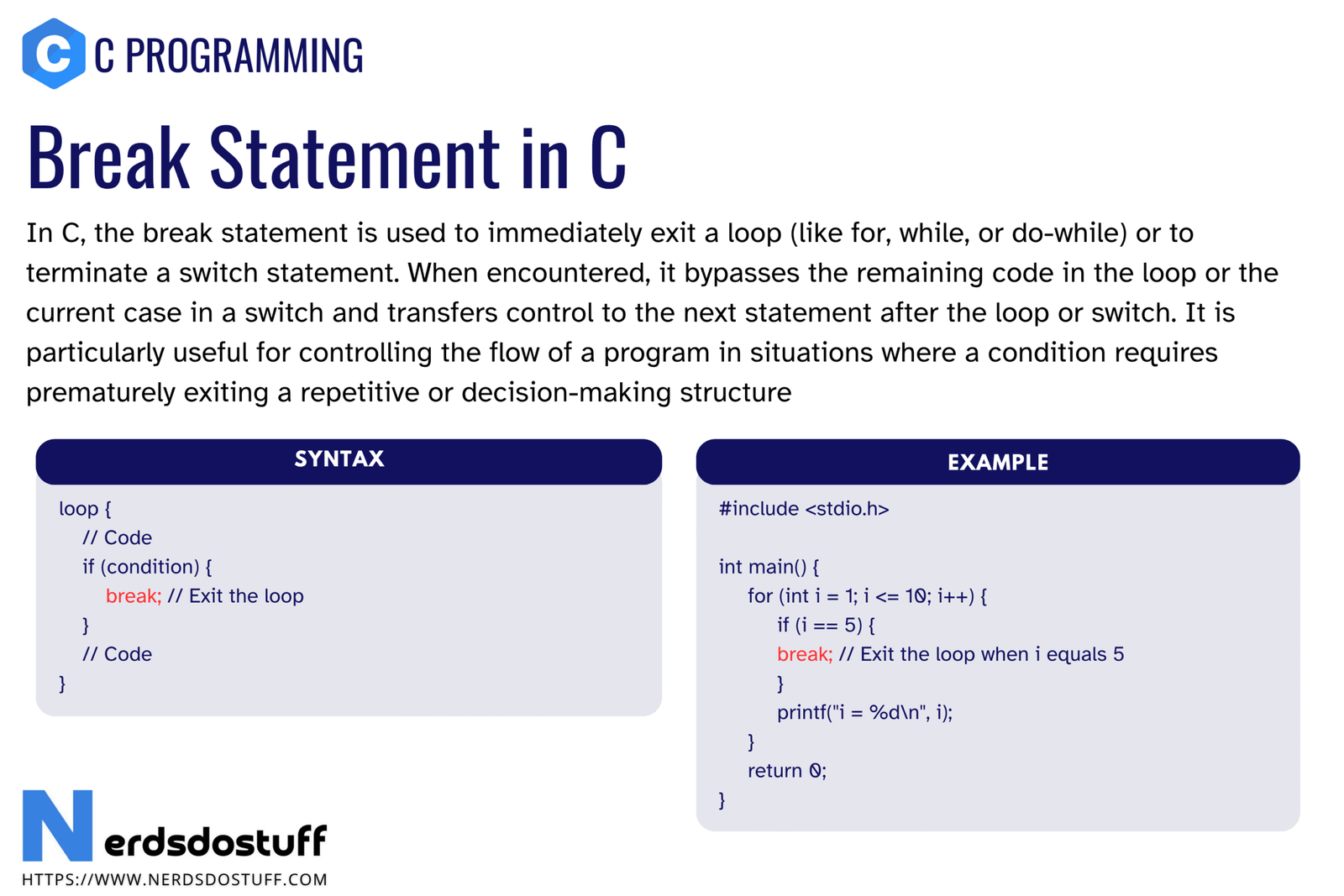
The break statement in C is used when you want to stop a loop or exit a switch statement immediately. It is one of the most important control flow statements in the language because it gives the programmer a direct way to stop repeated execution once a required condition has been met.
Without break, some loops would keep running until their normal condition becomes false, even when the program already has the result it needs. In switch statements, break prevents execution from falling into the next case unintentionally. In this article, we will understand the break statement in C, its syntax, how it works in loops and switch, difference from continue, nested loop behavior, common mistakes, and best practices.
What is Break Statement in C?
The break statement in C is a control statement that immediately terminates the nearest enclosing loop or switch statement.
It can be used inside:
forloopswhileloopsdo whileloopsswitchstatements
The break statement stops the nearest loop or switch block immediately and transfers control to the next statement after it.
Syntax of Break Statement in C
The syntax is very simple:
break;When the program reaches this statement inside a valid loop or switch, execution leaves that structure immediately.
How Break Statement Works in C
- The loop or switch starts execution normally.
- When the program reaches
break;, the current structure ends immediately. - Control moves to the first statement after that loop or switch block.
It is important to understand that break only affects the nearest enclosing loop or switch. It does not automatically exit multiple nested levels.
Simple Example of Break Statement in C
The following example stops the loop when the value becomes 4.
#include <stdio.h>
int main(void)
{
    int i;
    for (i = 1; i <= 10; i++)
    {
        if (i == 4)
        {
            break;
        }
        printf("%d ", i);
    }
    return 0;
}
This prints 1 2 3 and then stops because the loop terminates as soon as i == 4.
Break Statement in for Loop
In a for loop, break ends the loop immediately without performing more iterations. This is useful when the required result has already been found.
#include <stdio.h>
int main(void)
{
    int arr[5] = {10, 20, 30, 40, 50};
    int i;
    for (i = 0; i < 5; i++)
    {
        if (arr[i] == 30)
        {
            printf("Found at index %d\n", i);
            break;
        }
    }
    return 0;
}
Here the loop stops as soon as the required value is found, which avoids unnecessary extra iterations.
Break Statement in while Loop
In a while loop, break is often used when the loop condition alone is not the only stopping rule. For example, user input or a special event may require the loop to end early.
#include <stdio.h>
int main(void)
{
    int num;
    while (1)
    {
        printf("Enter a number (0 to stop): ");
        scanf("%d", &num);
        if (num == 0)
        {
            break;
        }
        printf("You entered %d\n", num);
    }
    return 0;
}
This is a common pattern where the loop is intentionally written as infinite and break provides the actual exit condition.
Break Statement in do while Loop
In a do while loop, break behaves the same way: it exits the loop immediately. This is useful when the loop must start at least once, but may still need an early exit before the condition check at the bottom.
#include <stdio.h>
int main(void)
{
    int i = 1;
    do
    {
        if (i == 4)
        {
            break;
        }
        printf("%d ", i);
        i++;
    } while (i <= 10);
    return 0;
}
This prints 1 2 3 and exits the loop before the condition at the bottom can continue it further.
Break Statement in Switch Statement
Inside a switch statement, break is used to end the current case block and exit the switch. Without break, execution usually falls through into the next case.
#include <stdio.h>
int main(void)
{
    int option = 2;
    switch (option)
    {
        case 1:
            printf("Option 1\n");
            break;
        case 2:
            printf("Option 2\n");
            break;
        default:
            printf("Invalid option\n");
    }
    return 0;
}
In switch statements, break is usually expected after each case unless fall-through is deliberate.
Difference Between Break and Continue in C
Break and continue both affect loop flow, but they do different jobs.
| Statement | Effect |
|---|---|
break | Terminates the loop or switch immediately |
continue | Skips the current loop iteration and moves to the next one |
If the program should stop the structure completely, use break. If the program should skip only the current loop cycle, use continue.
Break Statement in Nested Loops
When break is used inside nested loops, it exits only the nearest enclosing loop. It does not automatically terminate outer loops.
#include <stdio.h>
int main(void)
{
    int i, j;
    for (i = 1; i <= 3; i++)
    {
        for (j = 1; j <= 3; j++)
        {
            if (i == 2 && j == 2)
            {
                break;
            }
            printf("(%d,%d) ", i, j);
        }
    }
    return 0;
}
In this example, break exits only the inner loop when (2,2) is reached. The outer loop keeps running.
Can Break Be Used Outside Loop or Switch?
No. In standard C, break can only be used inside a loop or a switch statement. Using it outside those structures causes a compilation error.
Also, standard C does not support labeled break statements like some other languages do. So break cannot directly jump out of multiple nested loops by naming a label.
Common Uses of Break Statement in C
- stopping a loop after finding a required value
- exiting menu-driven loops on a chosen option
- ending infinite loops when an exit condition occurs
- preventing fall-through in switch statements
- handling unexpected conditions and stopping further processing
Common Mistakes in Break Statement in C
- confusing break with continue
- assuming break exits multiple nested loops automatically
- forgetting break in switch cases and causing unintended fall-through
- trying to use break outside loop or switch
- using break so often that the loop structure becomes hard to follow
| Mistake | Problem | Better Practice |
|---|---|---|
| Missing break in switch | Execution continues into the next case | Add break unless fall-through is intentional |
| Expecting break to exit all nested loops | Only the nearest loop stops | Design loop exits carefully and explicitly |
| Using break outside valid structures | Compilation error | Use break only in loops and switch |
Best Practices for Break Statement in C
- Use break when there is a clear reason to end the loop or switch early.
- Keep the exit condition readable and close to the relevant logic.
- Use break carefully in nested loops so the target level is clear.
- Always think about switch fall-through when break is omitted.
- Do not replace normal loop conditions with break unless that structure genuinely makes the code clearer.
FAQs
What is break statement in C?
The break statement in C immediately terminates the nearest loop or switch statement.
What is the difference between break and continue in C?
break ends the loop or switch completely, while continue skips only the current loop iteration.
Can break be used in switch statement?
Yes. Break is commonly used in switch statements to exit a case block and prevent fall-through.
Can break be used outside loop or switch?
No. Using break outside a loop or switch causes a compilation error in standard C.
Does break exit all nested loops?
No. It exits only the nearest enclosing loop or switch.
Can break be used in an infinite loop?
Yes. In fact, break is often used as the real exit condition for intentionally infinite loops.
Continue learning C in order
Follow the topic sequence with the previous and next lesson.