
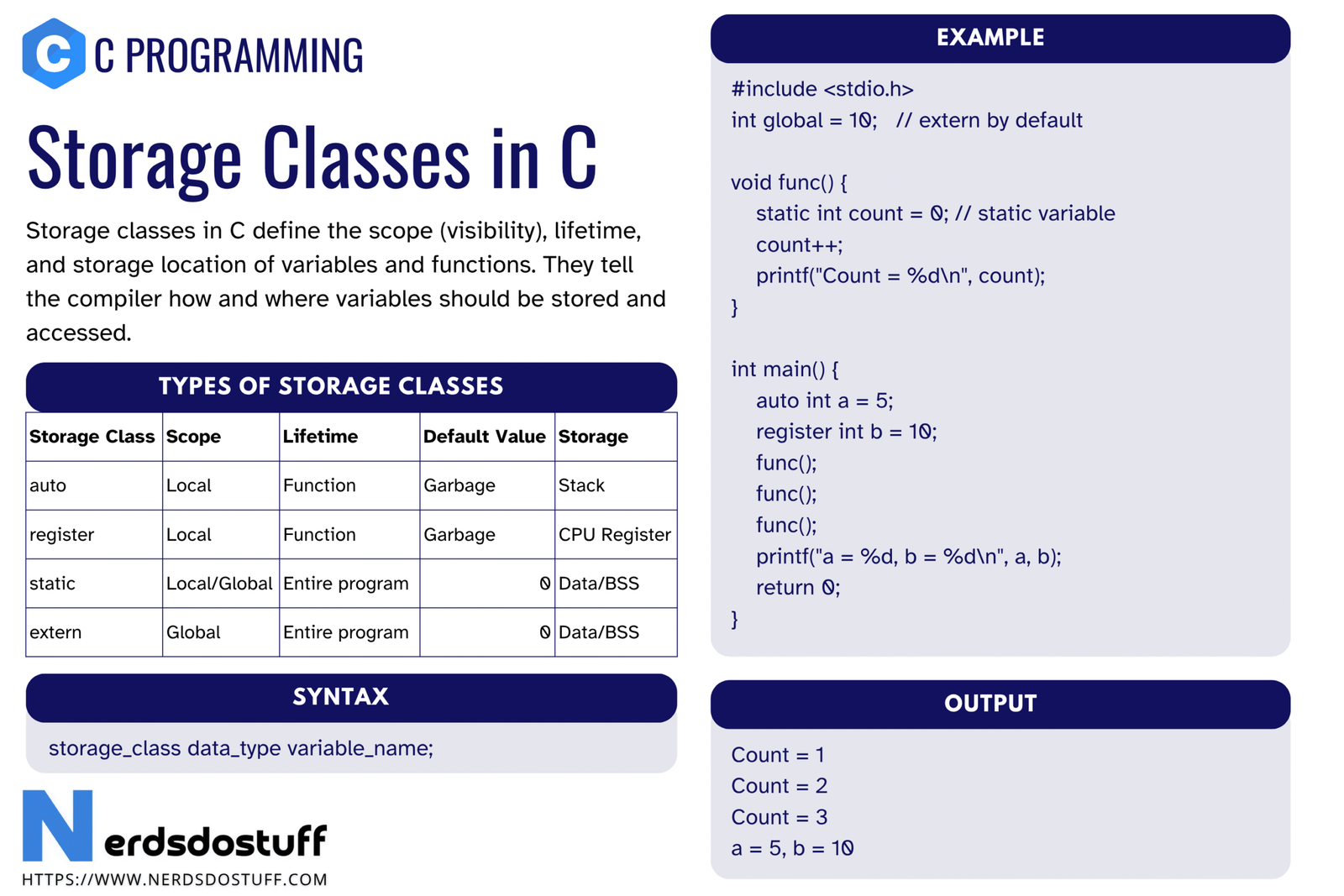
Storage classes in C define how a variable or function behaves in a program with respect to scope, lifetime, default value, and storage location. They tell the compiler where the variable exists, how long it stays alive, and where it can be accessed from. This is an important topic because many bugs in C happen when programmers misunderstand whether data is local, global, temporary, persistent, or shared across files.
In C, the main storage classes are auto, register, static, and extern. Each one is used for a different purpose. In this article, we will understand storage classes in C, the meaning of each storage class, their differences, examples, common mistakes, and best practices.
What are Storage Classes in C?
Storage classes in C are specifiers that describe the visibility, lifetime, and memory behavior of variables and functions.
Storage classes in C answer four main questions: where a variable is stored, how long it exists, where it can be accessed, and what its default value is.
This is why storage classes are closely connected to variable scope and memory management in C programs.
Why Storage Classes are Important in C
- to control where variables can be accessed
- to decide how long variables stay in memory
- to share data between functions or files when needed
- to keep variables private when needed
- to improve code clarity in larger programs
Without understanding storage classes, it becomes difficult to write reliable multi-function or multi-file C programs.
Types of Storage Classes in C
| Storage Class | Main Use | Typical Scope | Lifetime |
|---|---|---|---|
auto | Default local variable | Block scope | Until block ends |
register | Suggest fast access variable | Block scope | Until block ends |
static | Preserve value or restrict linkage | Block scope or file scope | Whole program |
extern | Refer to global variable defined elsewhere | File scope or external linkage | Whole program |
auto Storage Class in C
auto is the default storage class for local variables declared inside a block or function. In practice, most programmers do not write the word auto because local variables are already automatic by default.
int main(void)
{
    auto int x = 10;
    printf("%d\n", x);
    return 0;
}
Here x exists only inside the block where it is declared. Once the block ends, the variable is destroyed.
- scope: local block only
- lifetime: until control leaves the block
- default value: garbage value if not initialized
register Storage Class in C
register is used to suggest that a variable may be stored in a CPU register for faster access. Modern compilers make their own optimization decisions, so this keyword is less important today than it was in older C code, but it is still part of the language.
int main(void)
{
    register int counter;
    for (counter = 0; counter < 5; counter++)
    {
        printf("%d\n", counter);
    }
    return 0;
}
A register variable still has block scope and block lifetime like an automatic variable.
One important point is that you should not take the address of a register variable using the address operator &.
static Storage Class in C
static has different effects depending on where it is used.
Static Local Variable in C
If a local variable is declared as static, it keeps its value between function calls.
#include <stdio.h>
void showCount(void)
{
    static int count = 0;
    count++;
    printf("%d\n", count);
}
int main(void)
{
    showCount();
    showCount();
    showCount();
    return 0;
}
The output increases because count is initialized only once and then preserved for the whole program.
Static Global Variable in C
If a global variable is declared as static, it becomes limited to the current source file. This is called internal linkage.
That means other files cannot access it directly. This is useful when you want file-level privacy.
- scope: block scope if local, file scope if global
- lifetime: whole program
- default value: zero if not initialized
extern Storage Class in C
extern is used to declare a global variable or function that is defined in another file or another location. It does not create new storage by itself in the usual declaration form. It only tells the compiler that the definition exists elsewhere.
/* file1.c */
int total = 100;
/* file2.c */
extern int total;
This allows multiple files in one program to use the same global variable.
- scope: file scope with external linkage
- lifetime: whole program
- default value: zero if the original global definition is uninitialized
Difference Between Storage Classes in C
| Feature | auto | register | static | extern |
|---|---|---|---|---|
| Default for local variable | Yes | No | No | No |
| Visible outside block | No | No | Depends on location | Yes, if externally linked |
| Lifetime ends after block | Yes | Yes | No | No |
| Preserves value between calls | No | No | Yes, for static local | Global lifetime |
| Address can be taken | Yes | Usually no | Yes | Yes |
Default Values in Storage Classes
Default initialization is another important difference.
autoandregistervariables are not automatically initialized, so they contain garbage values if no explicit value is given.staticand global variables accessed throughexternare automatically initialized to zero if no explicit value is given.
Storage Classes and Functions in C
Functions can also be affected by storage-related keywords. A normal function at file scope has external linkage by default. If you declare a function as static, it becomes visible only inside that source file.
This is one reason static is used heavily in modular C programs.
Common Mistakes with Storage Classes in C
- thinking
staticmeans global in every situation - forgetting that local
staticvariables keep their old value between calls - trying to take the address of a
registervariable - using
externwithout a real definition somewhere else - confusing scope with lifetime
| Mistake | Problem | Better Practice |
|---|---|---|
Using extern without definition | Linker error | Make sure one real global definition exists |
Expecting local static to reset every call | Unexpected retained value | Remember static local variables persist |
| Confusing scope and lifetime | Wrong program design | Analyze both separately |
Best Practices for Storage Classes in C
- Use local automatic variables by default for simple local work.
- Use
staticlocal variables only when state must be preserved between calls. - Use file-scope
staticto hide internal data from other files. - Use
externcarefully and only when shared global data is really needed. - Think separately about scope, lifetime, and linkage before choosing a storage class.
FAQs
What are storage classes in C?
Storage classes in C define the scope, lifetime, default value, and linkage behavior of variables and functions.
What are the main storage classes in C?
The main storage classes in C are auto, register, static, and extern.
What is the difference between static and extern in C?
static can restrict visibility to the current file or preserve value between calls, while extern refers to a global variable or function defined elsewhere.
Why is register used in C?
register suggests that a variable may be stored in a CPU register for faster access, although modern compilers handle most optimization decisions automatically.
Does static local variable keep its value in C?
Yes. A static local variable keeps its value between function calls.
Can extern create a new variable in C?
In normal use, extern is used to declare an already defined global variable. It usually does not create a new definition by itself.
Continue learning C in order
Follow the topic sequence with the previous and next lesson.