
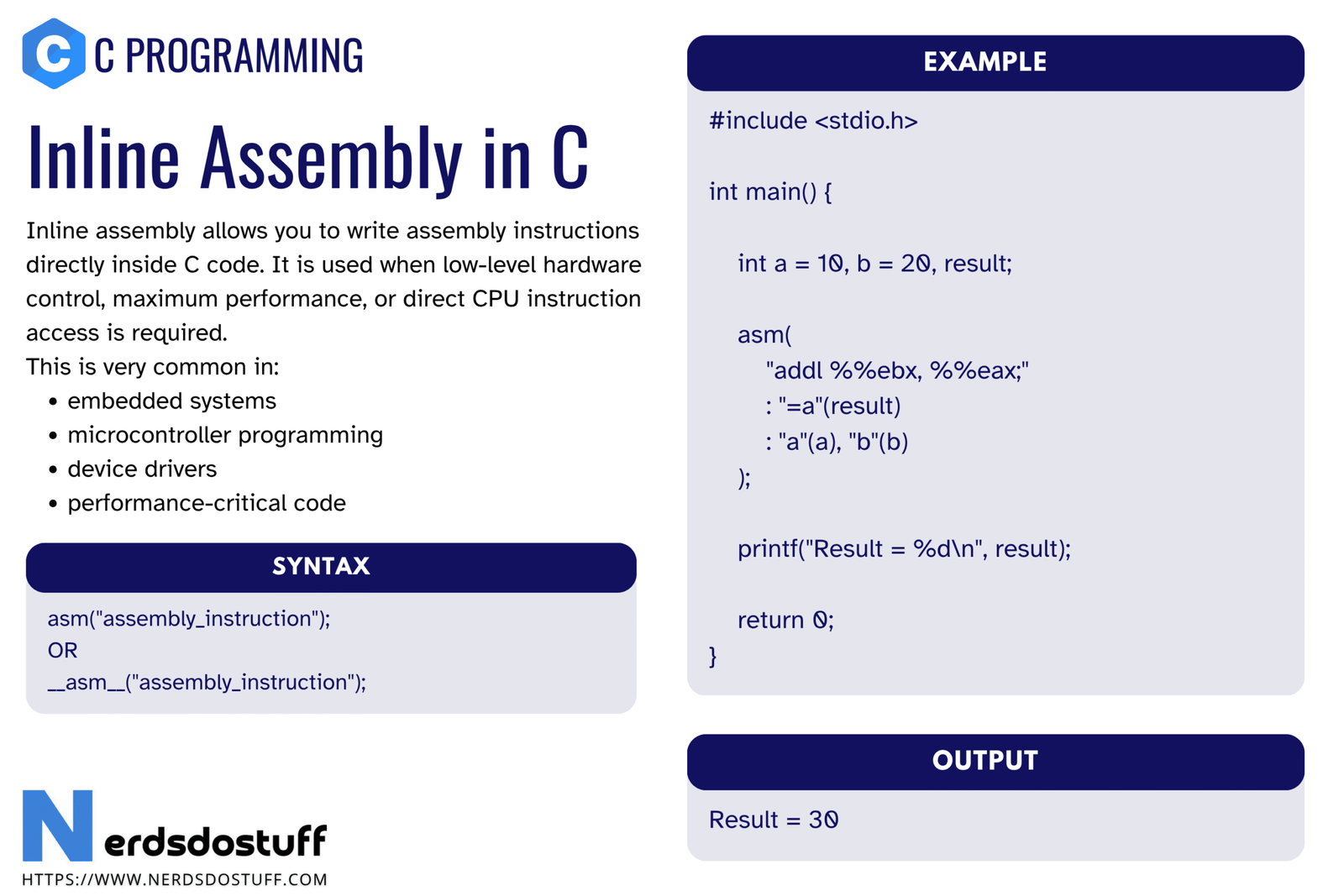
Inline assembly in C means writing assembly instructions directly inside a C program. This is done when a programmer wants very low-level control over hardware, CPU instructions, registers, timing, or special operations that are not easily expressed in plain C. Inline assembly can be powerful, but it is also compiler-specific, harder to maintain, and much less portable than normal C code.
It is important to understand that inline assembly is not a feature defined by standard C itself. It is usually provided as a compiler extension. Because of that, the exact syntax depends on the compiler, such as GCC, Clang, or older MSVC forms. In this article, we will understand inline assembly in C, where it is used, why it is compiler-specific, common syntax styles, examples, risks, and best practices.
What is Inline Assembly in C?
Inline assembly in C is the practice of embedding assembly language instructions directly inside C source code.
Inline assembly gives the programmer direct access to assembly instructions without leaving the C source file.
This allows C and assembly to work together in one program unit, which can be useful in low-level programming.
Why Inline Assembly is Used in C
- to access special CPU instructions
- to work with hardware or low-level system code
- to perform operations not directly available in plain C
- to control exact instruction behavior in critical code paths
- to interface with embedded or architecture-specific features
In older code, inline assembly was also used for performance tuning. Today, compilers are often very good at optimization, so manual assembly is used more carefully.
Inline Assembly is Compiler Specific
This is one of the most important facts about inline assembly in C. Standard C does not define a universal inline assembly syntax. That means one compiler may support one style while another may use a different form or may not support the same code at all.
- GCC and Clang commonly use
asmor__asm__ - older MSVC compilers supported
__asmin specific environments - support can differ by architecture such as x86, ARM, or x64
So inline assembly is powerful, but it is usually not portable.
Basic GCC Style Inline Assembly in C
A very simple GCC style example looks like this:
asm("nop");The instruction nop means no operation. It does nothing except occupy one instruction slot.
This is a simple example, but real inline assembly often needs inputs, outputs, and clobber information.
Extended GCC Inline Assembly in C
GCC style inline assembly can describe output operands, input operands, and registers or memory that may be affected.
General form:
asm("assembly code"
    : output_operands
    : input_operands
    : clobbered_registers);
This tells the compiler what values go in, what values come out, and what machine state may change.
Example of GCC Inline Assembly with Output
Here is a simple compiler-specific example that moves a value through inline assembly style operands:
int x = 5;
int y;
asm("mov %1, %0"
    : "=r" (y)
    : "r" (x));
This kind of code is compiler-specific and architecture-sensitive, so it should be used only when the exact environment is understood.
Older MSVC Style Inline Assembly in C
Older Microsoft compiler environments supported forms such as:
__asm
{
    mov eax, 1
}
But this style is not universally available and is not the same as GCC style. It is best treated as compiler-specific historical syntax rather than a portable C technique.
Where Inline Assembly is Commonly Used
- embedded systems programming
- device drivers and hardware control
- operating system kernels
- boot code and startup routines
- special architecture-dependent optimizations
In application-level code, inline assembly is much less common than it used to be.
Risks of Using Inline Assembly in C
- code becomes compiler-specific
- portability drops sharply
- maintenance becomes harder
- incorrect constraints can break optimization or correctness
- debugging becomes more difficult
- wrong assumptions about registers or memory can cause subtle bugs
| Issue | Why it Matters |
|---|---|
| Portability | Code may fail on another compiler or CPU |
| Maintainability | Assembly is harder for many programmers to read |
| Compiler coordination | Bad constraints can mislead the compiler |
| Testing difficulty | Architecture-specific bugs are harder to trace |
Inline Assembly vs Separate Assembly File
Inline assembly keeps everything inside the C source file, while a separate assembly file isolates low-level code into its own source unit.
- inline assembly is convenient for small targeted operations
- separate assembly files are often cleaner for larger low-level routines
- separate files can improve organization when assembly becomes complex
So inline assembly is usually better for small, focused cases rather than large logic blocks.
Modern Alternatives to Inline Assembly in C
- compiler intrinsics
- built-in functions provided by the compiler
- well-optimized normal C code when assembly is not truly necessary
- separate assembly modules for larger architecture-specific work
In many cases, intrinsics are easier to maintain than inline assembly while still giving access to low-level capabilities.
Common Mistakes with Inline Assembly in C
- assuming inline assembly is standard C
- writing compiler-specific code and expecting it to work everywhere
- forgetting input, output, or clobber details in GCC style assembly
- using inline assembly when normal C or intrinsics are enough
- making code harder to maintain for very small benefit
| Mistake | Problem | Better Practice |
|---|---|---|
| Treating inline assembly as portable C | Build failure on another toolchain | Document compiler and architecture assumptions clearly |
| Ignoring operand rules | Wrong results or broken optimization | Use the exact syntax and constraints required by the compiler |
| Using assembly too early | Complex code with little gain | Start with clean C and optimize only when needed |
Best Practices for Inline Assembly in C
- Use inline assembly only when there is a real low-level reason.
- Document the compiler and architecture assumptions.
- Prefer compiler intrinsics when they solve the same problem more cleanly.
- Keep assembly snippets short and focused.
- Test carefully on the exact target platform.
FAQs
What is inline assembly in C?
Inline assembly in C means embedding assembly instructions directly inside C source code using compiler-specific extensions.
Is inline assembly part of standard C?
No. Inline assembly is usually provided as a compiler extension, not as a feature of standard C itself.
Why is inline assembly considered non-portable?
Because the syntax and behavior depend on the compiler and often on the target CPU architecture as well.
Where is inline assembly used in C?
It is commonly used in embedded systems, kernels, drivers, startup code, and architecture-specific low-level programming.
Should inline assembly be used for normal C programs?
Usually no. Normal C code or compiler intrinsics are often better unless a specific low-level need exists.
What is the main risk of inline assembly in C?
The main risks are low portability, hard maintenance, and incorrect interaction with compiler optimization if written carelessly.
Continue learning C in order
Follow the topic sequence with the previous and next lesson.