
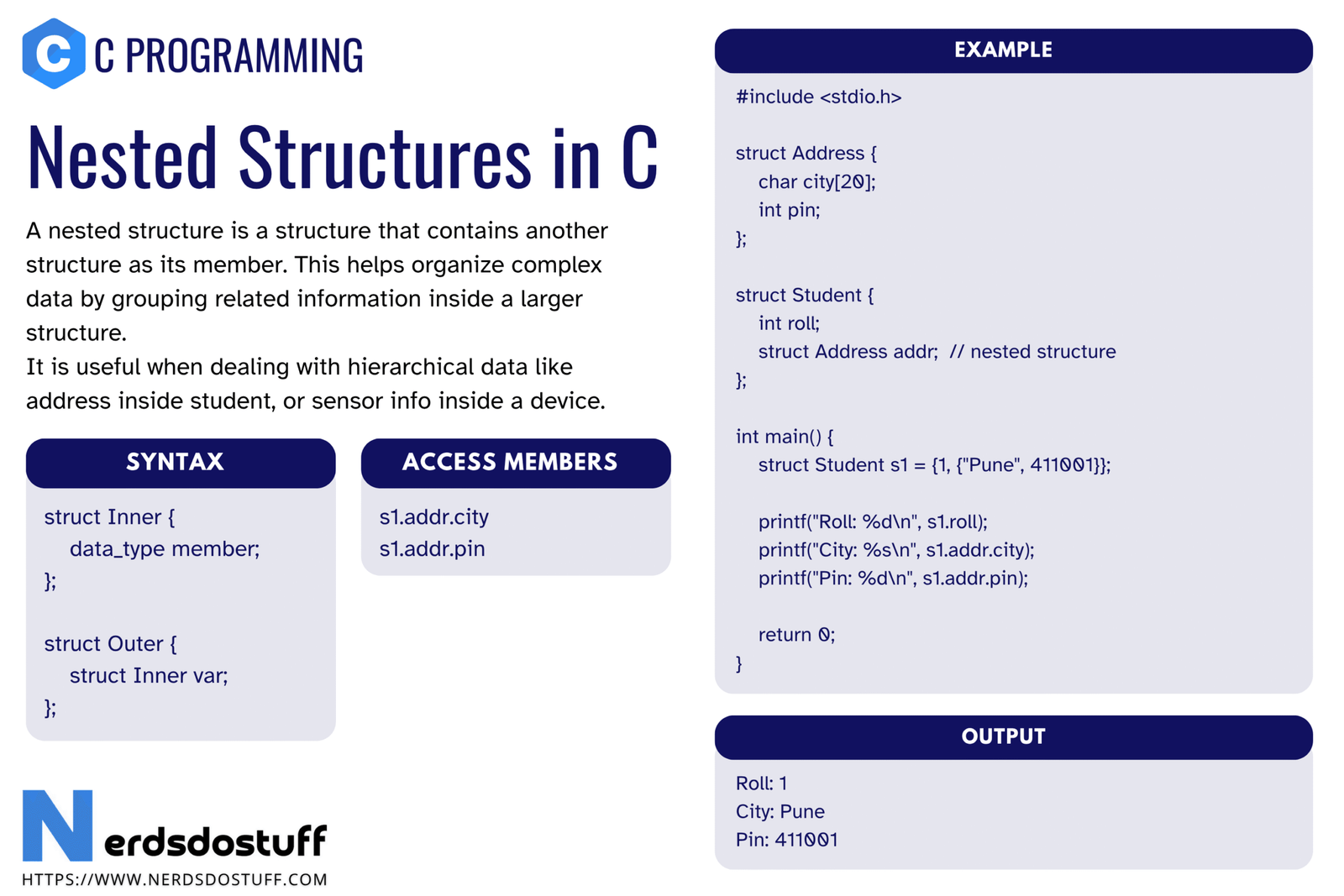
A nested structure in C is a structure that contains another structure as one of its members. This is useful when one logical object naturally contains another smaller logical object inside it. For example, a student record may contain a date of birth structure. An employee record may contain an address structure. A point in graphics may be part of a rectangle structure. Instead of storing every field separately at the top level, nested structures make the data model cleaner and easier to understand.
Once you understand normal structures, nested structures are the next natural step. They help you build more realistic records and prepare you for complex data organization in systems programming, file handling, and embedded software. In this article, we will understand nested structure in C, its syntax, declaration, initialization, member access, functions, pointers, memory behavior, and common mistakes.
What is Nested Structure in C?
A nested structure in C is a structure that contains another structure as one of its members. The inner structure becomes part of the outer structure, just like any other member.
This means a nested structure allows grouped data to be organized at more than one level.
A nested structure is simply a structure inside another structure.
Why Nested Structures are Used in C
- They organize complex data more clearly.
- They help model real-world records that naturally contain sub-records.
- They reduce clutter in the outer structure.
- They make related data easier to manage as one member group.
- They improve readability when records contain repeated logical sections such as address, date, or coordinates.
Syntax of Nested Structure in C
The basic idea is to define one structure and use it as a member inside another structure.
struct Inner
{
    data_type member1;
    data_type member2;
};
struct Outer
{
    data_type memberA;
    struct Inner inner_member;
};| Part | Meaning |
|---|---|
struct Inner | Structure used as nested member |
struct Outer | Main structure that contains it |
inner_member | Nested structure variable inside outer structure |
Example of Nested Structure in C
Let us take a simple example where a student structure contains a date structure.
#include <stdio.h>
struct Date
{
    int day;
    int month;
    int year;
};
struct Student
{
    int roll;
    char grade;
    struct Date dob;
};
int main(void)
{
    struct Student s1;
    return 0;
}
Here dob is a nested structure member of type struct Date.
Initialization of Nested Structure in C
A nested structure can be initialized using nested braces.
#include <stdio.h>
struct Date
{
    int day;
    int month;
    int year;
};
struct Student
{
    int roll;
    char grade;
    struct Date dob;
};
int main(void)
{
    struct Student s1 = {101, 'A', {15, 8, 2004}};
    return 0;
}
The inner braces initialize the members of the nested structure dob.
You can also assign values member by member after declaration.
s1.roll = 101;
s1.grade = 'A';
s1.dob.day = 15;
s1.dob.month = 8;
s1.dob.year = 2004;
Accessing Members of Nested Structure in C
Members of a nested structure are accessed by chaining the dot operator.
#include <stdio.h>
struct Date
{
    int day;
    int month;
    int year;
};
struct Student
{
    int roll;
    char grade;
    struct Date dob;
};
int main(void)
{
    struct Student s1 = {101, 'A', {15, 8, 2004}};
    printf("Roll = %d\n", s1.roll);
    printf("DOB = %d/%d/%d\n", s1.dob.day, s1.dob.month, s1.dob.year);
    return 0;
}
The expression s1.dob.day means: take structure s1, go to its member dob, then access the member day inside that nested structure.
Nested Structure with Pointer in C
When a pointer points to the outer structure, you can still access nested members using the arrow operator for the outer level and dot or arrow logic for the inner level.
#include <stdio.h>
struct Date
{
    int day;
    int month;
    int year;
};
struct Student
{
    int roll;
    struct Date dob;
};
int main(void)
{
    struct Student s1 = {101, {15, 8, 2004}};
    struct Student *ptr = &s1;
    printf("Roll = %d\n", ptr->roll);
    printf("Year = %d\n", ptr->dob.year);
    return 0;
}
The expression ptr->dob.year works because ptr->dob gives the nested structure and .year accesses its member.
Nested Structure and Functions in C
Nested structures can be passed to functions the same way as ordinary structures. The function can receive the outer structure and then access the nested members.
#include <stdio.h>
struct Date
{
    int day;
    int month;
    int year;
};
struct Student
{
    int roll;
    struct Date dob;
};
void display(struct Student s)
{
    printf("Roll = %d, DOB = %d/%d/%d\n", s.roll, s.dob.day, s.dob.month, s.dob.year);
}
int main(void)
{
    struct Student s1 = {101, {15, 8, 2004}};
    display(s1);
    return 0;
}
If the outer structure is large, passing a pointer is often the better choice for efficiency.
Memory Layout of Nested Structure in C
A nested structure is stored as part of the outer structure. The total size of the outer structure includes the size of the nested structure, plus any padding added for alignment.
This means nested structures do not behave like completely separate objects in memory when stored as members. They become part of the full record layout.
#include <stdio.h>
struct Date
{
    int day;
    int month;
    int year;
};
struct Student
{
    int roll;
    struct Date dob;
};
int main(void)
{
    printf("Size of Date = %zu\n", sizeof(struct Date));
    printf("Size of Student = %zu\n", sizeof(struct Student));
    return 0;
}
As with normal structures, the exact size depends on the compiler and system alignment rules.
Difference Between Normal Structure and Nested Structure
| Point | Normal Structure | Nested Structure |
|---|---|---|
| Members | Only direct members | Contains another structure as a member |
| Data organization | Flat | Multi-level |
| Access | One level like s.member | Multiple levels like s.inner.member |
| Use case | Simple records | Complex records with logical subgroups |
Nested structures are not a different language feature. They are just a more organized use of the normal structure feature.
Common Mistakes in Nested Structure in C
- forgetting to define the inner structure before using it as a member
- confusing dot and arrow operators while accessing nested members
- writing incorrect member chains like
ptr.dob.yearwhenptris a pointer - assuming nested structures are stored separately from the outer structure
- making nested designs too deep and hard to read
| Mistake | Problem | Better Practice |
|---|---|---|
| Using undefined inner structure | Compilation error | Define the inner structure before the outer one |
| Wrong operator on pointer | Member access fails | Use -> for pointer outer access |
| Too much nesting | Code becomes harder to follow | Keep data design meaningful and clear |
Best Practices for Nested Structure in C
- Use nested structures when the data naturally contains smaller grouped records.
- Keep inner structure names meaningful, such as
Date,Address, orPoint. - Do not create excessive nesting unless the data model really needs it.
- Use pointers for large outer structures when passing them to functions.
- Be careful with member access syntax in pointer-based code.
FAQs
What is nested structure in C?
A nested structure in C is a structure that contains another structure as one of its members.
Why do we use nested structures in C?
They are used to organize complex records more clearly when one record naturally contains another grouped record inside it.
How do you access members of a nested structure in C?
Use chained member access such as s1.dob.day or pointer-based access like ptr->dob.year.
Can a nested structure be initialized in C?
Yes. It can be initialized using nested braces or by assigning values member by member.
Can nested structures be passed to functions in C?
Yes. You can pass the outer structure by value or pointer, and the nested members can be accessed inside the function.
Does nested structure affect memory size in C?
Yes. The size of the outer structure includes the nested structure and any padding added by the compiler for alignment.
Continue learning C in order
Follow the topic sequence with the previous and next lesson.