
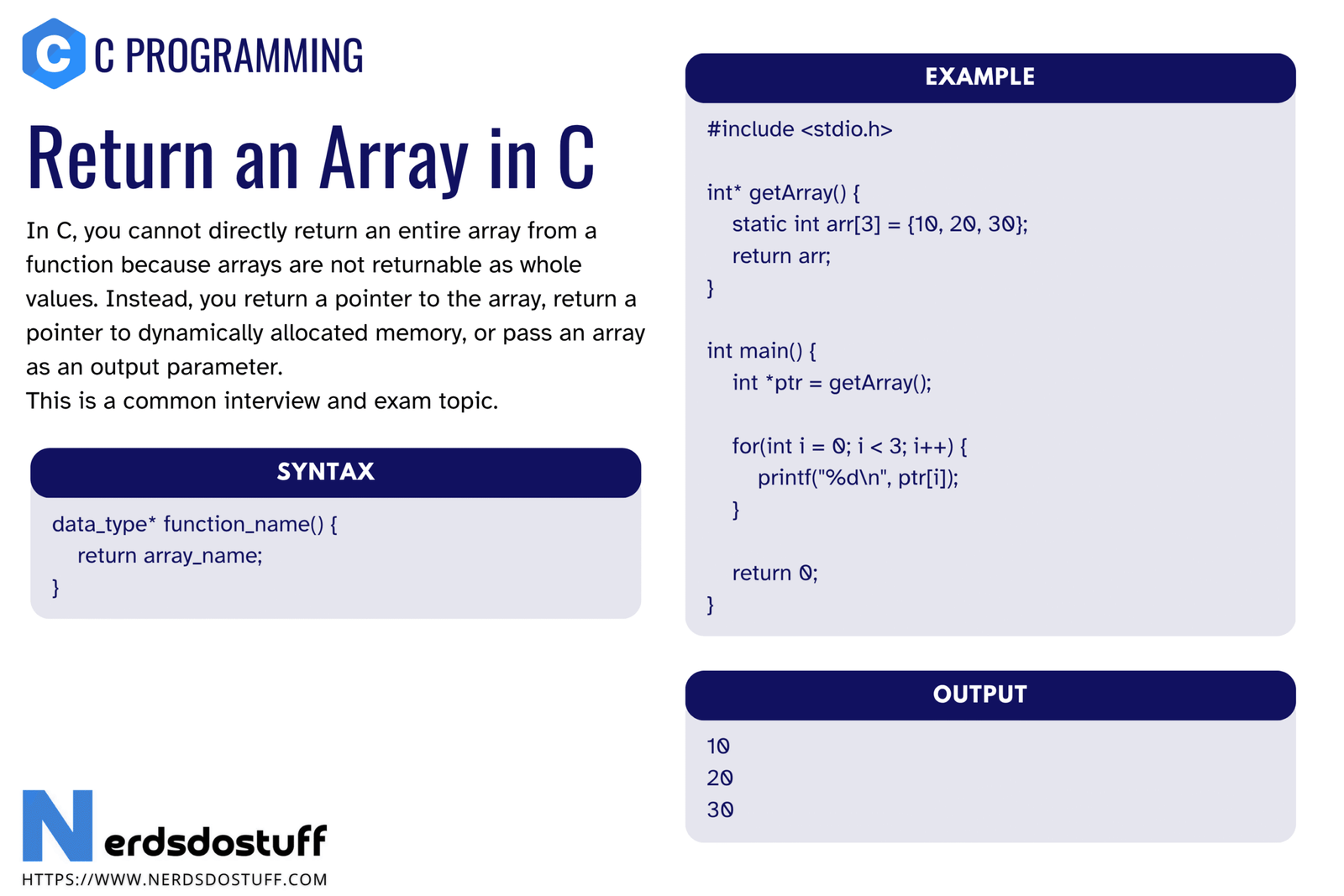
The phrase return an array in C is slightly tricky, because C does not allow a function to return an entire array directly as its return type. This is one of the first places where beginners get confused. They often try to write a function that returns int[] style data, but C does not work like some higher-level languages. Still, this does not mean array data cannot be returned in practice. It simply means the return has to be done through a valid C technique.
In real C programs, array data is usually returned in one of several safe ways: by returning a pointer, by using a static array, by dynamic memory allocation, by passing the array as an output parameter, or by wrapping the array inside a structure. In this article, we will understand return an array in C, why direct array return is not allowed, the correct alternatives, their pros and cons, and common mistakes.
Can We Return an Array in C?
In strict C, a function cannot directly return an array type. That means code like this is invalid:
int[] getArray(void);C allows functions to return values such as int, float, char, pointers, and structures, but not array types directly.
You cannot return an array directly in C, but you can return access to array data using valid C techniques.
Why Direct Array Return is Not Allowed in C
An array in C behaves differently from ordinary scalar variables. The array name is closely tied to the memory block where the elements are stored, and array values are not copied around in the same direct way as basic types. Because of this design, C does not allow a function to declare an array as its return type.
So the correct mindset is not “How do I directly return an array type?” but instead “Which safe method should I use to return array data?”
Common Ways to Return Array Data in C
| Method | Idea | Common use |
|---|---|---|
| Return pointer to static array | Function returns address of a static array | Simple examples and small fixed data |
| Return pointer to dynamically allocated memory | Allocate array with malloc() and return pointer | Flexible runtime-sized data |
| Pass output array to function | Caller gives array and function fills it | Very common and efficient in C |
| Return structure containing array | Wrap array inside a struct and return it | Fixed-size array returned as a group |
Each method has its own trade-offs. The best choice depends on array size, ownership of memory, and whether fixed or dynamic length is needed.
Method 1: Return Pointer to Static Array
A function can declare a static array inside itself and return a pointer to its first element. This works because a static array remains alive after the function ends.
#include <stdio.h>
int* getArray(void)
{
    static int arr[5] = {10, 20, 30, 40, 50};
    return arr;
}
int main(void)
{
    int *ptr = getArray();
    int i;
    for (i = 0; i < 5; i++)
    {
        printf("%d ", ptr[i]);
    }
    return 0;
}
This method is simple, but the same static array is reused every time the function is called. It also works best when the array size is fixed and known.
Method 2: Return Pointer to Dynamically Allocated Array
A function can allocate memory with malloc() and return the pointer. This is one of the most flexible approaches because the array size can be decided at runtime.
#include <stdio.h>
#include <stdlib.h>
int* createArray(int size)
{
    int *arr = malloc(size * sizeof(int));
    int i;
    if (arr == NULL)
    {
        return NULL;
    }
    for (i = 0; i < size; i++)
    {
        arr[i] = (i + 1) * 10;
    }
    return arr;
}
The caller must free the memory after use. If not, a memory leak occurs.
| Advantage | Risk |
|---|---|
| Flexible array size | Caller must remember to call free() |
| Useful for runtime-sized data | Null check is required after allocation |
Method 3: Pass Array as Output Parameter
This is one of the cleanest and most common methods in C. Instead of returning the array, the caller creates the array and passes it to the function. The function fills the values.
#include <stdio.h>
void fillArray(int arr[], int size)
{
    int i;
    for (i = 0; i < size; i++)
    {
        arr[i] = i * 2;
    }
}
This method avoids allocation inside the function and clearly keeps memory ownership with the caller.
Method 4: Return a Structure Containing an Array
C cannot return an array directly, but it can return a structure, and a structure may contain an array. This is useful when the array size is fixed.
#include <stdio.h>
struct Data
{
    int arr[5];
};
struct Data getData(void)
{
    struct Data d = {{1, 2, 3, 4, 5}};
    return d;
}
This is a valid return-by-value technique in C because the function returns a structure, not an array type directly.
Wrong Way: Returning Pointer to Local Array
One of the most dangerous mistakes is returning a pointer to a local non-static array. That array is destroyed when the function ends, so the returned pointer becomes invalid.
int* wrongArray(void)
{
    int arr[5] = {1, 2, 3, 4, 5};
    return arr;
}
This compiles in some environments with a warning, but using that returned pointer is undefined behavior.
Best Method to Return Array Data in C
There is no single best answer for every case. The right method depends on the problem.
| Situation | Recommended method |
|---|---|
| Fixed small internal data | Static array return |
| Runtime-sized data | Dynamic allocation with malloc() |
| Caller already owns memory | Output parameter |
| Fixed-size grouped result | Return a structure containing the array |
In production-style C code, passing an output array or returning dynamically allocated memory is often more practical than relying on a static internal array.
Common Mistakes When Returning Array Data in C
- trying to declare a function that returns an array type directly
- returning a pointer to a local array
- forgetting to free dynamically allocated memory
- not checking whether
malloc()returnedNULL - using a static array when the function needs separate results across calls
| Mistake | Problem | Better practice |
|---|---|---|
| Return local array pointer | Dangling pointer | Use static array or dynamic allocation |
Forget free() | Memory leak | Free dynamic memory after use |
No NULL check | Possible crash after failed allocation | Check returned pointer before use |
| Wrong ownership assumptions | Hard-to-track bugs | Define clearly who owns the memory |
Best Practices for Returning Array Data in C
- Do not try to return an array type directly.
- Never return a pointer to a local non-static array.
- Use dynamic allocation carefully and always free allocated memory.
- Prefer output parameters when the caller already has storage space.
- Use structures if a fixed-size array should be returned as a grouped value.
- Make memory ownership clear in your function design.
FAQs
Can a function return an array in C?
No, a function cannot directly return an array type in C. But it can return array data through pointers, structures, or output parameters.
Why can we not return an array directly in C?
C does not allow functions to use array types as direct return types. Array data must be handled through valid alternative approaches.
Is returning a static array safe in C?
It is valid, because the static array remains alive after the function returns. But the same array is reused across calls.
Can we return a dynamically allocated array in C?
Yes. A function can return a pointer to memory allocated with malloc(), but the caller must free that memory later.
What is the safest common way to return array data in C?
Passing an output array to the function is often one of the clearest and safest common methods in C.
Why is returning a local array pointer wrong in C?
Because the local array stops existing when the function ends, so the returned pointer becomes invalid.
Continue learning C in order
Follow the topic sequence with the previous and next lesson.