
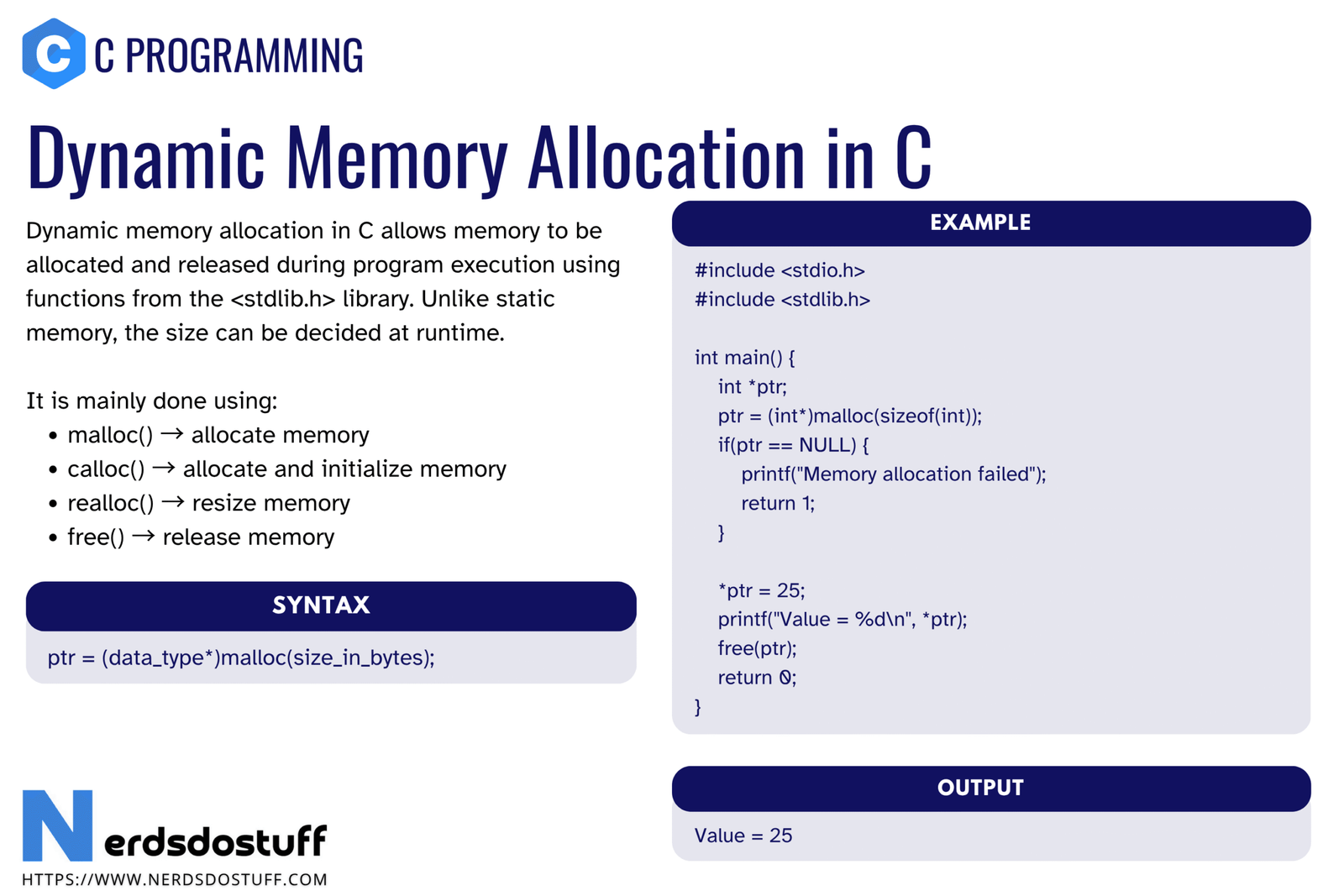
Dynamic memory allocation in C is the process of requesting memory during program execution instead of deciding all memory needs at compile time. This is important when the amount of data is not known in advance, when flexible data structures are needed, or when memory should be used only when required. Dynamic memory makes C more powerful, but it also requires more responsibility from the programmer.
In C, dynamic memory allocation is usually done with the functions malloc(), calloc(), realloc(), and free(). These functions work with heap memory. In this article, we will understand dynamic memory allocation in C, why it is needed, the role of each function, examples, memory errors, and best practices.
What is Dynamic Memory Allocation in C?
Dynamic memory allocation in C means allocating memory at runtime from the heap instead of using only fixed-size variables or arrays created during compilation.
Dynamic memory allocation lets a C program request, resize, and release memory while it is running.
This is different from static or automatic memory, where size and lifetime are already decided by the program structure.
Why Dynamic Memory Allocation is Needed in C
- when the number of elements is not known in advance
- when memory should be used only when needed
- for linked lists, trees, queues, stacks, and other dynamic data structures
- to avoid wasting memory with oversized fixed arrays
- to resize memory during execution
Without dynamic memory allocation, many flexible and real-world programs would be difficult to write in C.
Header File for Dynamic Memory Allocation in C
The standard functions for dynamic memory allocation are declared in:
#include <stdlib.h>Heap Memory in C
Dynamic memory allocation uses the heap. The heap is a memory region managed during program execution. The programmer requests memory from the heap and is also responsible for releasing it when it is no longer needed.
This is different from stack memory, where local variables are created and destroyed automatically.
malloc() in C
malloc() stands for memory allocation. It allocates a block of memory of the requested size and returns a pointer to the first byte of that block.
Syntax:
ptr = malloc(size_in_bytes);Example:
#include <stdio.h>
#include <stdlib.h>
int main(void)
{
    int *ptr = malloc(5 * sizeof(int));
    int i;
    if (ptr == NULL)
    {
        printf("Memory allocation failed\n");
        return 1;
    }
    for (i = 0; i < 5; i++)
        ptr[i] = i + 1;
    for (i = 0; i < 5; i++)
        printf("%d ", ptr[i]);
    free(ptr);
    return 0;
}
The memory returned by malloc() is not automatically initialized.
calloc() in C
calloc() stands for contiguous allocation. It allocates memory for multiple elements and initializes all bytes to zero.
Syntax:
ptr = calloc(number_of_elements, size_of_each_element);Example:
int *ptr = calloc(5, sizeof(int));This is useful when you want allocated memory to start from zero.
| Function | Initialization | Main Use |
|---|---|---|
malloc() | Not initialized | Fast raw allocation |
calloc() | Zero initialized | Array-style allocation with clean start |
realloc() in C
realloc() is used to resize a previously allocated memory block. This is useful when the program later needs more or less memory than originally requested.
Syntax:
ptr = realloc(ptr, new_size);Example:
int *ptr = malloc(3 * sizeof(int));
ptr = realloc(ptr, 6 * sizeof(int));
If the memory block is moved internally, realloc() returns the new address. That is why checking the result carefully is important.
free() in C
free() is used to release dynamically allocated memory back to the system.
Syntax:
free(ptr);If you allocate memory and never free it, your program creates a memory leak.
A common safe habit is to set the pointer to NULL after freeing it.
free(ptr);
ptr = NULL;
Complete Example of Dynamic Memory Allocation in C
#include <stdio.h>
#include <stdlib.h>
int main(void)
{
    int n, i;
    int *arr;
    printf("Enter number of elements: ");
    scanf("%d", &n);
    arr = malloc(n * sizeof(int));
    if (arr == NULL)
    {
        printf("Memory allocation failed\n");
        return 1;
    }
    for (i = 0; i < n; i++)
        arr[i] = i + 10;
    for (i = 0; i < n; i++)
        printf("%d ", arr[i]);
    free(arr);
    return 0;
}
This example allocates memory based on user input, uses it, and then releases it properly.
Common Errors in Dynamic Memory Allocation in C
- memory leak from forgetting
free() - dangling pointer after freeing memory and still using it
- null pointer dereference when allocation fails
- buffer overflow by writing outside allocated size
- double free by releasing the same block twice
| Error | Meaning | Prevention |
|---|---|---|
| Memory leak | Allocated memory never released | Always match allocation with free() |
| Dangling pointer | Pointer still used after free() | Set pointer to NULL |
| Null pointer issue | Allocation returned NULL | Check pointer before use |
| Double free | Same memory freed twice | Free once and null the pointer |
Dynamic Memory Allocation vs Static Memory in C
| Point | Dynamic Memory | Static or Fixed Memory |
|---|---|---|
| Allocated | At runtime | Before or during fixed program setup |
| Size flexibility | Flexible | Fixed |
| Managed by | Programmer | Compiler or normal scope rules |
| Main area | Heap | Stack or static area |
Best Practices for Dynamic Memory Allocation in C
- Always check whether allocation returned
NULL. - Use
sizeof(type)instead of hardcoded byte counts. - Free memory when it is no longer needed.
- Set pointers to
NULLafterfree()when appropriate. - Be careful when using
realloc()so the original pointer is not lost on failure.
FAQs
What is dynamic memory allocation in C?
It is the process of allocating memory during program execution using functions such as malloc(), calloc(), realloc(), and free().
Which header file is used for dynamic memory allocation in C?
The header file used is stdlib.h.
What is the difference between malloc() and calloc() in C?
malloc() allocates memory without initialization, while calloc() allocates memory and initializes all bytes to zero.
Why is free() important in C?
free() is important because it releases allocated heap memory and prevents memory leaks.
What is a memory leak in C?
A memory leak happens when dynamically allocated memory is not released after use.
What does realloc() do in C?
realloc() changes the size of a previously allocated memory block.
Continue learning C in order
Follow the topic sequence with the previous and next lesson.