
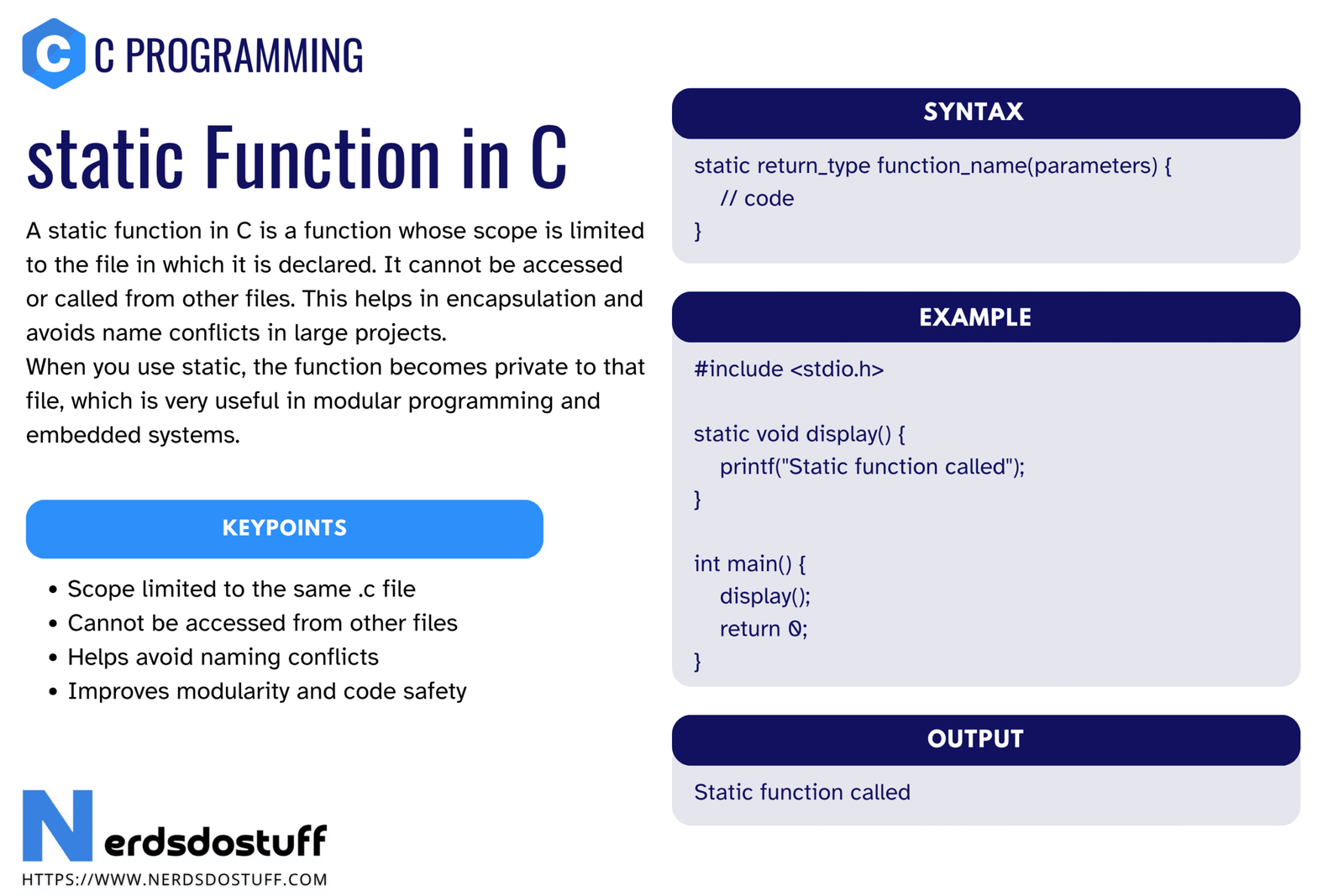
A static function in C is a function declared with the static keyword, and its most important effect is on linkage. When a function is declared static at file scope, it becomes limited to that source file only. In other words, the function can be called only from within the same file where it is defined.
Many beginners already know the static keyword from static variables, but static functions behave differently. A static variable affects storage duration or visibility depending on where it is declared, while a static function mainly controls file-level visibility. In this article, we will understand what a static function in C is, why it is used, how it affects linkage, how it differs from a normal function, and where it fits in real C programs.
What is Static Function in C?
A static function in C is a function whose scope is restricted to the source file in which it is declared. This happens when the function is defined with the static keyword outside all other functions.
static void displayMessage(void)
{
    printf("Hello\n");
}
This function can be used inside the same file, but another source file cannot call it directly.
A static function in C has internal linkage, which means it stays private to its source file.
Syntax of Static Function in C
The syntax is simple. You place the static keyword before the function return type.
static return_type function_name(parameters)
{
    /* function body */
}| Part | Meaning |
|---|---|
static | Restricts visibility to the current source file |
| Return type | Type of value returned by the function |
| Function name | Name used to call the function inside the same file |
| Parameters | Inputs accepted by the function |
How Static Function Works in C
When a function is declared normally at file scope, it has external linkage by default. That means other files may use it if they know its declaration. But when the function is declared as static, the linker keeps that function local to the current file.
- The compiler processes the source file and sees a static function definition.
- The function becomes visible only inside that translation unit.
- Other source files cannot link against that function name.
- The function behaves like a private helper for that file.
This is why static functions are useful in modular C design. They help hide internal implementation details.
Static Function and Internal Linkage in C
To understand static functions properly, you need to understand linkage.
| Linkage type | Meaning | Visibility |
|---|---|---|
| External linkage | Name can be used from other source files | Program-wide if declared properly |
| Internal linkage | Name stays limited to the current source file | Current file only |
A static function has internal linkage. That means it is intentionally hidden from the rest of the program outside that source file.
Example of Static Function in C
The following example shows a static helper function used inside one file.
#include <stdio.h>
static void showWelcome(void)
{
    printf("Welcome to the program\n");
}
int main(void)
{
    showWelcome();
    return 0;
}
Here, showWelcome() can be called from main() because both are in the same file. But another source file cannot access this function.
Static Function vs Normal Function in C
The main difference is visibility across files.
| Point | Static function | Normal function |
|---|---|---|
| Linkage | Internal linkage | External linkage by default |
| Visibility | Current source file only | Can be used from other files with declaration |
| Typical purpose | Private helper logic | Public reusable logic across files |
| Modular design | Helps hide implementation details | Exposes function as part of module interface |
This difference is not about speed or memory in the same way as static variables. It is mainly about visibility and file-level encapsulation.
Why Static Functions are Used in C
- to keep helper functions private to a file
- to avoid exposing internal implementation details
- to reduce naming conflicts across multiple source files
- to improve modular program design
- to make source files easier to maintain
In a large project, different files may have helper functions with similar roles. Declaring them as static avoids global naming clashes.
Static Function in Multi-File C Programs
Static functions become especially useful when a program is divided into multiple source files. Suppose one file contains internal utility logic that should not be used elsewhere. Declaring those helper functions as static keeps the module cleaner.
For example:
/* file1.c */
static int addInternal(int a, int b)
{
    return a + b;
}
int computeTotal(void)
{
    return addInternal(10, 20);
}
In this design, addInternal() is meant only for file1.c. Other files should interact with the module through public functions such as computeTotal().
Can We Declare Function Prototype as Static in C?
Yes. If a static function is used before its definition, you can declare a static prototype first.
#include <stdio.h>
static void showMessage(void);
int main(void)
{
    showMessage();
    return 0;
}
static void showMessage(void)
{
    printf("Hello\n");
}
The prototype and the definition should both match the intended static linkage.
What Happens if Another File Tries to Call a Static Function?
If another file tries to call a static function from outside its source file, the linker will not find a valid externally visible symbol for that function. This usually causes a linker error.
That behavior is useful because it prevents accidental access to internal-only functions.
Advantages of Static Function in C
- improves file-level encapsulation
- prevents unnecessary global exposure of helper functions
- reduces the risk of name collision across multiple files
- makes modular source code cleaner
- helps separate public API from private implementation
Limitations of Static Function in C
- cannot be called directly from another source file
- not suitable for functions that should be part of a public interface
- can confuse beginners who mix up static variables and static functions
So a static function is useful only when you intentionally want file-level privacy.
Common Mistakes with Static Function in C
- thinking static function means the function remembers values between calls
- confusing static functions with static local variables
- declaring a function static even when other files need access to it
- forgetting that static affects linkage, not function logic itself
| Mistake | Problem | Better understanding |
|---|---|---|
| Static means saved values | Wrong concept for functions | Static function affects linkage, not stored state |
| Using static on public API function | Other files cannot access it | Use normal external function for shared interface |
| Ignoring file boundaries | Leads to design confusion | Treat static functions as private file helpers |
Best Practices for Static Function in C
- Use static functions for internal helper logic.
- Keep public functions non-static when other files must access them.
- Use static to separate private implementation from public module interface.
- Be clear that static function and static variable do not mean the same thing.
- Prefer static functions in multi-file projects when helper functions should stay local.
FAQs
What is static function in C?
A static function in C is a function with internal linkage, which means it can be used only inside the source file where it is defined.
Why do we use static functions in C?
Static functions are used to keep helper functions private to a source file and avoid exposing internal implementation details.
What is the difference between static function and normal function in C?
A static function has internal linkage and stays within one source file, while a normal function has external linkage by default and can be shared across files.
Can a static function be called from another file in C?
No. A static function cannot be called directly from another source file because it is not externally visible to the linker.
Does static function in C keep values between function calls?
No. That idea applies to static variables, not static functions. Static functions affect visibility, not stored state.
Can we write a static function prototype in C?
Yes. A static function prototype can be declared before the function definition if needed, as long as it matches the same internal linkage intent.
Continue learning C in order
Follow the topic sequence with the previous and next lesson.