
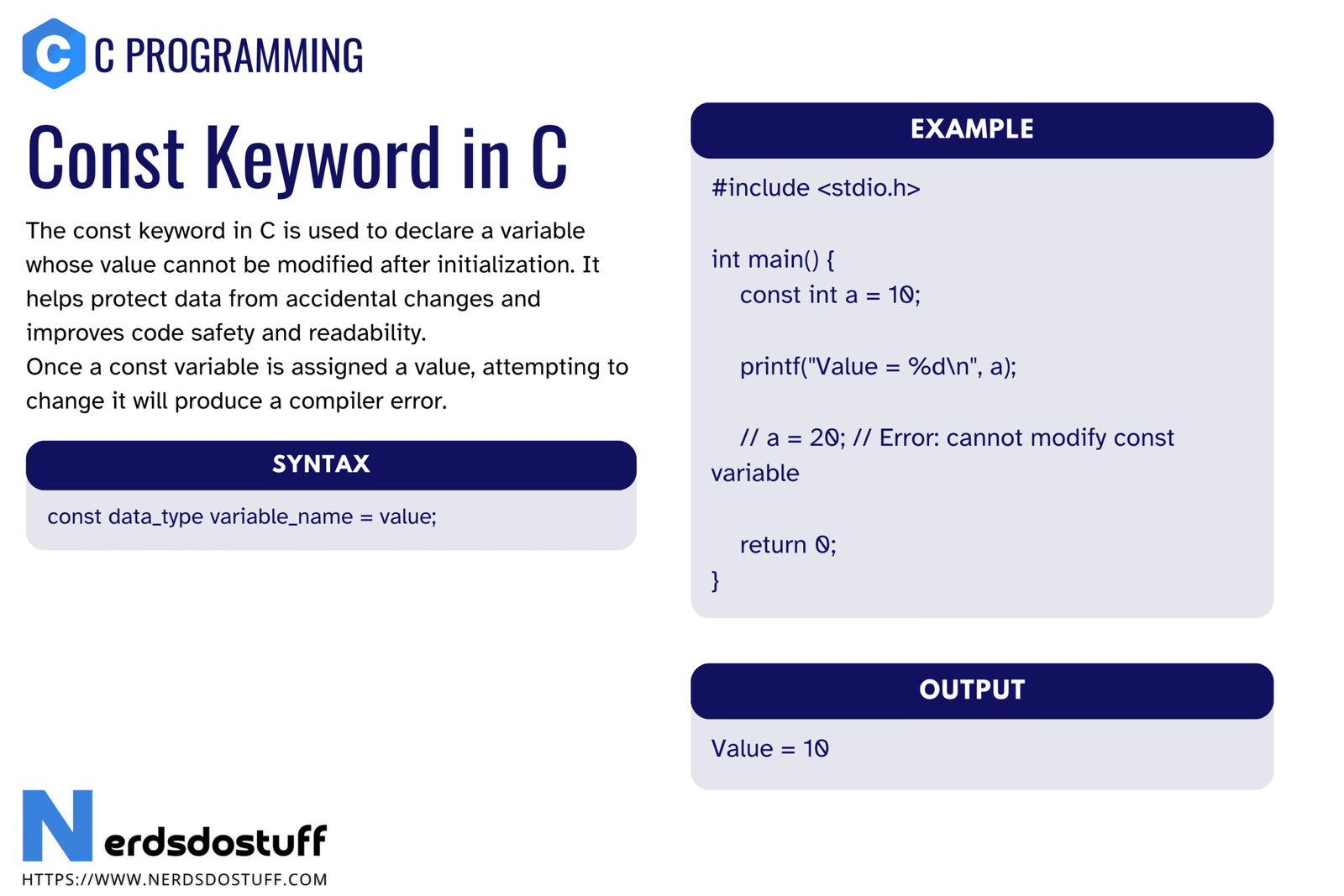
Const keyword in C is used to tell the compiler that a value should not be modified through a particular variable, pointer, or reference form in the code. It is one of the most useful type qualifiers in C because it helps prevent accidental changes, improves code clarity, and makes program intent easier to understand.
The const keyword appears in many places in C, including normal variables, pointer declarations, function parameters, and read-only data. But many beginners get confused when const is combined with pointers. In this article, we will understand the const keyword in C, its syntax, common forms, pointer cases, practical uses, mistakes, and best practices.
What is Const Keyword in C?
The const keyword in C is a type qualifier that tells the compiler that a value should not be modified through that declaration.
constin C means read-only through that name, not magical permanent protection for all possible access paths.
This is an important nuance. The keyword mainly controls what the current program code is allowed to do through that declared object or pointer form.
Syntax of Const Keyword in C
The keyword is usually written before the type name.
const int x = 10;
const float pi = 3.14f;
const char grade = 'A';
You can also see forms where const appears after the base type. In many simple declarations, both styles mean the same thing.
Const Variable in C
A const variable is a variable whose value should not be changed after initialization through that variable name.
#include <stdio.h>
int main(void)
{
    const int x = 10;
    printf("%d\n", x);
    return 0;
}
If you try to write x = 20;, the compiler should report an error because x is read-only.
Why Const Keyword is Used in C
- to prevent accidental modification of important values
- to make function parameters safer
- to express programmer intent clearly
- to protect read-only configuration values
- to improve maintainability in larger programs
In serious codebases, const is not just decoration. It is a design tool.
Const with Pointers in C
This is the area where many learners get confused. The const keyword can apply either to the pointed data or to the pointer itself.
Pointer to Const in C
A pointer to const means the pointer can point somewhere else, but the value being pointed to should not be modified through that pointer.
const int *ptr;Meaning:
*ptrshould not be modified throughptrptritself can point to another address
Const Pointer in C
A const pointer means the pointer itself cannot be changed after initialization, but the pointed value may still be modifiable if it is not const.
int * const ptr = &x;Meaning:
ptrcannot point to another address*ptrmay be modified if the target value is not const
Const Pointer to Const in C
This form makes both the pointer and the pointed value read-only through that declaration.
const int * const ptr = &x;| Declaration | Meaning |
|---|---|
const int *ptr | Pointer to const int |
int * const ptr | Const pointer to int |
const int * const ptr | Const pointer to const int |
Const with Function Parameters in C
const is very useful in function parameters, especially when passing pointers. It tells both the compiler and the reader that the function should not modify the input data through that parameter.
void showValue(const int *ptr)
{
    printf("%d\n", *ptr);
}
This is common in APIs where data should be read but not changed.
Const with Strings in C
String literals should usually be treated as read-only. That is why declarations like the following are common:
const char *message = "Hello";This expresses the correct intent more clearly than treating the literal as writable data.
Const vs #define in C
Both const and #define can be used for fixed-looking values, but they are not the same.
| Feature | const | #define |
|---|---|---|
| Type awareness | Yes | No |
| Compiler checking | Better | Limited macro substitution |
| Debug visibility | Usually better | Often less clear |
| Main nature | Typed object or qualified data | Preprocessor replacement |
For many fixed values, const gives clearer and safer code than a raw macro.
Const Does Not Always Mean Fully Immutable Data
This is another subtle point. In C, const means the program should not modify the value through that declaration. It does not automatically guarantee that the underlying memory can never change by any other route.
So the keyword is powerful, but it should still be understood correctly.
Common Mistakes with Const Keyword in C
- mixing up pointer-to-const and const-pointer forms
- using
consttoo little in function parameters - thinking
constand#defineare identical - assuming
constmeans global immutability in every situation - casting away
constcarelessly
| Mistake | Problem | Better Practice |
|---|---|---|
| Confusing pointer forms | Wrong read/write assumptions | Read declarations carefully from right to left when needed |
| Skipping const in APIs | Unclear design and accidental modification risk | Use const for read-only inputs |
| Casting away const without reason | Undefined or unsafe behavior risk | Avoid unless you fully control the underlying data |
Best Practices for Const Keyword in C
- Use
constfor values that should not be modified. - Use it in function parameters to protect input data.
- Be especially careful when reading const pointer declarations.
- Prefer
const char *for string literals. - Use
constto express intent clearly in APIs and internal code.
FAQs
What is const keyword in C?
The const keyword in C is a type qualifier that marks data as read-only through that declaration.
What is the difference between const int *ptr and int * const ptr?
const int *ptr is a pointer to const data, while int * const ptr is a const pointer to modifiable data.
Why is const used in function parameters in C?
It is used to show that the function should not modify the input data through that parameter.
Is const the same as #define in C?
No. const is type-aware and belongs to the language type system, while #define is a preprocessor replacement mechanism.
Can const be used with pointers in C?
Yes. It can qualify the pointed data, the pointer itself, or both.
Can const and volatile be used together in C?
Yes. This can be useful when data should not be modified by the program through that name but may still change externally.
Continue learning C in order
Follow the topic sequence with the previous and next lesson.