
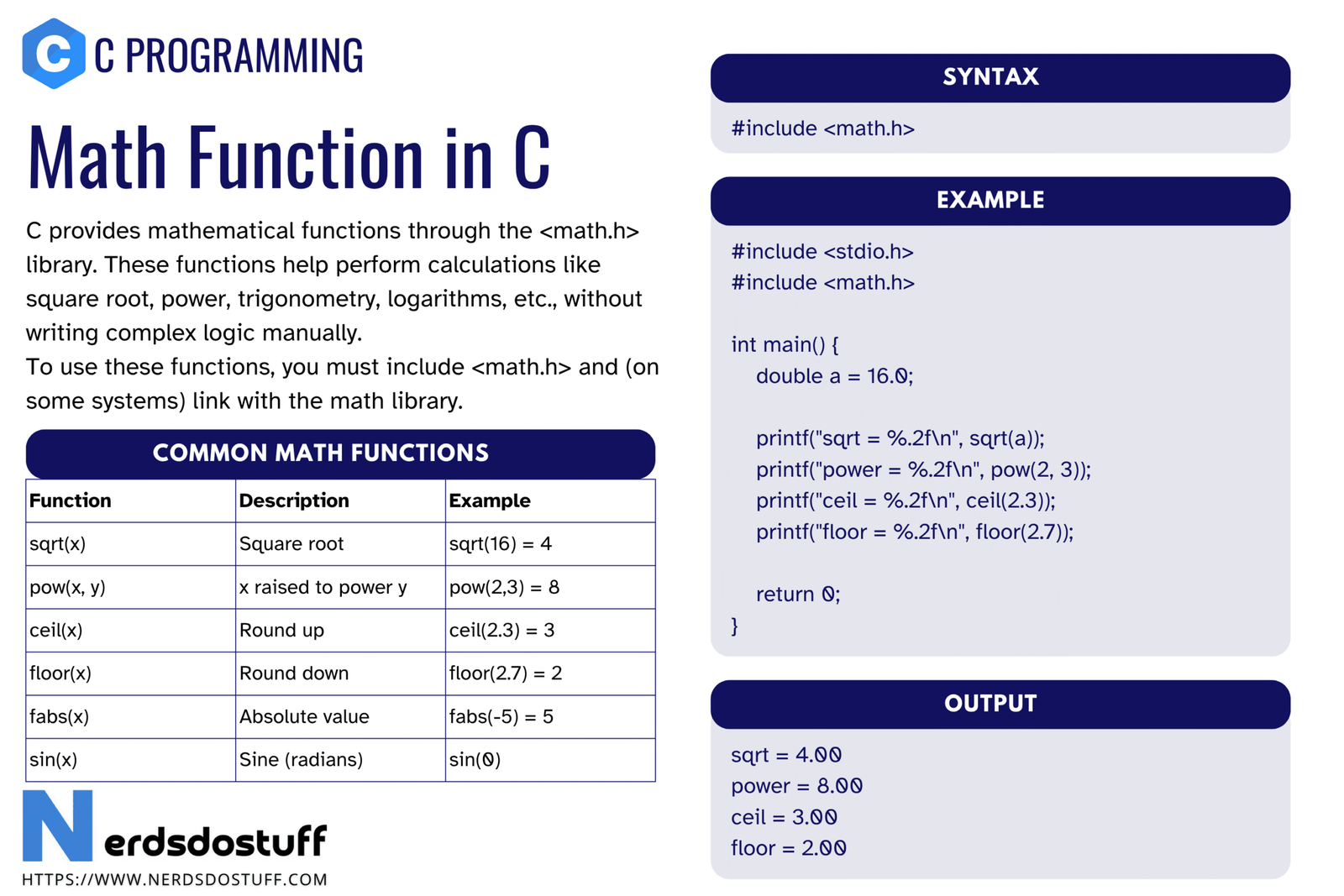
Math function in C means the predefined library functions used for mathematical calculations such as square root, power, absolute value, trigonometric operations, rounding, logarithms, and exponentials. C already provides arithmetic operators like +, -, *, and /, but many useful mathematical operations need dedicated library functions.
These functions are mostly available through the math.h header file. They are useful in scientific programs, geometry calculations, embedded applications, graphics, simulations, and general numerical processing. In this article, we will understand the main math functions in C, their syntax, examples, common categories, and common mistakes.
What are Math Functions in C?
Math functions in C are predefined library functions used to perform mathematical calculations that go beyond simple arithmetic operators.
Most of these functions are declared in:
#include <math.h>Math functions in C help perform advanced calculations such as power, square root, trigonometry, rounding, and logarithms.
Why Math Functions are Needed in C
- to calculate square roots and powers
- to work with angles and trigonometric operations
- to round values up or down
- to find absolute values
- to perform logarithmic and exponential calculations
Important Math Functions in C
| Function | Use |
|---|---|
sqrt() | Square root |
pow() | Power calculation |
fabs() | Absolute value of floating-point number |
ceil() | Rounds upward |
floor() | Rounds downward |
round() | Rounds to nearest integer value |
sin(), cos(), tan() | Trigonometric functions |
log(), log10() | Logarithmic functions |
exp() | Exponential function |
fmod() | Remainder of floating-point division |
sqrt() in C
sqrt() returns the square root of a number.
#include <stdio.h>
#include <math.h>
int main(void)
{
    double x = 25.0;
    printf("Square root = %.2f\n", sqrt(x));
    return 0;
}
The result here is 5.00.
pow() in C
pow(a, b) returns a raised to the power b.
double result = pow(2.0, 3.0);Here the result is 8.0.
fabs() in C
fabs() returns the absolute value of a floating-point number.
double value = fabs(-12.75);If you need absolute value for integers, abs() from stdlib.h is commonly used.
ceil(), floor(), and round() in C
These functions are used for rounding operations.
| Function | Meaning | Example Result for 4.6 |
|---|---|---|
ceil(4.6) | Rounds upward | 5.0 |
floor(4.6) | Rounds downward | 4.0 |
round(4.6) | Rounds to nearest | 5.0 |
printf("%.2f\n", ceil(4.6));
printf("%.2f\n", floor(4.6));
printf("%.2f\n", round(4.6));
sin(), cos(), and tan() in C
These functions are used for trigonometric calculations. Their arguments are usually in radians, not degrees.
double angle = 0.0;
printf("sin = %.2f\n", sin(angle));
printf("cos = %.2f\n", cos(angle));
printf("tan = %.2f\n", tan(angle));
If you have degrees, convert them to radians before using these functions.
radians = degrees * 3.141592653589793 / 180.0
log(), log10(), and exp() in C
log() gives the natural logarithm, log10() gives the base-10 logarithm, and exp() gives the exponential value.
printf("log = %.2f\n", log(10.0));
printf("log10 = %.2f\n", log10(100.0));
printf("exp = %.2f\n", exp(1.0));
These functions are commonly used in scientific and engineering applications.
fmod() in C
fmod() returns the remainder after floating-point division.
printf("%.2f\n", fmod(10.5, 3.0));This is useful when normal integer modulus is not enough.
Common Return Type Behavior of Math Functions in C
Many math functions in C work with and return double values by default. Even if you pass integers, the result is often treated as a floating-point value.
This is why output formatting often uses %f or %.2f.
Compiling Programs with math.h in C
On many systems using GCC, math functions require linking with the math library.
Example command:
gcc program.c -lmIf -lm is missing on such systems, linker errors may appear for functions like sqrt() and pow().
Common Mistakes with Math Functions in C
- forgetting to include
math.h - forgetting
-lmduring compilation on some systems - assuming trigonometric functions use degrees instead of radians
- expecting integer return values from floating-point functions
- using negative input where the operation is not defined in normal real numbers
| Mistake | Problem | Better Practice |
|---|---|---|
No #include <math.h> | Function declarations may be missing | Include the correct header |
No -lm where needed | Linker error | Link math library properly |
Passing degree values directly to sin() | Unexpected result | Convert degrees to radians first |
Best Practices for Math Functions in C
- Include
math.hwhenever using standard math functions. - Use the correct format specifier for floating-point output.
- Check the expected domain of the function before using it.
- Remember that many results are
doublevalues. - Compile with the math library when required by your toolchain.
FAQs
Which header file is used for math functions in C?
The math.h header file is used for standard math functions in C.
What does sqrt() do in C?
sqrt() returns the square root of a number.
Why is -lm used while compiling math programs in C?
It links the program with the math library on systems where math functions are stored separately.
What is the difference between ceil() and floor() in C?
ceil() rounds upward, while floor() rounds downward.
Do sin() and cos() use degrees in C?
No. They usually use radians.
What does pow() do in C?
pow() returns the value of one number raised to the power of another.
Continue learning C in order
Follow the topic sequence with the previous and next lesson.