
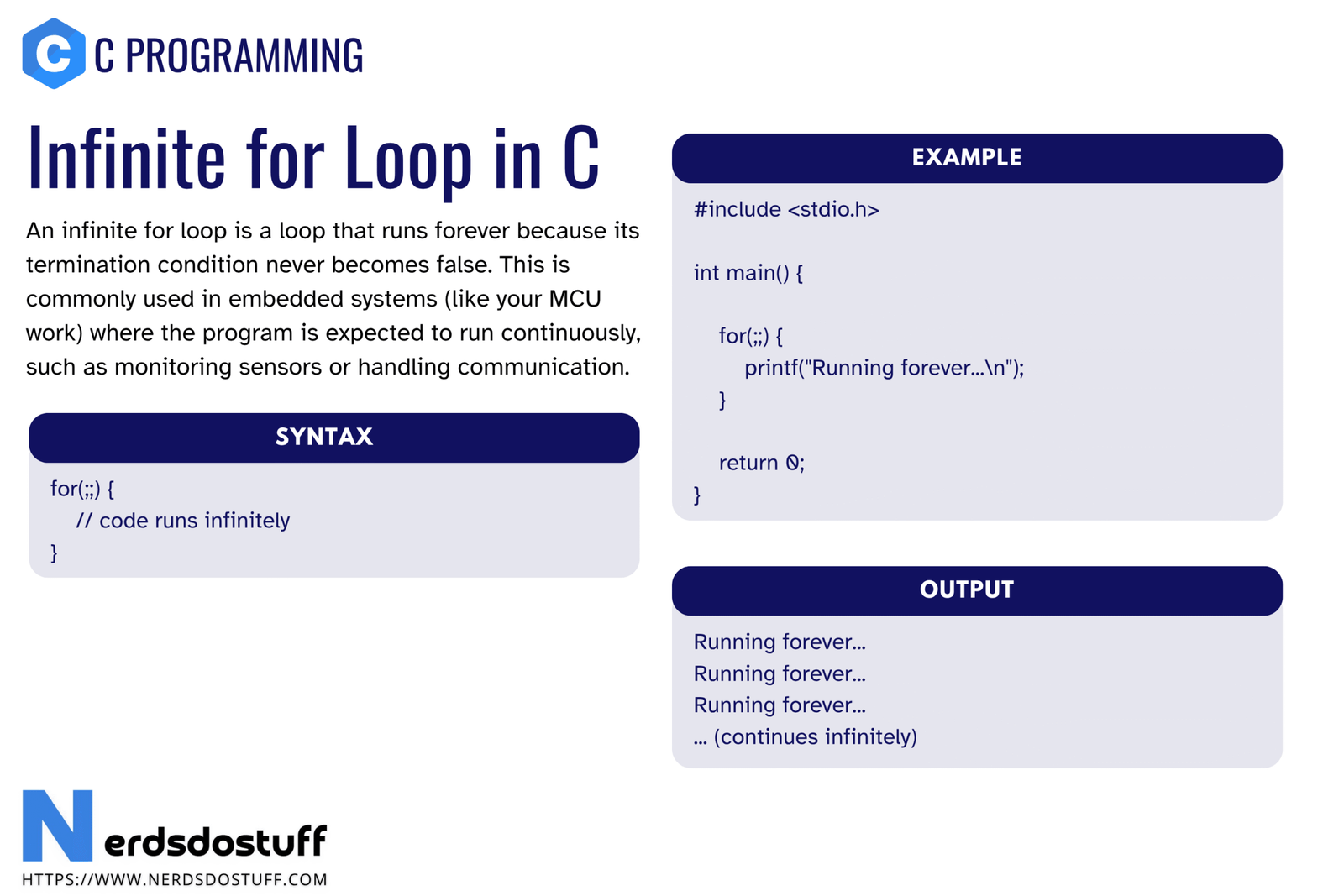
An infinite for loop in C is a for loop that does not stop by itself because its stopping condition never becomes false, or because no stopping condition is written at all. Sometimes this is a programming mistake. Sometimes it is fully intentional and useful, especially in embedded systems, operating loops, event polling, or continuously running services.
Beginners usually first meet infinite loops as bugs, often caused by a wrong condition or a missing update. But infinite loops are not always bad. The important point is whether the loop is controlled intentionally or created accidentally. In this article, we will understand what an infinite for loop in C is, how it is formed, where it is useful, how accidental infinite loops happen, and the mistakes beginners should avoid.
What is Infinite for Loop in C?
An infinite for loop in C is a for loop that keeps executing forever unless the program is stopped from outside or unless a statement such as break, return, or some external event ends the repetition.
for (;;)
{
    /* repeated task */
}
This is the most common and direct form of an intentional infinite for loop in C.
An infinite loop is not automatically wrong. It is wrong only when it is unintended or uncontrolled.
How Infinite for Loop Happens in C
A for loop becomes infinite when the condition never becomes false or when the loop is written without a terminating condition.
| Case | Why loop never ends |
|---|---|
for (;;) | No stopping condition is provided |
| Condition always true | The condition never becomes false |
| Update missing or wrong | The loop variable never moves toward termination |
| Logic mistake | The stopping rule is incorrect |
So the root cause is always the same: the loop has no valid path to termination under normal execution.
Syntax of Infinite for Loop in C
The most common syntax is:
for (;;)
{
    statements;
}
This looks unusual to beginners, but it is valid C. The initialization, condition, and update fields are all omitted, so the loop keeps repeating without any built-in stopping rule.
Example of Intentional Infinite for Loop in C
Here is a simple example:
#include <stdio.h>
int main(void)
{
    for (;;)
    {
        printf("Running...\n");
    }
    return 0;
}
This will keep printing Running... continuously until the program is stopped.
This type of loop may be useful in special systems, but as written here it would flood the output, so in real programs some control logic is usually added inside.
Infinite for Loop with a Condition That is Always True
An infinite loop does not have to use the empty for (;;) form. It can also happen when the condition never becomes false.
for (int i = 1; i > 0; i++)
{
    printf("%d\n", i);
}
At first glance, this looks normal, but if the condition keeps staying true for the valid range of the type during execution, the loop can continue for a very long time or behave unexpectedly depending on overflow and environment. It is not a good design.
Infinite for Loop Caused by Missing Update
A loop can also become infinite when the update expression is missing or when the loop variable is not changed properly.
int i;
for (i = 1; i <= 5; )
{
    printf("%d\n", i);
}
Here, the condition i <= 5 stays true because i never changes. That makes the loop infinite.
Infinite for Loop with Break in C
Many intentional infinite loops are written with a control statement inside the loop body so they can stop when a certain condition is met.
#include <stdio.h>
int main(void)
{
    int i = 1;
    for (;;)
    {
        printf("%d\n", i);
        if (i == 5)
            break;
        i++;
    }
    return 0;
}
This loop is infinite by structure, but it becomes controlled because the break statement gives it a defined exit point.
| Loop Form | Behavior |
|---|---|
| Uncontrolled infinite loop | Runs forever with no internal stop |
| Controlled infinite loop | Runs until a break or return condition is met |
Where Infinite for Loop is Used in C
Intentional infinite loops are often used in special kinds of programs:
- embedded firmware main loops
- event polling systems
- continuous monitoring programs
- menu systems waiting for user actions
- servers or repeated service loops
In embedded programming, for example, a device may need to keep running forever while reading sensors, checking inputs, and updating outputs.
Risks of Accidental Infinite for Loop
When an infinite loop is unintentional, it can cause serious problems.
- program hangs or never finishes
- high CPU usage
- massive output flooding
- battery or power waste in embedded systems
- unresponsive software behavior
That is why loop boundaries and update logic should always be checked carefully when debugging C programs.
How to Avoid Accidental Infinite for Loop in C
- Verify that the condition can actually become false.
- Check that the loop variable changes in the correct direction.
- Review boundary conditions such as
<versus<=. - Use print statements or a debugger if the loop seems stuck.
- Keep the loop logic simple when possible.
Many accidental infinite loops are small logic mistakes, not deep programming problems. Careful review usually reveals the issue.
Common Mistakes with Infinite for Loop in C
- forgetting the update step
- writing a condition that never becomes false
- using an infinite loop without any exit strategy when one is needed
- flooding output inside a fast infinite loop
- not understanding whether the loop is intentional or accidental
| Mistake | Why it is wrong | Better approach |
|---|---|---|
| Missing update | Loop variable never changes | Check the update expression carefully |
| No break when one is needed | Loop never exits under program logic | Add a proper stop condition inside the loop |
| Heavy work inside endless loop | Can waste CPU or system resources | Control the workload and exit logic intentionally |
The important beginner lesson is simple: every loop should have a reason for ending, unless you intentionally want it to run forever.
Best Practices for Infinite for Loop in C
- Use
for (;;)only when endless execution is truly intended. - Add a clear internal control path if the loop should stop under some condition.
- Be careful with output or heavy processing inside an infinite loop.
- Document the purpose of an intentional infinite loop in important code.
- Review loop logic carefully when debugging hangs.
Intentional infinite loops should be deliberate and controlled. Accidental infinite loops should be fixed quickly because they usually signal flawed logic.
FAQs
What is infinite for loop in C?
An infinite for loop in C is a for loop that keeps running indefinitely because its stopping condition never becomes false or no stopping condition is written.
How do you write an infinite for loop in C?
The common form is for (;;), which creates a loop with no initialization, condition, or update in the header.
Can an infinite for loop be useful in C?
Yes. It can be useful in embedded systems, continuous monitoring, menu systems, and other programs that are meant to keep running.
How do I stop an infinite for loop in C?
You can stop it by using a statement such as break, return, or by stopping the program externally.
What is the most common cause of an accidental infinite for loop in C?
A very common cause is forgetting to update the loop variable or writing a condition that never becomes false.
Continue learning C in order
Follow the topic sequence with the previous and next lesson.