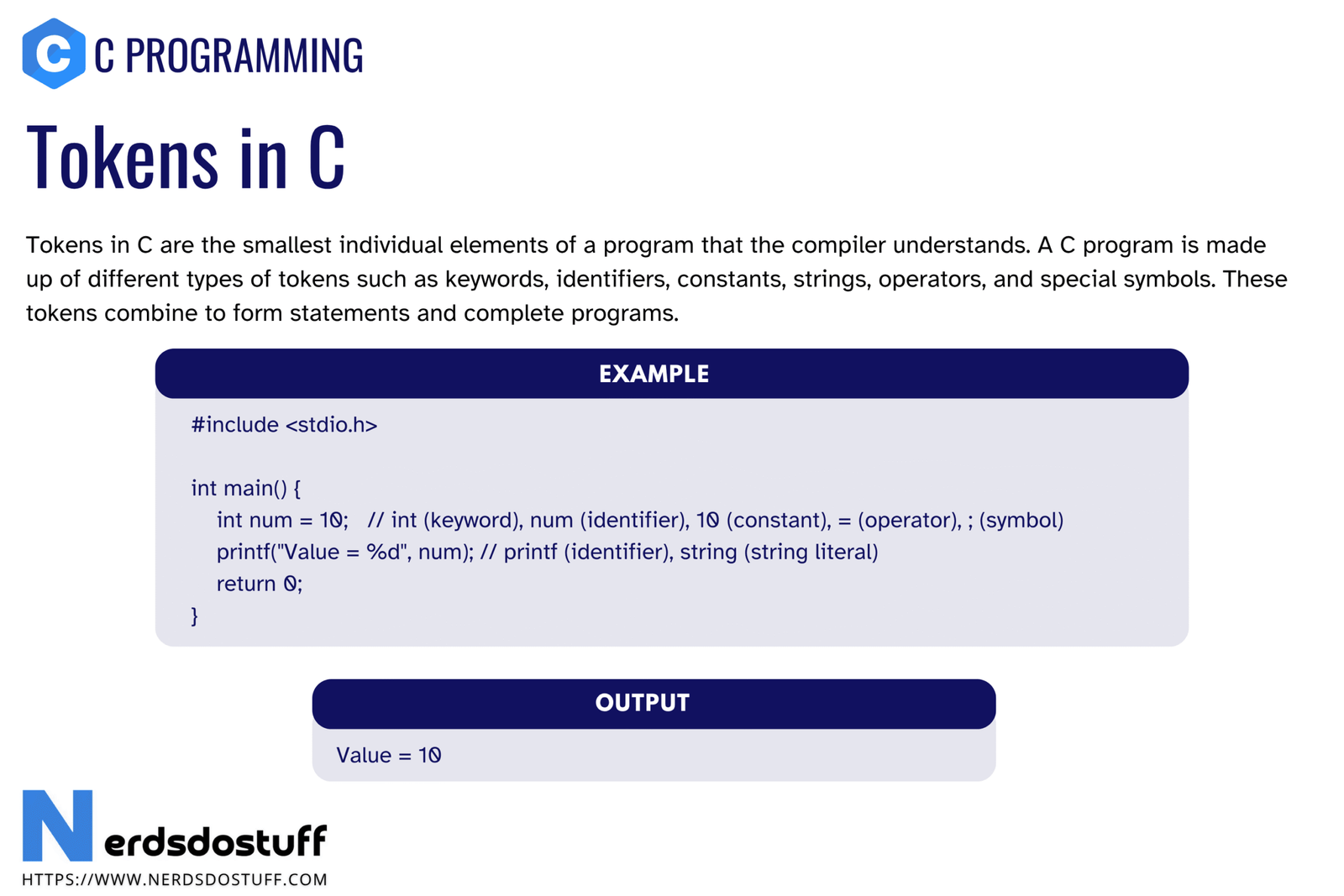
Tokens in C are the smallest individual units that the compiler recognizes while reading a program. Before the compiler understands the full meaning of a statement, it first breaks the source code into pieces such as keywords, identifiers, constants, strings, operators, and symbols. Those pieces are called tokens.
This topic is important because tokens form the lexical foundation of the C language. If you understand tokens properly, many later topics become easier, including keywords, identifiers, operators, constants, expressions, syntax, and even compiler errors. In this article, we will understand what tokens in C are, the main types of tokens, how a statement is broken into tokens, the difference between practical and formal classification, and the mistakes beginners should avoid.
What are Tokens in C?
A token in C is the smallest meaningful element of a program that the compiler can recognize. When a C source file is processed, the compiler does not read the whole program as one giant text block. It separates the code into tokens and then analyzes how those tokens fit together.
For example, look at this statement:
int sum = a + 10;This line is not treated as one single unit. It is divided into tokens such as int, sum, =, a, +, 10, and ;.
Tokens are the lexical building blocks of a C program.
Why Tokens are Important in C
- They help explain how the compiler reads source code.
- They form the base for understanding syntax.
- They make it easier to classify parts of a statement.
- They help beginners distinguish keywords, identifiers, constants, and operators.
- They are useful when reading compiler errors and debugging code.
Many beginner mistakes come from not knowing what part of the code is acting as what. Tokens solve that confusion because they force you to see a line of C as a set of separate meaningful pieces.
Types of Tokens in C
In beginner-friendly C programming, tokens are usually divided into the following categories:
- Keywords
- Identifiers
- Constants
- String literals
- Operators
- Special symbols or separators
In formal language terminology, operators and many symbols are often grouped under punctuators. But in educational explanations, separating them makes the concept easier to understand.
| Token Type | Examples | Purpose |
|---|---|---|
| Keyword | int, if, return | Reserved words with fixed meaning |
| Identifier | sum, count, main | User-defined names |
| Constant | 10, 3.14, 'A' | Fixed values |
| String literal | "Hello" | Sequence of characters in double quotes |
| Operator | +, =, && | Performs operations |
| Special symbol | ;, (), {}, , | Defines structure and separation |
Keywords as Tokens in C
Keywords are reserved words that already have a fixed meaning in the language. You cannot use them as ordinary variable names.
int value;
if (value > 0)
{
    return 1;
}
In this code, int, if, and return are keywords. They are tokens recognized by the compiler with fixed roles.
Identifiers as Tokens in C
Identifiers are names created by the programmer for variables, functions, arrays, structures, and other user-defined elements.
int total_marks;
float average_value;
void print_result(void);
Here, total_marks, average_value, and print_result are identifiers. They are tokens too, but unlike keywords, they are chosen by the programmer.
Constants as Tokens in C
Constants are fixed values that appear directly in the program. Integer values, floating values, and character constants all act as tokens.
| Constant | Type |
|---|---|
25 | Integer constant |
9.81 | Floating constant |
'X' | Character constant |
These are tokens because the compiler recognizes each one as a distinct valid language element.
String Literals as Tokens in C
A string literal is a sequence of characters inside double quotes. The compiler treats the entire quoted string as one token.
printf("Hello, World!");In this statement, printf is an identifier, ( and ) are symbols, ; is a separator, and "Hello, World!" is one string-literal token.
Operators as Tokens in C
Operators perform actions such as assignment, arithmetic, comparison, and logical evaluation. Each operator is also treated as a token.
| Operator | Role |
|---|---|
= | Assignment |
+ | Addition |
- | Subtraction |
== | Equality comparison |
&& | Logical AND |
Even when two symbols combine, such as == or &&, they are treated as one complete token, not two separate ones.
Special Symbols and Separators as Tokens in C
C also uses symbols such as parentheses, braces, commas, and semicolons. These symbols help define the structure of the program, and they are treated as tokens too.
;ends a statement()are used in function calls and conditions{}define blocks,separates items[]are used with arrays
In more formal descriptions of C, many of these are called punctuators.
Example of Breaking a Statement into Tokens
Consider the following statement:
int total = marks + 5;| Part | Token Type |
|---|---|
int | Keyword |
total | Identifier |
= | Operator |
marks | Identifier |
+ | Operator |
5 | Constant |
; | Special symbol / separator |
This kind of breakdown is the easiest way to understand tokens in practice.
Are Comments and Spaces Tokens in C?
Beginners often ask whether spaces, tabs, and comments are tokens. In normal educational explanation, the answer is no. They help separate code or improve readability, but they are not counted as meaningful program tokens in the same way as identifiers or operators.
Whitespace is mainly used to separate tokens so the compiler can read them properly. Comments are removed before actual compilation stages that analyze the program structure.
Difference Between Tokens and Statements in C
| Concept | Meaning | Example |
|---|---|---|
| Token | Smallest meaningful unit | int, =, 5 |
| Statement | Complete instruction made of tokens | int x = 5; |
So a statement is built from multiple tokens. Tokens are the parts. A statement is the full instruction.
Common Mistakes with Tokens in C
- Thinking a full statement is one token
- Confusing identifiers with keywords
- Thinking every visible character is automatically a token
- Splitting multi-character operators like
==into two separate operators - Forgetting that a complete string literal counts as one token
| Mistake | Why it is wrong | Correct view |
|---|---|---|
if used as variable name | if is a keyword | Keywords are reserved tokens |
== treated as two = symbols | The compiler reads it as one operator token | Multi-character operators are single tokens |
"Hello" treated as many tokens | The string literal is one token | The quoted text is a single token unit |
The best way to avoid confusion is to take one statement and classify each piece step by step.
Best Practices for Learning Tokens in C
- Break simple statements into parts and name each token type.
- Study keywords, identifiers, constants, and operators separately.
- Remember that operators and symbols may be described more formally as punctuators.
- Use compiler errors as clues to understand which token is being misused.
- Practice with declarations, expressions, and function calls.
Once tokens become clear, many grammar-related topics in C become much easier to understand.
FAQs
What are tokens in C?
Tokens in C are the smallest meaningful elements of a C program recognized by the compiler.
How many types of tokens are there in C?
In beginner-level classification, tokens in C are commonly grouped as keywords, identifiers, constants, string literals, operators, and special symbols or separators.
Is a keyword a token in C?
Yes. Keywords are one of the main token categories in C.
Are comments tokens in C?
In normal beginner explanation, no. Comments help readability but are not treated as meaningful program tokens like identifiers or operators.
What is the difference between tokens and statements in C?
A token is a smallest meaningful unit, while a statement is a complete instruction built from multiple tokens.
Continue learning C in order
Follow the topic sequence with the previous and next lesson.