
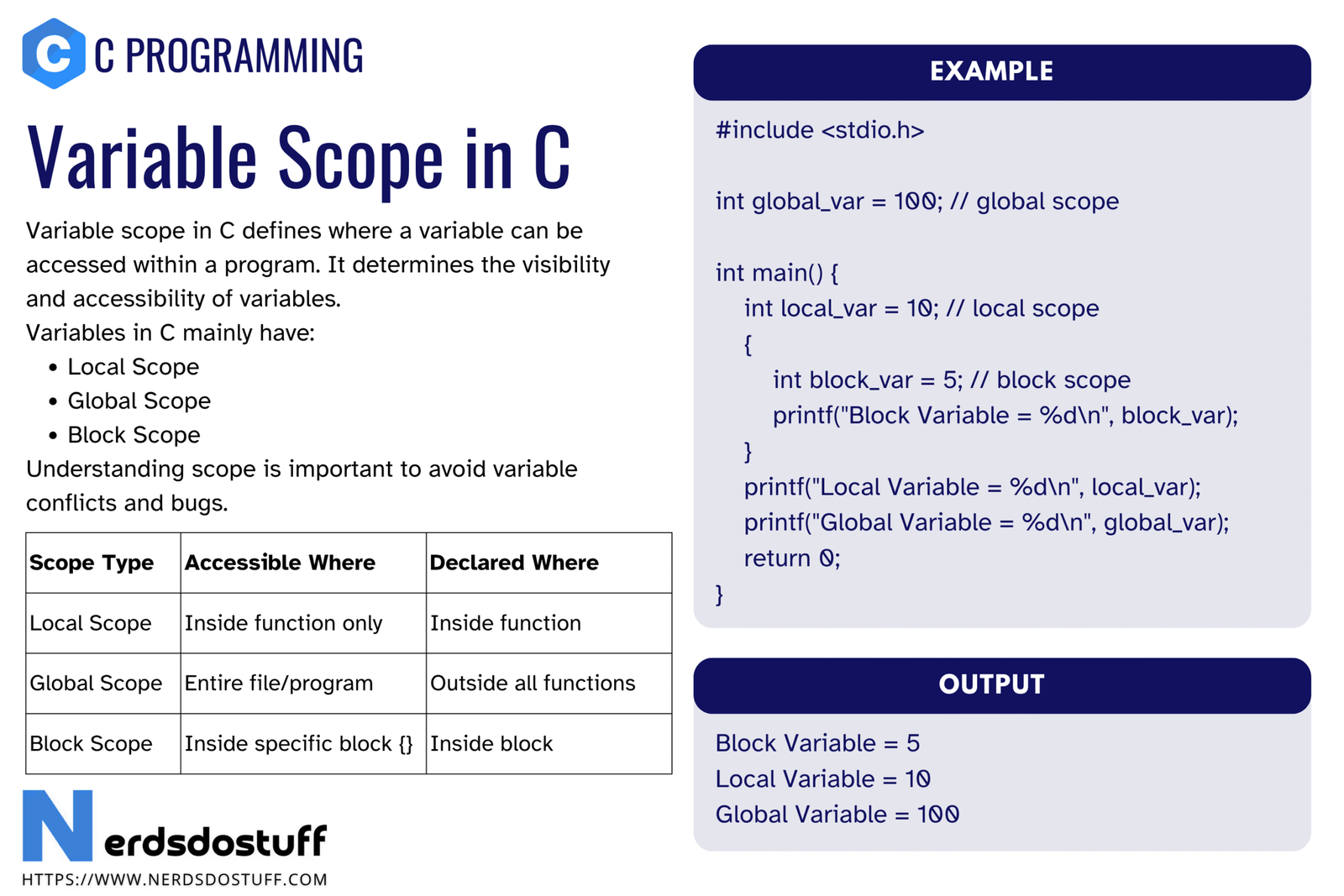
Variable scope in C tells us where a variable can be accessed in a program. This is one of the most important basic concepts in C because a variable is not automatically visible everywhere. Its location of declaration decides where it can be used, and misunderstanding scope often causes compiler errors, hidden bugs, and confusing code.
Scope is closely connected to program structure, functions, blocks, and variable lifetime. If you understand it properly, you can write cleaner and safer C programs. In this article, we will understand variable scope in C, its types, examples, differences, and common mistakes.
What is Variable Scope in C?
Variable scope in C is the region of the program where a variable name is visible and can be accessed.
Scope decides where a variable can be used. It does not by itself decide how long the variable exists in memory.
This point is important because many beginners confuse scope with lifetime. A variable may exist in memory for a certain duration, but still not be accessible everywhere in the program.
Types of Variable Scope in C
The main types of variable scope in C are:
- local scope
- block scope
- global scope
- function scope
Local Scope in C
A local variable is declared inside a function, and it can be accessed only inside that function.
#include <stdio.h>
int main(void) {
    int x = 10;
    printf("x = %d\n", x);
    return 0;
}
Here x is local to main. It cannot be accessed directly from another function.
Local variables are useful because they keep data limited to the function that actually needs it.
Block Scope in C
A block in C means any section of code inside curly braces { }. A variable declared inside a block is accessible only within that block.
#include <stdio.h>
int main(void) {
    if (1) {
        int y = 20;
        printf("y = %d\n", y);
    }
    return 0;
}
Here y exists only inside the if block. Trying to use it outside that block causes an error.
Block scope is common in loops, conditionals, and nested code sections.
Global Scope in C
A global variable is declared outside all functions. It can be accessed by all functions that are in the same file after proper declaration rules are satisfied.
#include <stdio.h>
int count = 100;
void show(void) {
    printf("count = %d\n", count);
}
int main(void) {
    show();
    printf("count = %d\n", count);
    return 0;
}
Here count has global scope, so both show and main can use it.
Global variables are convenient, but too many of them can make programs harder to understand and maintain.
Function Scope in C
Function scope in C is different from variable scope. It mainly applies to labels used with the goto statement. A label is visible throughout the function in which it appears.
#include <stdio.h>
int main(void) {
    goto message;
message:
    printf("Label has function scope\n");
    return 0;
}
Labels are not variables, but they are an important part of the scope rules in C.
Variable Scope vs Lifetime in C
Scope and lifetime are related, but they are not the same.
| Concept | Meaning |
|---|---|
| Scope | Where the variable name can be accessed in code |
| Lifetime | How long the variable exists in memory during program execution |
For example, a local variable normally has scope only inside one function, and its lifetime usually ends when that function returns. A global variable has wider visibility and usually exists for the full program execution.
Variable Shadowing in C
Variable shadowing happens when a variable declared in an inner scope has the same name as a variable in an outer scope. The inner variable temporarily hides the outer one inside that block.
#include <stdio.h>
int x = 50;
int main(void) {
    int x = 10;
    printf("x = %d\n", x);
    return 0;
}
Inside main, the local x hides the global x. This is legal in C, but it can make code confusing if overused.
Common Mistakes in Variable Scope in C
- trying to access a local variable outside its function
- trying to use a block variable outside the block
- confusing scope with lifetime
- using too many global variables
- creating shadowed variable names that reduce clarity
These mistakes often lead to compile-time errors or logic problems that are hard to notice at first.
Best Practices for Variable Scope in C
- keep variables in the smallest scope that makes sense
- prefer local variables when possible
- use global variables only when they are genuinely needed
- avoid unnecessary shadowing
- choose clear variable names so scope-related bugs are easier to spot
- organize functions so data flow stays simple
FAQs
What is variable scope in C?
Variable scope in C is the part of the program where a variable can be accessed by its name.
What is the difference between local and global scope in C?
A local variable is accessible only inside the function or block where it is declared, while a global variable is declared outside functions and can be accessed more widely.
Can a block variable be used outside the block in C?
No. A variable declared inside a block can only be used within that block.
What is variable shadowing in C?
Variable shadowing happens when an inner-scope variable has the same name as an outer-scope variable, causing the inner one to hide the outer one within that scope.
Continue learning C in order
Follow the topic sequence with the previous and next lesson.