
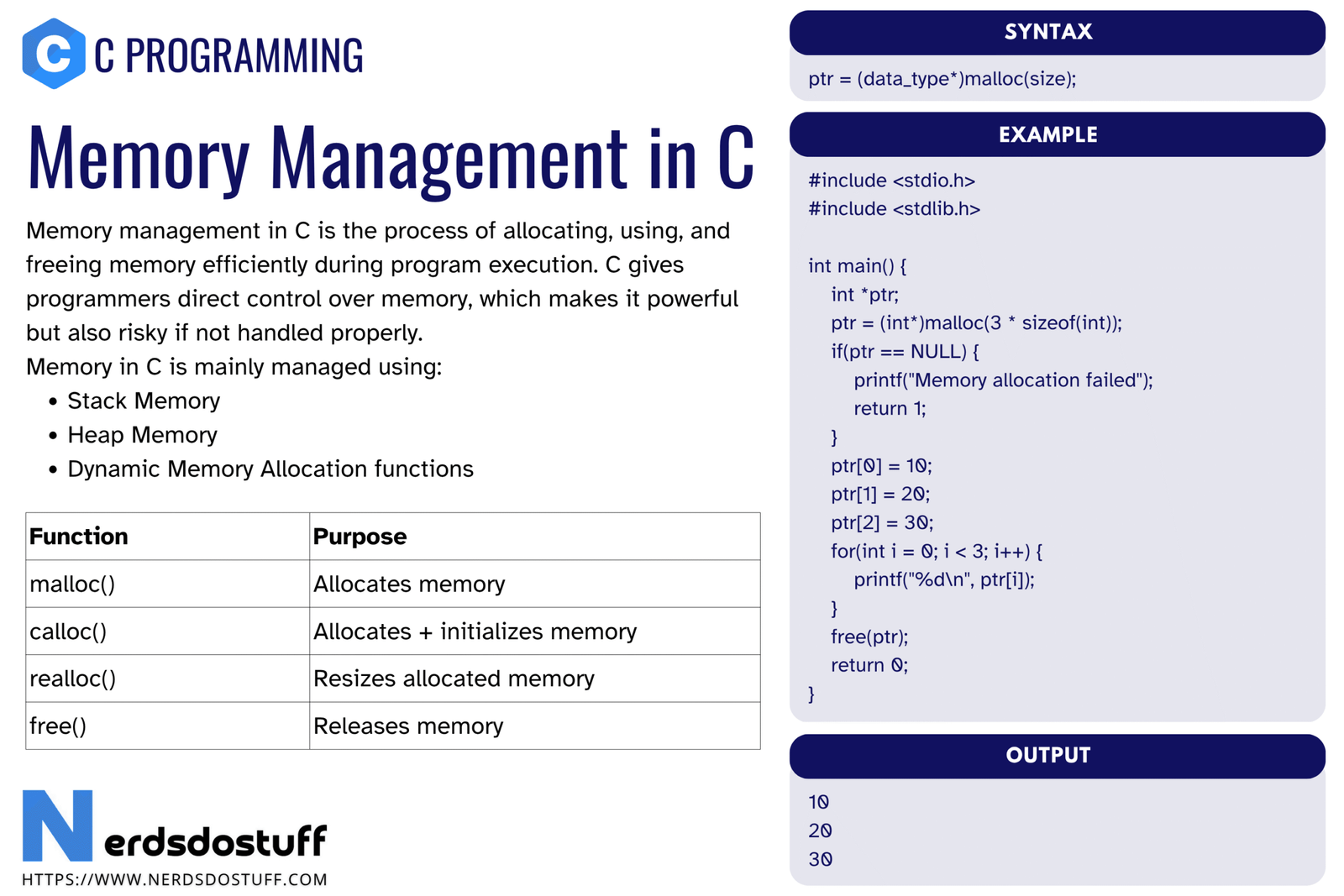
Memory management functions in C are used when a program needs memory during runtime instead of at compile time. This is one of the most important low-level topics in C because real programs often do not know in advance how much memory they will need. User input, file size, data packets, linked lists, dynamic arrays, and many other situations require memory to be requested and released while the program is running.
C gives direct control over dynamic memory through standard library functions. That control is powerful, but it also means the programmer is responsible for using memory correctly. If memory is allocated and not released, the program leaks memory. If released memory is used again, the program can behave unpredictably. In this article, we will understand the memory management functions in C, their syntax, examples, mistakes, and best practices.
What Are Memory Management Functions in C?
Memory management functions in C are standard library functions used to allocate, resize, initialize, and free memory dynamically.
The four main memory management functions in C are
malloc(),calloc(),realloc(), andfree().
These functions work with the heap, which is the area of memory used for dynamic allocation.
malloc()allocates a block of memorycalloc()allocates memory for multiple elements and initializes it to zerorealloc()changes the size of an existing memory blockfree()releases dynamically allocated memory
Why Dynamic Memory Management is Needed in C
Static variables and fixed-size arrays are useful, but they do not fit every problem. Many programs only know the required amount of memory after the program has started.
- reading an unknown number of values from a file
- creating linked lists, queues, trees, and graphs
- building dynamic strings and buffers
- resizing arrays based on user input
- writing memory-efficient embedded or system software
Without dynamic memory management, programs would need large fixed buffers everywhere, which wastes memory and reduces flexibility.
Header File for Memory Management Functions in C
The memory management functions are declared in the stdlib.h header file.
#include <stdlib.h>If this header is missing, the program may compile with warnings or errors depending on the compiler settings.
malloc in C
malloc stands for memory allocation. It allocates a block of memory of the requested size and returns a pointer to the first byte of that block.
Syntax:
ptr = (type *)malloc(number_of_bytes);Important point: memory returned by malloc is not initialized. It contains whatever bytes were already present in that memory area.
Example:
#include <stdio.h>
#include <stdlib.h>
int main(void) {
    int *arr;
    int n = 5;
    arr = malloc(n * sizeof(int));
    if (arr == NULL) {
        printf("Memory allocation failed\n");
        return 1;
    }
    for (int i = 0; i < n; i++) {
        arr[i] = (i + 1) * 10;
    }
    for (int i = 0; i < n; i++) {
        printf("%d ", arr[i]);
    }
    free(arr);
    return 0;
}
This allocates memory for 5 integers on the heap. The array is then filled manually before use.
calloc in C
calloc stands for contiguous allocation. It allocates memory for multiple elements, and unlike malloc, it initializes all allocated bytes to zero.
Syntax:
ptr = (type *)calloc(number_of_elements, size_of_each_element);Example:
#include <stdio.h>
#include <stdlib.h>
int main(void) {
    int *arr;
    int n = 5;
    arr = calloc(n, sizeof(int));
    if (arr == NULL) {
        printf("Memory allocation failed\n");
        return 1;
    }
    for (int i = 0; i < n; i++) {
        printf("%d ", arr[i]);
    }
    free(arr);
    return 0;
}
Here the array elements start as zero because calloc clears the allocated memory.
Difference Between malloc and calloc in C
| Feature | malloc | calloc |
|---|---|---|
| Arguments | Takes total bytes as one argument | Takes element count and element size as two arguments |
| Initialization | Does not initialize memory | Initializes memory to zero |
| Use case | Useful when values will be assigned immediately | Useful when zero-initialized memory is needed |
realloc in C
realloc is used to change the size of previously allocated memory. It can increase or decrease the memory block size.
Syntax:
ptr = (type *)realloc(ptr, new_size_in_bytes);realloc may keep the memory in the same location or may move it to a new location. That is why the return value must always be handled carefully.
Example:
#include <stdio.h>
#include <stdlib.h>
int main(void) {
    int *arr;
    int n = 3;
    arr = malloc(n * sizeof(int));
    if (arr == NULL) {
        return 1;
    }
    for (int i = 0; i < n; i++) {
        arr[i] = i + 1;
    }
    n = 6;
    int *temp = realloc(arr, n * sizeof(int));
    if (temp == NULL) {
        free(arr);
        return 1;
    }
    arr = temp;
    for (int i = 3; i < n; i++) {
        arr[i] = (i + 1) * 10;
    }
    for (int i = 0; i < n; i++) {
        printf("%d ", arr[i]);
    }
    free(arr);
    return 0;
}
The temporary pointer is important. If realloc fails and returns NULL, the original pointer should not be lost.
free in C
free releases memory that was previously allocated by malloc, calloc, or realloc.
Syntax:
free(ptr);After calling free, that memory block no longer belongs to your program in a valid way. Using that pointer again without reassigning it is unsafe.
Safer pattern:
free(ptr);
ptr = NULL;
Setting the pointer to NULL after freeing it helps reduce accidental reuse.
Practical Example Using Memory Management Functions in C
The following example combines allocation, resizing, and freeing in one flow.
#include <stdio.h>
#include <stdlib.h>
int main(void) {
    int n;
    printf("Enter number of values: ");
    scanf("%d", &n);
    int *arr = calloc(n, sizeof(int));
    if (arr == NULL) {
        printf("Allocation failed\n");
        return 1;
    }
    for (int i = 0; i < n; i++) {
        arr[i] = i + 1;
    }
    int new_n = n + 2;
    int *temp = realloc(arr, new_n * sizeof(int));
    if (temp == NULL) {
        free(arr);
        printf("Resize failed\n");
        return 1;
    }
    arr = temp;
    for (int i = n; i < new_n; i++) {
        arr[i] = i + 1;
    }
    for (int i = 0; i < new_n; i++) {
        printf("%d ", arr[i]);
    }
    free(arr);
    arr = NULL;
    return 0;
}
This example shows a realistic flow: allocate memory, use it, resize it, use the new space, and release it at the end.
Common Mistakes in Memory Management Functions in C
- forgetting to check if the returned pointer is
NULL - using memory before initializing it after
malloc - losing the original pointer directly with
realloc - forgetting to call
free, which causes memory leaks - using a pointer after
free, which creates a dangling pointer - freeing the same pointer twice
- accessing memory outside the allocated range
Most dynamic memory bugs are not syntax errors. The code may compile and even run for some time, but the logic is still broken.
Best Practices for Memory Management Functions in C
- always include
stdlib.h - use
sizeof(type)orsizeof(*ptr)instead of hard-coded byte counts - check every allocation result for
NULL - free memory when it is no longer needed
- set pointers to
NULLafter freeing when practical - use a temporary pointer with
realloc - keep ownership of memory clear in larger programs
- match every successful allocation path with a cleanup path
Memory Management Functions in C Table
| Function | Purpose | Initialization | Returns |
|---|---|---|---|
malloc | Allocates one block of memory | No | Pointer to allocated block or NULL |
calloc | Allocates memory for multiple elements | Yes, zero-initialized | Pointer to allocated block or NULL |
realloc | Changes the size of existing allocated memory | Existing data preserved as much as possible | New pointer or NULL |
free | Releases allocated memory | Not applicable | No return value |
FAQs
What is the difference between malloc and calloc in C?
malloc allocates memory without clearing it, while calloc allocates memory and initializes all bytes to zero.
Why do we use free in C?
We use free to release dynamically allocated memory after it is no longer needed. Without it, the program may leak memory.
Can realloc move memory to a different location?
Yes. realloc may return the same address or a new address. That is why the returned pointer must be handled carefully.
What happens if malloc fails in C?
If malloc fails, it returns NULL. The program must check for this before using the pointer.
Continue learning C in order
Follow the topic sequence with the previous and next lesson.