
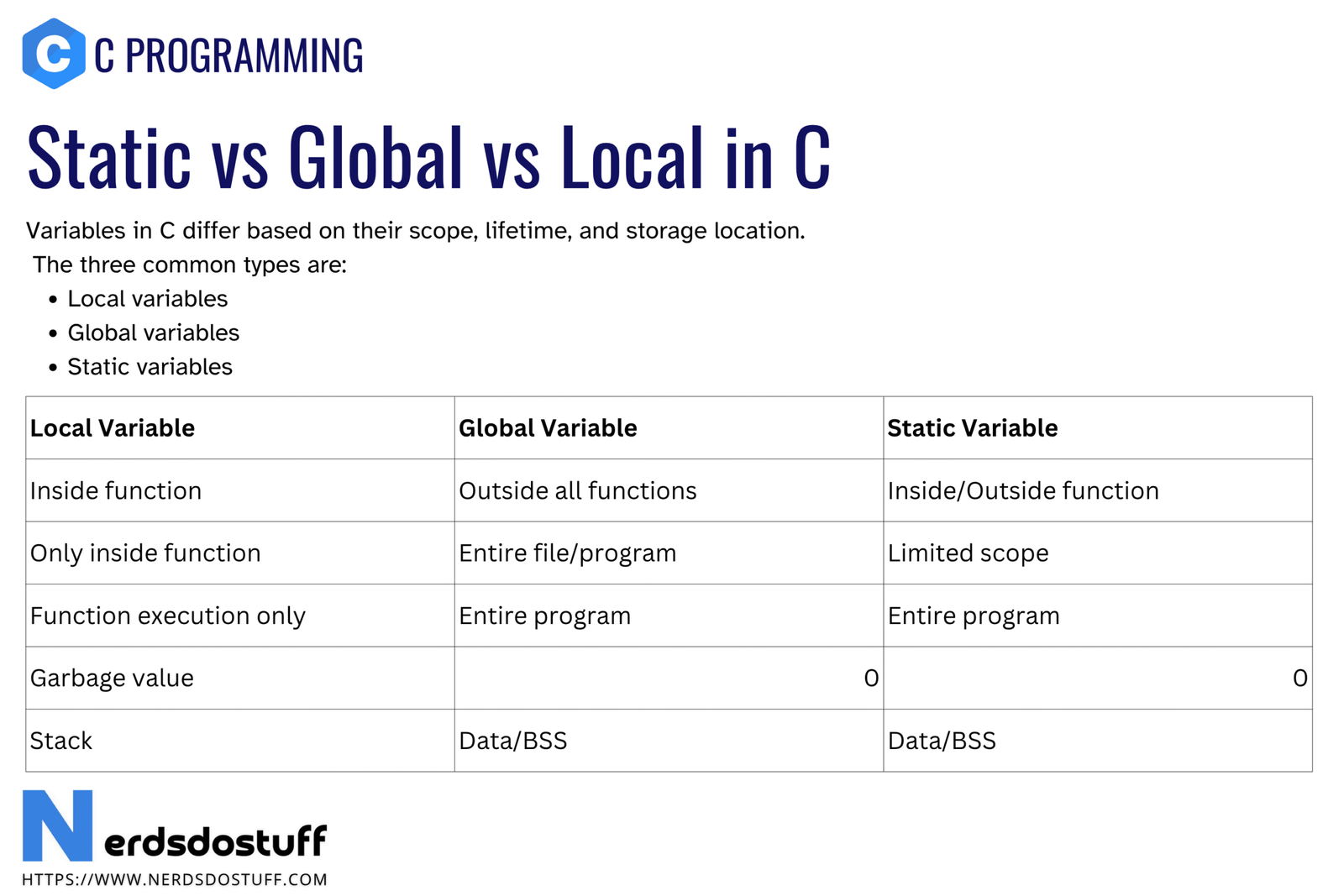
Static vs global vs local in C is an important comparison because these three forms of variables behave differently in scope, lifetime, default initialization, and visibility. Beginners often confuse them because all three store values, but the real difference is not just where they are declared. The real difference is how long they live, where they can be accessed, and whether they keep their values between function calls.
If you understand this topic clearly, many later concepts in C become easier, including storage classes, memory layout, functions, multi-file programs, and debugging. In this article, we will understand static vs global vs local in C, define each one properly, compare them clearly, see examples, and cover common mistakes and best practices.
What is the Difference Between Static, Global, and Local in C?
The difference between static, global, and local in C is mainly based on scope, lifetime, visibility, and default value.
Local variables are temporary and limited to a block, global variables are accessible more widely, and static variables preserve lifetime or restrict visibility depending on where they are declared.
So even though all of them can store values, they are not interchangeable.
Local Variable in C
A local variable is declared inside a function or block. It can be accessed only within that block, and it is destroyed when the block ends.
#include <stdio.h>
int main(void)
{
    int x = 10;
    printf("%d\n", x);
    return 0;
}
Here x is a local variable because it exists only inside main().
- scope: current block or function only
- lifetime: until the block ends
- default value: garbage value if not initialized
Global Variable in C
A global variable is declared outside all functions. It can usually be accessed by functions written after its declaration in the same file, and it has program-wide lifetime.
#include <stdio.h>
int value = 100;
int main(void)
{
    printf("%d\n", value);
    return 0;
}
Here value is global because it is declared outside any function.
- scope: file scope by declaration, often accessible across functions
- lifetime: entire program
- default value: zero if not initialized
Static Variable in C
A static variable in C can behave differently depending on where it is declared. This is why many learners get confused.
Static Local Variable in C
If a local variable is declared as static, it remains local in scope, but its lifetime becomes the entire program. It keeps its value between function calls.
#include <stdio.h>
void showCount(void)
{
    static int count = 0;
    count++;
    printf("%d\n", count);
}
int main(void)
{
    showCount();
    showCount();
    showCount();
    return 0;
}
The variable count is local to the function, but it does not get destroyed after each call.
Static Global Variable in C
If a global variable is declared with static, it still has full program lifetime, but its visibility becomes limited to the current source file. This is called internal linkage.
That means other source files cannot access it directly.
- scope: local if static local, file scope if static global
- lifetime: entire program
- default value: zero if not initialized
Static vs Global vs Local in C Table
| Feature | Local Variable | Global Variable | Static Variable |
|---|---|---|---|
| Declared where | Inside function or block | Outside all functions | Inside function or outside with static |
| Scope | Current block only | Usually whole file and possibly other files with declaration | Block scope if local, file scope if static global |
| Lifetime | Until block ends | Entire program | Entire program |
| Default value | Garbage if not initialized | Zero | Zero |
| Keeps value between function calls | No | Yes, because it exists for whole program | Yes, for static local |
| Visibility outside file | No | Possible with external linkage | No for static global |
Example Comparing Local, Global, and Static in C
#include <stdio.h>
int global_var = 50;
void demo(void)
{
    int local_var = 10;
    static int static_var = 0;
    static_var++;
    printf("local = %d, global = %d, static = %d\n", local_var, global_var, static_var);
}
int main(void)
{
    demo();
    demo();
    demo();
    return 0;
}
In this example:
local_varis recreated every time the function runsglobal_varexists for the whole programstatic_varkeeps its value between calls
When to Use Local Variables in C
- when data is needed only inside one function or block
- when temporary values are enough
- when you want simpler and safer function-level logic
Local variables should usually be the default choice unless you need wider access or longer lifetime.
When to Use Global Variables in C
- when multiple functions need the same shared data
- when the data should exist during the whole program
- when design simplicity truly benefits from shared program-level state
Global variables should be used carefully because too many shared values can make code harder to maintain.
When to Use Static Variables in C
- when a local variable must remember its old value between function calls
- when a global-like value should stay private to one source file
- when program state must persist without exposing it everywhere
This is why static is often useful in embedded programming and internal module design.
Common Mistakes in Static vs Global vs Local in C
- assuming static and global are exactly the same
- forgetting that a static local variable keeps its old value
- using too many global variables and creating hidden dependencies
- expecting local variables to keep values after function return
- confusing scope with lifetime
| Mistake | Problem | Better Practice |
|---|---|---|
| Using globals everywhere | Hard-to-track program state | Prefer local variables when possible |
| Forgetting static local persistence | Unexpected output across calls | Remember static local values survive |
| Thinking scope and lifetime are the same | Concept confusion | Study them separately |
Best Practices for Static vs Global vs Local in C
- Prefer local variables by default.
- Use global variables only when shared state is truly needed.
- Use static local variables when state must persist between calls.
- Use static global variables to keep file-level data private.
- Always think about scope, lifetime, and visibility before choosing a variable form.
FAQs
What is the difference between static, global, and local in C?
They differ in scope, lifetime, default value, and visibility. Local variables are block-limited, global variables are widely accessible, and static variables preserve lifetime or restrict visibility depending on where they are declared.
Does a local variable keep its value between function calls in C?
No. A normal local variable is recreated each time the function is called.
Does a static local variable keep its value between calls in C?
Yes. A static local variable keeps its value between function calls.
What is the default value of a global variable in C?
A global variable gets zero by default if it is not explicitly initialized.
What is the default value of a local variable in C?
A local variable has a garbage value if it is not initialized.
Is a static global variable visible in other files in C?
No. A static global variable has internal linkage and stays limited to its own source file.
Continue learning C in order
Follow the topic sequence with the previous and next lesson.