
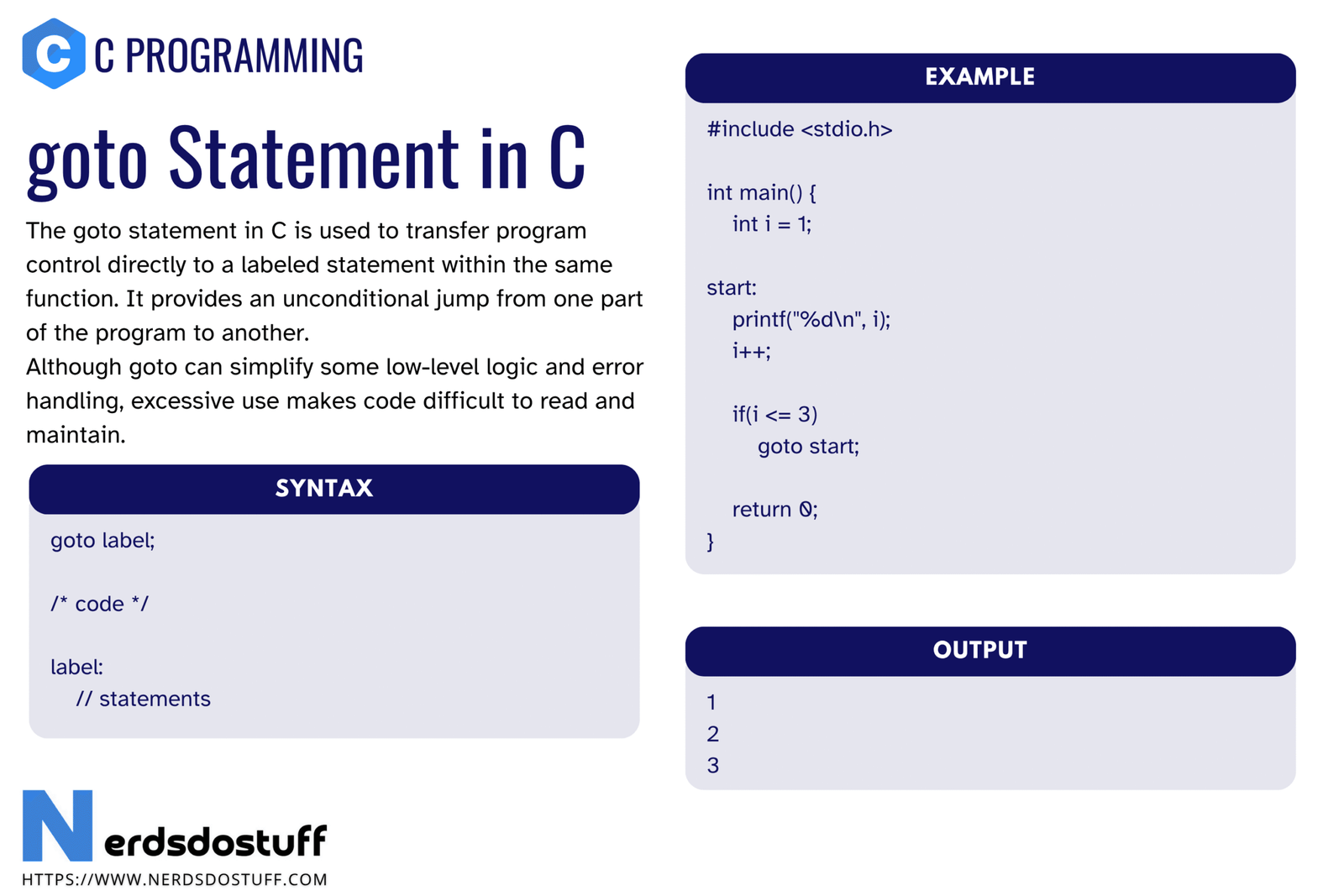
Goto statement in C is a jump statement that transfers program control directly from one place to another inside the same function. It works with a label. When the goto statement is executed, the program skips normal sequential flow and jumps to the labeled statement. This makes it different from loops and conditional statements, which follow more structured paths.
The goto statement is one of the most debated topics in C. It is part of the language and it has valid uses, but careless use can make programs confusing and hard to maintain. In this article, we will understand the goto statement in C, its syntax, examples, valid use cases, restrictions, disadvantages, common mistakes, and best practices.
What is goto Statement in C?
The goto statement in C is a control statement used to jump from one statement to a labeled statement within the same function.
The goto statement changes normal program flow by sending control directly to a labeled location.
A label is an identifier followed by a colon. The goto keyword uses that label name as the jump target.
Syntax of goto Statement in C
goto label_name;
label_name:
    statement;
The program jumps to label_name when the goto statement is executed.
Simple Example of goto Statement in C
#include <stdio.h>
int main(void)
{
    printf("Start\n");
    goto end;
    printf("This line will not execute\n");
end:
    printf("End\n");
    return 0;
}
When the program reaches goto end;, it jumps directly to the label end:. The middle printf() statement is skipped.
How goto Statement Works in C
- The compiler reads the label name inside the same function.
- When
gotois executed, normal top-to-bottom flow is interrupted. - Control jumps directly to the labeled statement.
- Execution continues from that label onward.
The jump can be forward or backward, but it must stay within the same function.
Forward Jump and Backward Jump in goto Statement
A forward jump means control moves to a label written later in the function. A backward jump means control returns to a label written earlier in the function.
Backward jumps can create loop-like behavior, although using loops is usually cleaner.
#include <stdio.h>
int main(void)
{
    int i = 1;
repeat:
    printf("%d\n", i);
    i++;
    if (i <= 3)
        goto repeat;
    return 0;
}
This works, but a normal loop is usually better for repeated execution.
Where goto Statement is Used in C
Most everyday logic should use loops, functions, and conditional statements. Still, there are some cases where goto can be reasonable.
- breaking out of deeply nested logic in older C code
- jumping to a single cleanup section before returning
- error handling in low-level or resource-management code
- certain state-machine style code in embedded systems
Among these, cleanup and error handling is the most common practical use in serious C programs.
goto for Cleanup in C
One accepted use of goto is centralized cleanup. When a function allocates multiple resources, a jump to a cleanup label can avoid duplicated release code.
#include <stdio.h>
int process(void)
{
    FILE *fp = fopen("data.txt", "r");
    if (fp == NULL)
        goto cleanup;
    printf("Processing file\n");
cleanup:
    if (fp != NULL)
        fclose(fp);
    return 0;
}
This style keeps cleanup in one place instead of repeating the same code in many branches.
Restrictions of goto Statement in C
- The jump target must be inside the same function.
- You cannot jump to a label in another function.
- The label must exist somewhere in that function.
- Careless jumping can skip important initialization or make code confusing.
So while the compiler allows goto, the programmer must still use it carefully.
Disadvantages of goto Statement in C
- It can make program flow difficult to follow.
- It can produce messy code known as spaghetti code.
- It often hides better structured alternatives.
- It becomes harder to debug and maintain when overused.
| Approach | Readability | Typical Use |
|---|---|---|
if, else, loops | High | Normal structured programming |
goto | Low when overused | Special jump or cleanup case |
goto Statement vs break and continue in C
break and continue work only in limited structured situations such as loops and switch statements. goto is more general because it can jump to a named label in the same function.
breakexits a loop or switch.continueskips to the next loop iteration.gotojumps to a labeled location.
This extra power is exactly why goto needs more discipline.
Common Mistakes with goto Statement in C
- using
gotowhen a loop or function would be simpler - creating too many labels in one function
- jumping in ways that make the control flow hard to understand
- forgetting that labels belong only to the same function
- using
gotoas a habit instead of a last resort
| Mistake | Problem | Better Practice |
|---|---|---|
Replacing loops with goto | Unclear logic | Use for, while, or do while |
| Too many labels | Spaghetti code | Keep labels minimal and meaningful |
| Ignoring cleanup benefit | Missed practical use | Use goto mainly for controlled cleanup when needed |
Best Practices for goto Statement in C
- Use
gotorarely and only when it makes the code simpler, not more confusing. - Prefer loops, functions, and conditionals for normal control flow.
- Use meaningful label names such as
cleanuporerror. - Keep jumps inside a small and easy-to-read function.
- If the code becomes hard to follow, refactor it instead of adding more labels.
FAQs
What is goto statement in C?
The goto statement in C is a jump statement that transfers control directly to a labeled statement inside the same function.
Why is goto statement considered dangerous in C?
It can make code hard to follow and maintain if used too often or without discipline.
Can goto jump to another function in C?
No. The jump target must be a label inside the same function.
Is goto ever useful in C?
Yes. It can be useful for centralized cleanup and error handling in some low-level programs.
What is a label in goto statement?
A label is an identifier followed by a colon that marks the jump target for the goto statement.
Should goto be avoided completely in C?
It should not be used carelessly, but it does not need to be avoided in every possible case. The real rule is to use it only when it makes the code cleaner and clearer.
Continue learning C in order
Follow the topic sequence with the previous and next lesson.