
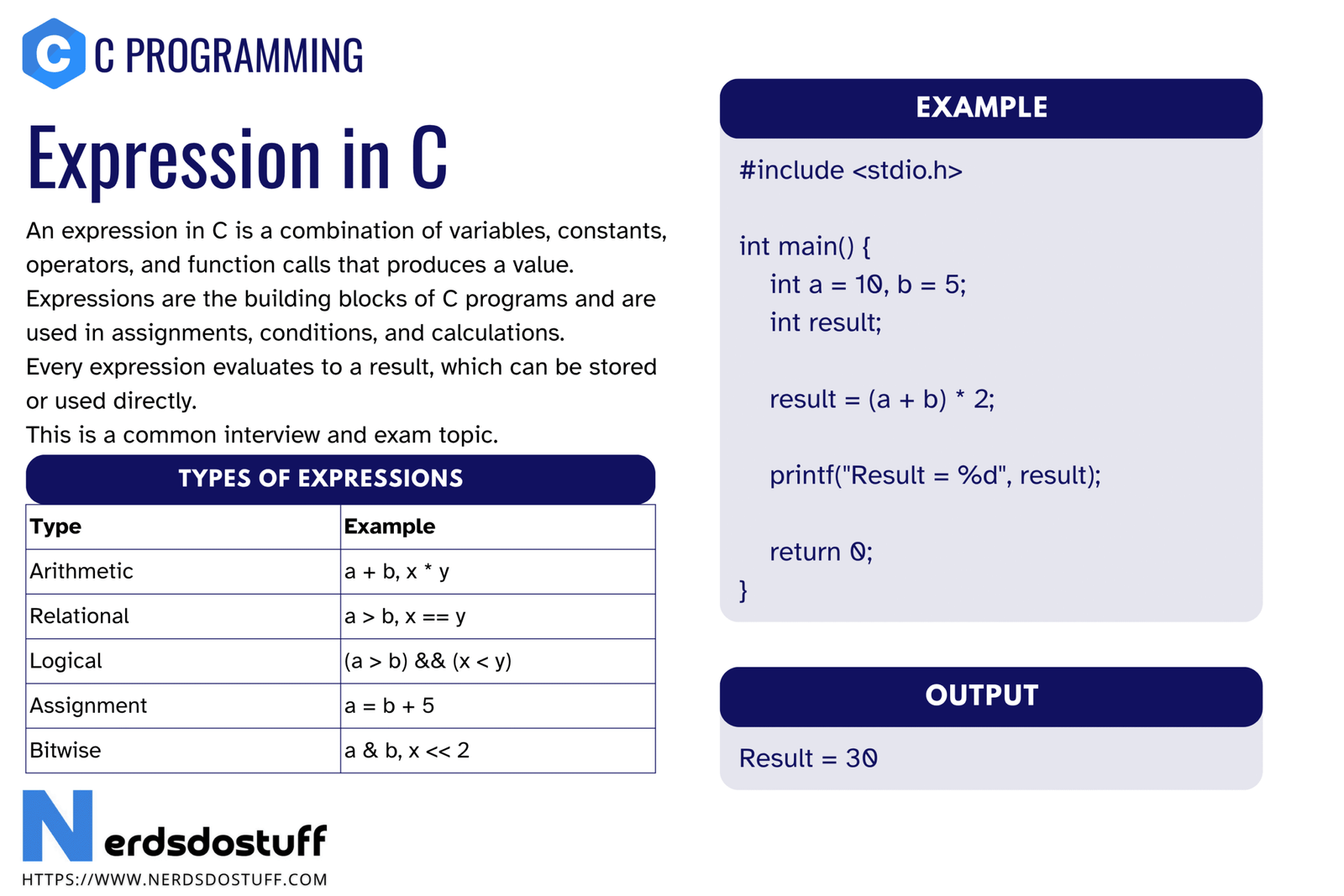
Expression in C is one of the most fundamental topics in the language because almost every meaningful statement in a program depends on expressions. Whether you are doing arithmetic, comparing values, assigning data, checking conditions, or working with bits, you are ultimately using expressions. A beginner may learn operators and variables first, but real understanding grows when those parts are seen together as expressions.
An expression in C is formed by combining operands such as variables, constants, and function results with operators such as +, -, *, /, <, &&, and =. The compiler evaluates that expression according to the rules of precedence, associativity, and data types. In this article, we will understand expression in C, its types, how it is evaluated, the difference between expression and statement, common mistakes, and best practices.
What is Expression in C?
An expression in C is a combination of operands and operators that produces a value.
The operands may be constants, variables, function calls, or even other expressions. The operators tell the compiler what operation should be performed on those operands.
An expression in C is anything that can be evaluated to produce a value.
For example:
a + b
x * y - 5
num > 10
count = count + 1
Each of these is an expression because each one can be evaluated.
Parts of an Expression in C
| Part | Meaning | Example |
|---|---|---|
| Operand | Value or variable used in the expression | a, 10, sum |
| Operator | Symbol that performs an action | +, *, &&, = |
| Result | The final value after evaluation | 15, 1, 0 |
For example, in a + b, a and b are operands, and + is the operator.
Types of Expressions in C
C supports many kinds of expressions depending on the operators used and the purpose of evaluation.
1. Arithmetic Expression
Arithmetic expressions are used for mathematical calculations.
sum = a + b;
avg = total / count;
value = x * y - z;
2. Relational Expression
Relational expressions compare two values and produce either true or false, usually represented as 1 or 0 in C.
a > b
x == y
num <= 100
3. Logical Expression
Logical expressions combine conditions using logical operators like &&, ||, and !.
(age >= 18) && (age <= 60)
(a > b) || (b > c)
!(x == 0)
4. Assignment Expression
Assignment expressions assign a value to a variable. The assignment itself is also an expression in C.
x = 10;
y = a + b;
count += 5;
5. Bitwise Expression
Bitwise expressions work at the bit level and are common in low-level and embedded programming.
mask & value
x | y
num << 1
6. Conditional Expression
Conditional expressions use the ternary operator ?: to choose one of two values.
max = (a > b) ? a : b;How Expression is Evaluated in C
C evaluates expressions according to precedence and associativity rules. Precedence decides which operator gets priority. Associativity decides the direction of evaluation when operators have the same precedence.
For example:
int result = 2 + 3 * 4;Here multiplication happens first because * has higher precedence than +. So the result becomes:
2 + 12 = 14
If you want addition first, parentheses must be used.
int result = (2 + 3) * 4;Now the result becomes 20.
Operator Precedence and Associativity in Expression in C
| Operator Group | Examples | General Priority |
|---|---|---|
| Unary | ++, --, ! | High |
| Multiplicative | *, /, % | High |
| Additive | +, - | Medium |
| Relational | <, >, <=, >= | Below arithmetic |
| Equality | ==, != | Below relational |
| Logical | &&, || | Lower |
| Assignment | =, +=, -= | Lower |
You do not need to memorize every row immediately, but you must understand that parentheses make expressions much clearer and safer.
Expression vs Statement in C
This is a common point of confusion. An expression produces a value. A statement performs an action. Many statements contain expressions.
| Item | Meaning | Example |
|---|---|---|
| Expression | Produces a value | a + b |
| Statement | Complete instruction ending with semicolon or block form | sum = a + b; |
In sum = a + b;, the part a + b is an expression, and the whole line is a statement.
Expression with Increment and Decrement in C
Expressions involving ++ and -- can confuse beginners because they may change a variable and also produce a value.
int x = 5;
int y = ++x;   /* x becomes 6, y becomes 6 */
int z = x--;   /* z gets old value, then x decreases */
This is why such expressions should be used carefully. If readability suffers, simpler separate statements are often better.
Expression with Type Conversion in C
Expressions in C may involve automatic type conversion. For example, when an int and a float are used together, the int is usually promoted during evaluation.
int a = 5;
float b = 2.5f;
float result = a + b;
Here the expression produces a floating-point result.
Examples of Expression in C
| Expression | Type | Meaning |
|---|---|---|
a + b | Arithmetic | Adds two values |
x > y | Relational | Checks comparison |
(a > b) && (b > c) | Logical | Combines conditions |
n = 10 | Assignment | Assigns value to variable |
(a > b) ? a : b | Conditional | Chooses one of two values |
Common Mistakes in Expression in C
- confusing
=with== - ignoring operator precedence
- writing very complex expressions that are hard to read
- misusing increment and decrement inside larger expressions
- assuming integer division gives a decimal result
| Mistake | Problem | Better Practice |
|---|---|---|
if (a = b) | Assignment used instead of comparison | Use == when comparing |
2 + 3 * 4 misunderstood | Wrong expected result | Use parentheses when needed |
| Huge mixed expression | Hard to debug | Break into smaller steps |
Best Practices for Expression in C
- Use parentheses when clarity matters.
- Keep expressions readable instead of clever.
- Do not combine too many side effects in one line.
- Know the difference between integer and floating-point evaluation.
- Review precedence rules for common operators.
FAQs
What is expression in C?
Expression in C is a combination of operands and operators that produces a value.
What are the types of expressions in C?
Common types include arithmetic, relational, logical, assignment, bitwise, and conditional expressions.
What is the difference between expression and statement in C?
An expression produces a value, while a statement is a complete instruction. A statement may contain one or more expressions.
Why is precedence important in expression in C?
Precedence decides which operator is evaluated first. Without understanding it, expressions may produce unexpected results.
Can assignment be an expression in C?
Yes. Assignment in C is also an expression because it produces a value after assignment.
How can I avoid mistakes in expressions in C?
Use parentheses for clarity, avoid overly complex expressions, understand operator precedence, and review comparison versus assignment carefully.
Continue learning C in order
Follow the topic sequence with the previous and next lesson.