
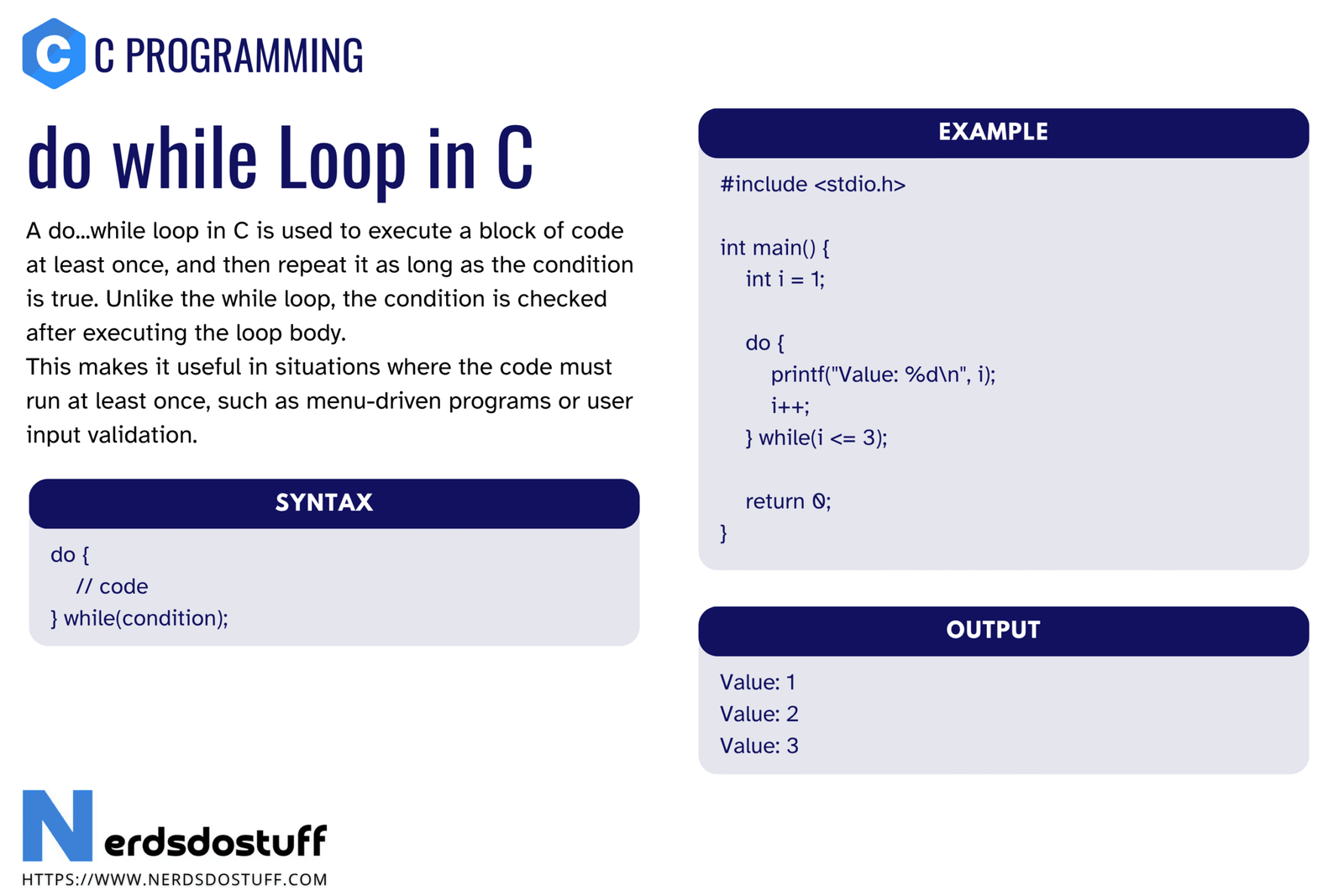
The do while loop in C is a looping structure used when a block of code must run first and the condition should be checked afterward. This makes it different from the while loop and the for loop, both of which test the condition before entering the loop body.
Many beginners understand the basic syntax of loops but miss the practical importance of the do while loop. Its value appears when at least one execution is necessary before deciding whether the loop should continue. Menu-driven programs, input validation, repeated prompts, and state-driven logic often use this pattern. In this article, we will understand what the do while loop in C is, how it works, why it is called an exit-controlled loop, common use cases, differences from other loops, common mistakes, and best practices.
What is do while Loop in C?
A do while loop in C is a control structure that executes the loop body first and checks the condition after that. If the condition is true, the loop repeats. If the condition is false, the loop stops.
do
{
    /* statements */
} while (condition);
The key point is that the loop body runs at least one time even if the condition is false from the beginning.
A do while loop guarantees one execution before the condition is tested.
Why do while Loop is Used in C
- It is useful when one execution must happen before checking a condition.
- It works well in menu-driven programs.
- It is useful in repeated user input and retry-style logic.
- It makes post-check repetition explicit.
- It avoids repeating setup code before the loop begins.
The do while loop is not the most commonly used loop in all programs, but it is the right choice when first execution is mandatory.
Syntax of do while Loop in C
The general syntax is:
do
{
    statements;
} while (condition);| Part | Meaning |
|---|---|
do | Starts the loop body |
| Loop body | Runs first before condition checking |
while (condition); | Tests whether another iteration should happen |
Notice the semicolon after the while (condition) part. This is a common place where beginners make syntax mistakes.
How do while Loop Works in C
The execution flow of the do while loop is simple.
- The loop body executes first.
- The condition is checked after the body finishes.
- If the condition is true, control returns to the start of the loop body.
- If the condition is false, the loop ends.
Because the check happens after execution, the loop body always runs at least once.
#include <stdio.h>
int main(void)
{
    int i = 1;
    do
    {
        printf("%d\n", i);
        i++;
    } while (i <= 5);
    return 0;
}
This prints the numbers from 1 to 5. The loop body runs, then the condition is checked to decide whether another iteration is needed.
do while Loop as an Exit-Controlled Loop
The do while loop in C is called an exit-controlled loop because the condition is checked after the loop body. This is the main difference between do while and while.
#include <stdio.h>
int main(void)
{
    int i = 10;
    do
    {
        printf("This runs once.\n");
    } while (i < 5);
    return 0;
}
Even though i < 5 is false, the body still runs once because the condition is checked after execution.
Simple Example of do while Loop in C
A basic counting loop can also be written using do while.
#include <stdio.h>
int main(void)
{
    int i = 1;
    do
    {
        printf("%d ", i);
        i++;
    } while (i <= 10);
    return 0;
}
This prints numbers from 1 to 10. The structure is similar to a while loop, but the condition comes later.
When to Use do while Loop in C
- When the loop body must run at least once
- When you need to show a menu before checking whether to repeat it
- When user input must be taken before validation
- When retry-style logic begins with one mandatory attempt
- When post-check control makes the logic clearer than a while loop
If the body should not run when the condition is false at the beginning, a while loop is usually the better choice.
Menu-Driven Example of do while Loop in C
One of the most common uses of the do while loop is a menu that should appear at least once.
#include <stdio.h>
int main(void)
{
    int choice;
    do
    {
        printf("1. Add\n");
        printf("2. Delete\n");
        printf("3. Exit\n");
        printf("Enter choice: ");
        scanf("%d", &choice);
        printf("You selected %d\n", choice);
    } while (choice != 3);
    return 0;
}
This works well because the menu is shown first, then the program decides whether another menu cycle is needed.
Input Validation with do while Loop in C
The do while loop is also useful when input must be taken first and then validated.
#include <stdio.h>
int main(void)
{
    int age;
    do
    {
        printf("Enter a valid age: ");
        scanf("%d", &age);
    } while (age < 0);
    return 0;
}
This structure ensures the user is prompted at least once before the program decides whether to repeat the input request.
Difference Between do while Loop and while Loop in C
| Point | do while loop | while loop |
|---|---|---|
| Condition check | After the loop body | Before the loop body |
| Minimum executions | At least one | May be zero |
| Typical use | Mandatory first execution | Condition-based entry |
The difference is important. If one execution must happen before checking, do while fits better. If execution should depend on the condition from the start, while fits better.
Difference Between do while Loop and for Loop in C
| Point | do while loop | for loop |
|---|---|---|
| Style | Post-condition loop | Compact count-controlled loop |
| Best fit | First execution is required | Initialization, condition, and update are naturally grouped |
| Readability | Good for menus and retries | Good for counting and indexed repetition |
A for loop is usually cleaner for fixed counting patterns, while a do while loop is often better for repeated operations that must happen once before checking whether to continue.
Common Mistakes in do while Loop
- forgetting the semicolon after
while (condition) - expecting the loop to skip execution when the condition is false initially
- forgetting to update values needed by the condition
- using the wrong condition and causing an infinite loop
- placing important updates outside the loop body when they should happen inside it
| Mistake | Problem | Better approach |
|---|---|---|
| Missing semicolon | Causes syntax error | Always write } while (condition); |
| Wrong expectation | Loop runs once even when condition is false | Remember that do while is exit-controlled |
| Missing update | Loop may become infinite | Check how the condition can become false |
The most common conceptual mistake is forgetting that the body always runs once. That behavior is not a bug in the language. It is the defining behavior of the do while loop.
Best Practices for do while Loop in C
- Use it only when first execution is actually required.
- Keep the loop condition easy to understand.
- Make sure the loop has a clear path to termination.
- Do not choose do while just for variety if while or for is clearer.
- Be careful with user input and validation conditions.
- Remember the required semicolon at the end.
A do while loop is most readable when the program logic naturally says: perform this once, then decide whether to repeat.
FAQs
What is do while loop in C?
A do while loop in C is a loop that executes the body first and checks the condition afterward.
Why is do while loop called an exit-controlled loop?
It is called an exit-controlled loop because the condition is checked after the loop body executes.
How many times does a do while loop execute at minimum?
It executes at least one time because the condition is tested only after the first execution.
What is the difference between while and do while loop in C?
A while loop checks the condition before execution, while a do while loop checks the condition after execution.
Where is do while loop used in C?
It is commonly used in menu-driven programs, repeated input, retry logic, and situations where one execution must happen first.
Is the semicolon required in do while loop syntax?
Yes. The syntax ends with while (condition);, so the semicolon is required.
Continue learning C in order
Follow the topic sequence with the previous and next lesson.