
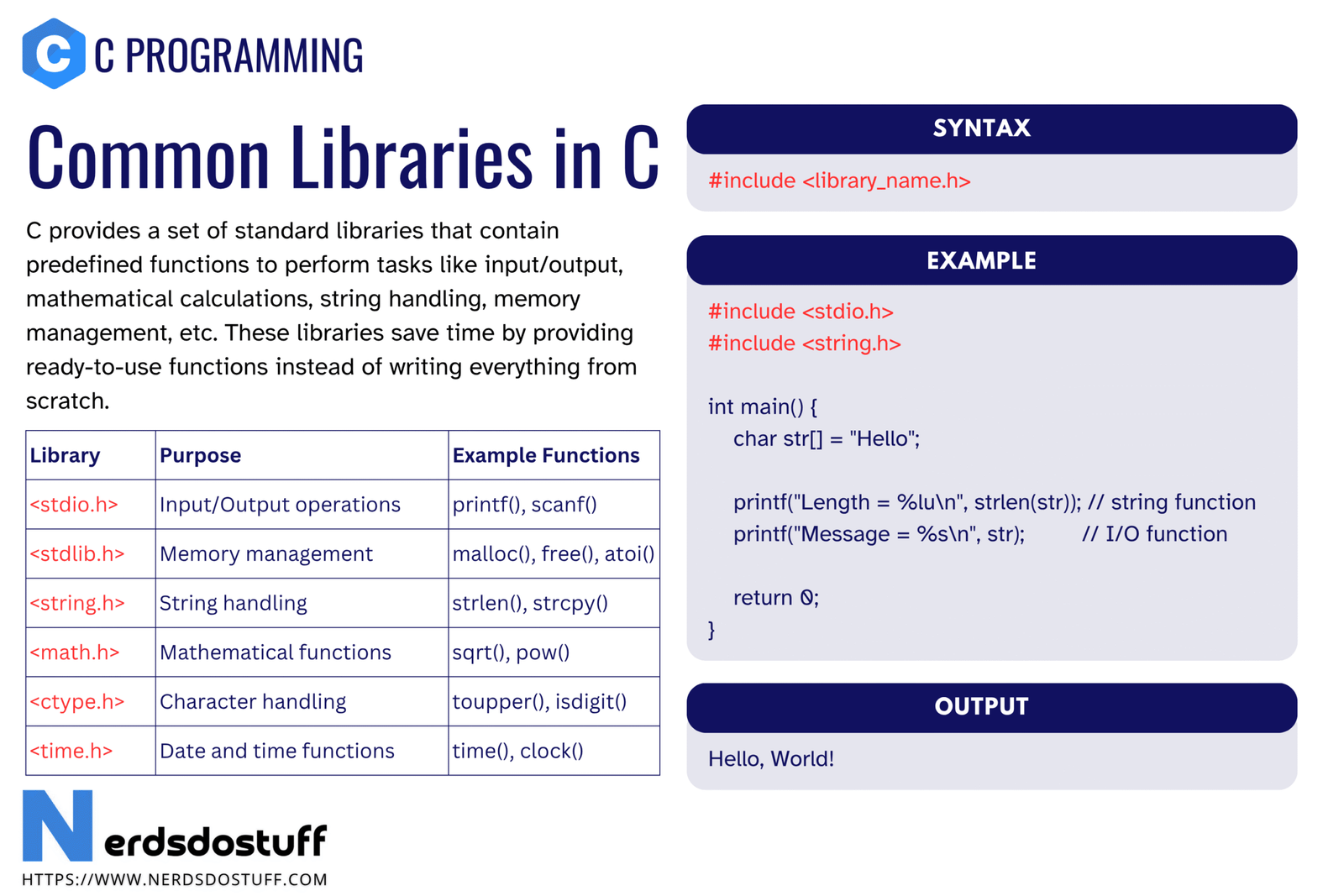
Common C libraries are the standard library headers and related functionality that make everyday C programming practical. Without them, even simple tasks such as printing output, reading input, working with strings, allocating memory, checking characters, or performing mathematical calculations would become much harder.
Beginners often use functions like printf(), scanf(), strlen(), malloc(), or sqrt() without clearly understanding which library they belong to and why the correct header file matters. In this article, we will understand what common C libraries are, why they are important, and the most useful libraries every beginner should know.
What are Common C Libraries?
Common C libraries are collections of standard functions, macros, types, and utilities provided through header files. You include the required header file in your program and then use the related functions.
#include <stdio.h>
#include <string.h>
These headers make standard input-output and string functions available to your program.
A C library gives you ready-made tools so you do not have to build every basic operation from scratch.
Why C Libraries are Important
- They provide standard reusable functions.
- They reduce duplicate code.
- They improve portability across systems.
- They make common tasks easier and safer.
- They help you write shorter and more practical programs.
Instead of manually implementing every string copy, memory allocation routine, or math utility, you use proven library functions where appropriate.
Most Common C Libraries Every Beginner Should Know
| Header File | Used For | Examples |
|---|---|---|
stdio.h | Input and output | printf(), scanf(), fgets() |
stdlib.h | Utilities and memory management | malloc(), free(), atoi() |
string.h | String handling | strlen(), strcpy(), strcmp() |
math.h | Mathematical functions | sqrt(), pow(), sin() |
ctype.h | Character testing and conversion | isdigit(), toupper() |
time.h | Date and time utilities | time(), clock() |
stdbool.h | Boolean type support | bool, true, false |
These are not the only C libraries, but they are among the most important ones for beginners and intermediate programmers.
stdio.h in C
stdio.h stands for standard input-output header. It is one of the most frequently used libraries in beginner programs.
- printing output to the screen
- reading input from the keyboard
- working with files
- formatted input and output
#include <stdio.h>
int main(void)
{
    int age = 20;
    printf("Age = %d\n", age);
    return 0;
}| Common Function | Purpose |
|---|---|
printf() | Print formatted output |
scanf() | Read formatted input |
fgets() | Read a line of text |
fprintf() | Print formatted output to a file |
If you are printing values or reading user input, stdio.h is usually involved.
stdlib.h in C
stdlib.h is the standard library utility header. It contains memory management functions, conversion routines, process control helpers, and general utility tools.
#include <stdlib.h>
int *ptr = malloc(5 * sizeof(int));
free(ptr);- dynamic memory allocation with
malloc(),calloc(),realloc(), andfree() - string-to-number conversion using
atoi(),atof(), or related functions - program termination using
exit() - random numbers using
rand()
string.h in C
string.h is used for working with strings and blocks of characters.
#include <stdio.h>
#include <string.h>
int main(void)
{
    char name[] = "Nerds";
    printf("Length = %zu\n", strlen(name));
    return 0;
}| Common Function | Purpose |
|---|---|
strlen() | Get string length |
strcpy() | Copy one string into another |
strcat() | Concatenate strings |
strcmp() | Compare strings |
memcpy() | Copy raw memory block |
Because strings in C are character arrays, this header becomes very important in practical programming.
math.h in C
math.h provides mathematical functions such as square root, power, trigonometric functions, and more.
#include <stdio.h>
#include <math.h>
int main(void)
{
    double value = sqrt(25.0);
    printf("%.2f\n", value);
    return 0;
}
Some compilers or systems may require additional linking for math functions, such as linking with the math library when using GCC on some environments.
| Common Function | Purpose |
|---|---|
sqrt() | Square root |
pow() | Raise to a power |
sin() | Sine |
cos() | Cosine |
fabs() | Absolute value for floating-point numbers |
ctype.h in C
ctype.h is used for checking and converting character data. It is useful when validating input or processing text one character at a time.
#include <stdio.h>
#include <ctype.h>
int main(void)
{
    char ch = '7';
    if (isdigit(ch))
        printf("Digit\n");
    return 0;
}| Common Function | Purpose |
|---|---|
isdigit() | Check whether a character is a digit |
isalpha() | Check whether a character is alphabetic |
isspace() | Check whether a character is whitespace |
toupper() | Convert to uppercase |
tolower() | Convert to lowercase |
time.h in C
time.h is used when a program needs time-related features such as the current calendar time, processor clock time, or date-time formatting support.
#include <stdio.h>
#include <time.h>
int main(void)
{
    time_t now = time(NULL);
    printf("%ld\n", (long)now);
    return 0;
}
This header is useful in logging, timing measurements, timestamps, and time-based program behavior.
stdbool.h in C
stdbool.h provides boolean support in standard C by introducing bool, true, and false macros.
#include <stdio.h>
#include <stdbool.h>
int main(void)
{
    bool flag = true;
    printf("%d\n", flag);
    return 0;
}
This header makes code more readable when working with logical true/false values instead of raw integer conventions.
How to Use C Libraries Correctly
- Include the correct header file before using the function.
- Read the expected parameter and return types carefully.
- Do not assume a function belongs to a header without checking.
- Use the right format specifier for the returned data type.
- Be careful with string and memory functions because misuse can cause bugs.
Many beginner errors happen not because the library is difficult, but because the wrong header is included or the function is used with the wrong argument types.
Common Mistakes with C Libraries
| Mistake | Why it is wrong | Better approach |
|---|---|---|
Using strlen() without string.h | The function declaration may be missing | Include the proper header first |
Using sqrt() without understanding math linking needs | Build may fail depending on environment | Check compiler requirements for math library usage |
| Calling memory functions carelessly | Can lead to leaks or invalid access | Use allocation and free logic carefully |
| Using wrong format specifiers with library functions | Can print wrong data or cause undefined behavior | Match the format to the actual type |
A C library function is helpful only when you also understand its input, output, side effects, and required header.
Best Libraries to Learn First in C
If you are just starting, the most useful sequence is:
stdio.hfor input and outputstring.hfor string handlingstdlib.hfor memory and conversionsctype.hfor character processingmath.hfor calculationsstdbool.hfor clear logical values
This order matches common beginner needs and builds a strong practical base.
FAQs
What are common C libraries?
Common C libraries are standard header-based libraries such as stdio.h, stdlib.h, string.h, math.h, and others that provide reusable functions and utilities.
Which C library is used for input and output?
stdio.h is used for standard input and output functions such as printf() and scanf().
Which C library is used for string functions?
string.h is used for string-related functions such as strlen(), strcpy(), strcmp(), and strcat().
Which C library is used for memory allocation?
stdlib.h provides memory allocation functions such as malloc(), calloc(), realloc(), and free().
Why are header files important in C libraries?
Header files provide the declarations needed to use library functions correctly. Without the proper header, code may fail to compile correctly or behave unsafely.
Continue learning C in order
Follow the topic sequence with the previous and next lesson.