
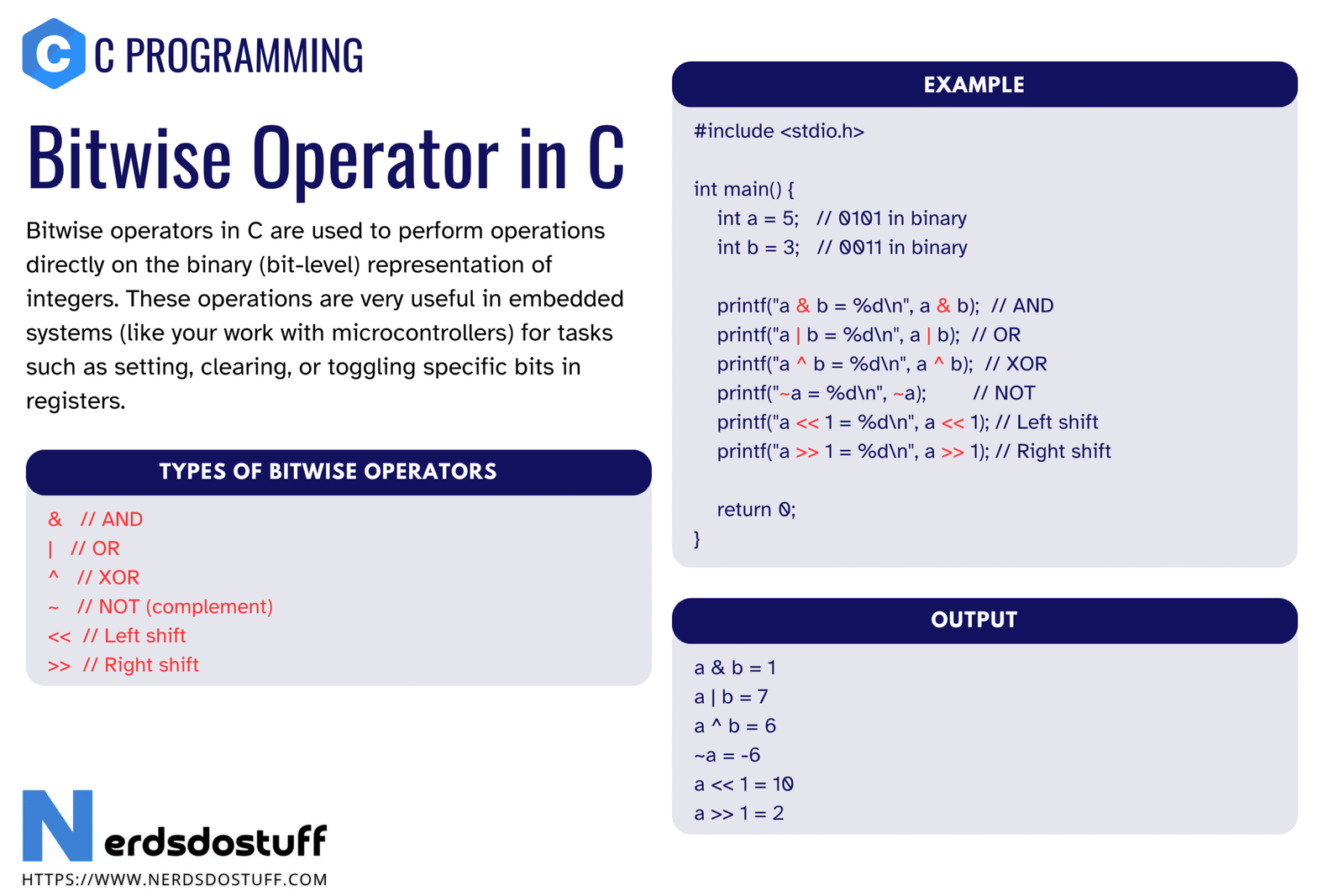
Bitwise operator in C is a topic that introduces direct operations on the individual bits of a number. Instead of working with a full decimal value in the usual arithmetic way, bitwise operators work at the binary level. This makes them extremely useful in low-level programming, embedded systems, flags, masks, hardware control, and efficient data manipulation.
Many beginners find this topic difficult at first because the results do not feel intuitive in decimal form. The key is to think in binary. Once you understand how each bitwise operator affects individual bits, the whole topic becomes much clearer. In this article, we will understand what bitwise operators in C are, why they are used, the six main bitwise operators, truth-style examples, shift operations, masks, practical use cases, and the mistakes beginners should avoid.
What is Bitwise Operator in C?
A bitwise operator in C is an operator that works on the binary representation of integers. It compares, changes, or shifts bits directly. For example, instead of adding two values, a bitwise operator can compare each bit position or move bits left and right.
If you write 5 & 3, C does not compare the numbers in decimal. It first considers their binary forms:
5is01013is0011
Then the operator works bit by bit. That is why the result depends on binary positions, not just ordinary numeric intuition.
Why Bitwise Operators are Important in C
- They allow direct control over individual bits.
- They are useful in embedded systems and hardware programming.
- They help build masks, flags, and compact status variables.
- They support fast low-level operations in some situations.
- They are common in communication protocols, registers, and device control logic.
Bitwise operators are not only for advanced programmers. Even at the beginner level, understanding them helps explain how numbers are stored and how low-level programming works.
Binary Basics Before Learning Bitwise Operators
To understand bitwise operators, you must first remember that integers are stored in binary. Each binary digit is called a bit, and each bit is either 0 or 1.
| Decimal | Binary |
|---|---|
| 1 | 0001 |
| 2 | 0010 |
| 3 | 0011 |
| 4 | 0100 |
| 5 | 0101 |
| 6 | 0110 |
| 7 | 0111 |
| 8 | 1000 |
Once you can switch between small decimal values and their binary form, bitwise operations become easier to trace.
List of Bitwise Operators in C
| Operator | Name | Main Action |
|---|---|---|
& | Bitwise AND | Returns 1 only if both bits are 1 |
| | Bitwise OR | Returns 1 if at least one bit is 1 |
^ | Bitwise XOR | Returns 1 if the bits are different |
~ | Bitwise NOT | Flips every bit |
<< | Left shift | Shifts bits to the left |
>> | Right shift | Shifts bits to the right |
These six operators form the core of bitwise programming in C.
Bitwise AND Operator in C
The bitwise AND operator is written as &. It returns 1 in a bit position only when both corresponding bits are 1.
| A | B | A & B |
|---|---|---|
| 0 | 0 | 0 |
| 0 | 1 | 0 |
| 1 | 0 | 0 |
| 1 | 1 | 1 |
int a = 5;   // 0101
int b = 3;   // 0011
int result = a & b; // 0001 = 1
Bitwise AND is commonly used for masking, especially when checking whether specific bits are set.
Bitwise OR Operator in C
The bitwise OR operator is written as |. It returns 1 if at least one of the corresponding bits is 1.
| A | B | A | B |
|---|---|---|
| 0 | 0 | 0 |
| 0 | 1 | 1 |
| 1 | 0 | 1 |
| 1 | 1 | 1 |
int a = 5;   // 0101
int b = 3;   // 0011
int result = a | b; // 0111 = 7
Bitwise OR is often used to set specific bits in a number.
Bitwise XOR Operator in C
The bitwise XOR operator is written as ^. It returns 1 when the two bits are different and 0 when they are the same.
| A | B | A ^ B |
|---|---|---|
| 0 | 0 | 0 |
| 0 | 1 | 1 |
| 1 | 0 | 1 |
| 1 | 1 | 0 |
int a = 5;   // 0101
int b = 3;   // 0011
int result = a ^ b; // 0110 = 6
XOR is useful for toggling bits and in some logic tricks, but beginners should first understand its simple “different bits become 1” behavior.
Bitwise NOT Operator in C
The bitwise NOT operator is written as ~. It flips every bit, turning 1 into 0 and 0 into 1.
unsigned int a = 5;   // 00000101
unsigned int result = ~a;
Beginners should be careful here because the result depends on the full bit width of the type. That is why ~ often looks surprising if you think only in terms of small decimal values.
Left Shift Operator in C
The left shift operator is written as <<. It shifts all bits to the left by a specified number of positions. For small positive integers, shifting left by one position often behaves like multiplying by 2.
int a = 5;        // 00000101
int result = a << 1; // 00001010 = 10
This operator is useful for creating masks, positioning bits, and efficient low-level arithmetic in carefully controlled cases.
Right Shift Operator in C
The right shift operator is written as >>. It shifts bits to the right. For small positive integers, shifting right by one position often behaves like dividing by 2 and dropping the remainder.
int a = 10;        // 00001010
int result = a >> 1; // 00000101 = 5
With signed values, right shift behavior can be implementation-dependent in some details, so beginners should be careful and prefer understanding the positive-integer case first.
Practical Bit Mask Operations in C
One of the biggest real uses of bitwise operators is bit masking. A mask is a value used to test, set, clear, or toggle specific bits.
| Task | Operator Pattern | Meaning |
|---|---|---|
| Check a bit | value & mask | Tests whether selected bit is set |
| Set a bit | value | mask | Forces selected bit to 1 |
| Clear a bit | value & ~mask | Forces selected bit to 0 |
| Toggle a bit | value ^ mask | Flips selected bit |
unsigned int value = 0b00000101;
unsigned int mask  = 0b00000010;
unsigned int checked = value & mask;
unsigned int setBit  = value | mask;
unsigned int clearBit = value & ~mask;
unsigned int toggleBit = value ^ mask;
This style of code appears often in embedded systems and register-level programming.
Applications of Bitwise Operators in C
- Embedded systems and microcontroller register control
- Flag variables and compact status storage
- Permission bits and mode settings
- Communication protocols and packet parsing
- Efficient binary-level data manipulation
- Low-level graphics, compression, and driver code
Even if a beginner does not use all of these immediately, understanding bitwise logic is important because it reveals how software talks to hardware and how data is controlled at the binary level.
Common Mistakes with Bitwise Operators in C
- Confusing bitwise operators with logical operators such as
&&and|| - Trying to understand results only in decimal without checking the binary form
- Using
~without thinking about type width - Shifting signed values without understanding the consequences
- Forgetting operator precedence in larger expressions
- Using bitwise tricks where clear code would be better
| Mistake | Why It Is Wrong | Better Approach |
|---|---|---|
a && b vs a & b | Logical and bitwise operators are not the same | Use the operator that matches your intent |
| Reading only decimal results | Bitwise logic becomes hard to follow | Write the binary form beside the values |
Using ~5 and expecting a simple small result | NOT flips all bits in the type | Think about full bit width and signedness |
The biggest beginner improvement is to write out the binary representation on paper until the pattern becomes natural.
Best Practices for Bitwise Programming in C
- Convert small examples to binary before reasoning about the result.
- Use unsigned types where bit-level intent is clearer.
- Use named masks such as
BIT0,ENABLE_FLAG, orMASK_READY. - Add comments when bit positions have hardware meaning.
- Prefer readable masking code over clever but unclear expressions.
Good bitwise code is not only correct. It should also be understandable to the next person reading it.
FAQs
What is bitwise operator in C?
A bitwise operator in C is an operator that works directly on the binary bits of integer values.
How many bitwise operators are there in C?
There are six main bitwise operators in C: &, |, ^, ~, <<, and >>.
What is the difference between & and && in C?
& is the bitwise AND operator, while && is the logical AND operator. They are used for different purposes.
What does left shift do in C?
The left shift operator moves bits to the left by the given number of positions. For small positive integers, it often behaves like multiplication by 2 for each shift step.
Where are bitwise operators used in C?
They are widely used in embedded systems, hardware registers, flags, masks, communication protocols, and other low-level programming tasks.
Continue learning C in order
Follow the topic sequence with the previous and next lesson.