
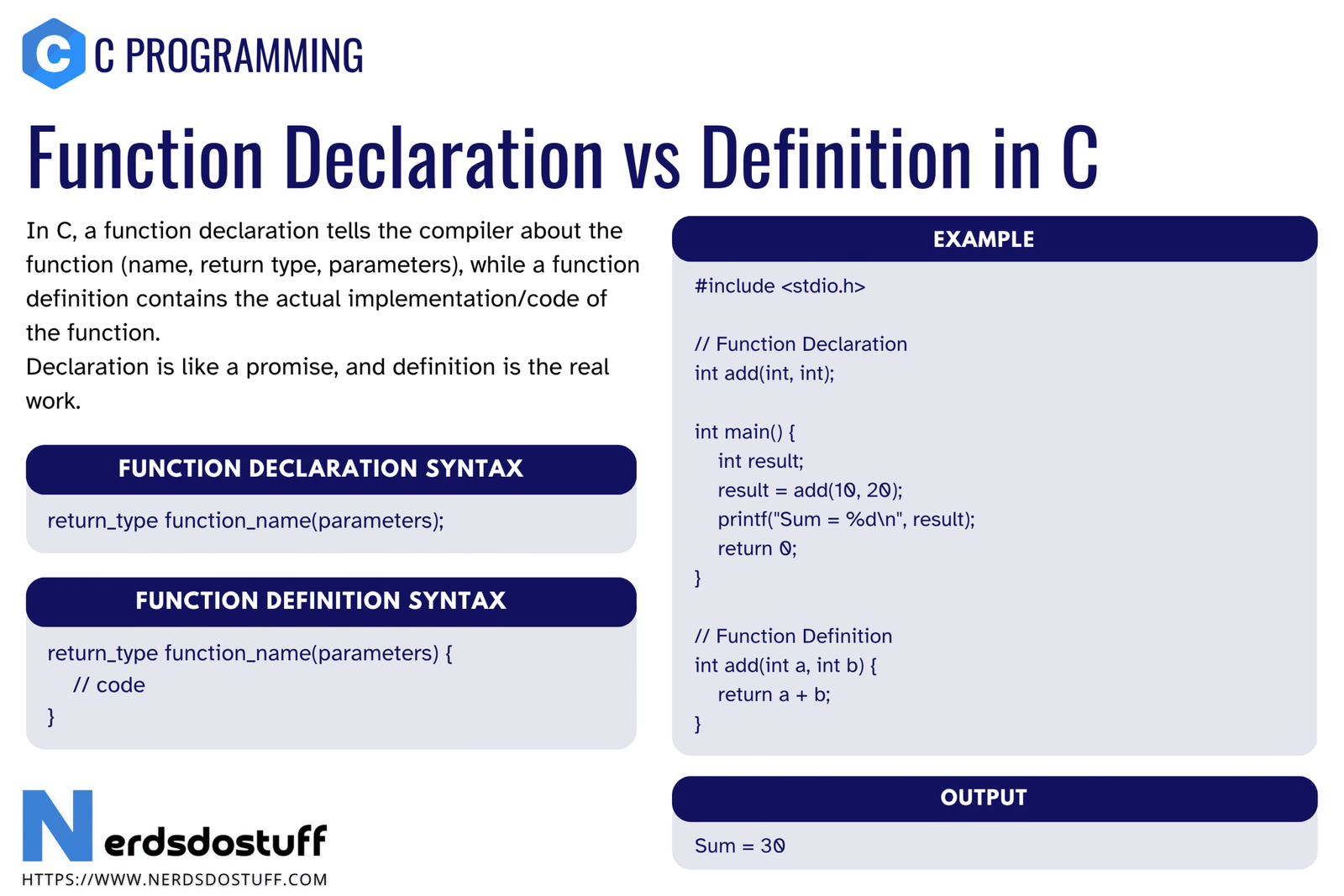
Function declaration and function definition are two closely related ideas in C, but they are not the same. Beginners often mix them because both are connected to functions, both use the function name, and both involve parameter and return types. But they serve different purposes in a C program.
If you understand this difference clearly, you will write cleaner programs, organize code better across multiple files, and avoid common compiler errors. In this article, we will understand function declaration vs definition in C, their syntax, differences, examples, why both are used, and common mistakes.
What is Function Declaration in C?
A function declaration in C tells the compiler about the function name, return type, and parameters before the function is actually used.
A function declaration announces that a function exists and tells the compiler how it should be called.
It does not contain the actual body of the function. Because of that, it does not say how the function works internally. It only gives the compiler the required interface information.
Syntax:
return_type function_name(parameter_list);Example:
int add(int a, int b);This line tells the compiler that a function named add exists, it returns an int, and it takes two integer arguments.
What is Function Definition in C?
A function definition in C provides the complete implementation of the function. It contains the function body and tells the compiler what the function actually does.
Syntax:
return_type function_name(parameter_list) {
    // function body
}
Example:
int add(int a, int b) {
    return a + b;
}
This definition contains the actual logic of the function.
Function Declaration vs Definition in C
The easiest way to remember the difference is this:
- declaration tells the compiler that the function exists
- definition gives the actual code of the function
A declaration is like a promise. A definition is the actual delivery of that promise.
Difference Between Function Declaration and Definition in C Table
| Feature | Function Declaration | Function Definition |
|---|---|---|
| Purpose | Introduces the function to the compiler | Provides the actual implementation |
| Function body | Not present | Present |
| Ends with | Semicolon | Curly braces with statements |
| Compiler use | Checks function calls before the definition is seen | Generates code for the function |
| Can appear multiple times | Yes, if consistent | No, only one actual definition in a program unit |
Why Function Declaration is Needed in C
C compilers read source code in order. If a function is called before the compiler has seen its declaration or definition, the compiler may not know its return type or parameters correctly.
That is why declarations are useful, especially when:
- a function is defined below
main - functions are spread across multiple source files
- header files expose function interfaces
- large projects need clear separation between interface and implementation
Function declarations are commonly placed in header files, while definitions are usually kept in source files.
Example of Function Declaration and Definition in C
The following program shows both a declaration and a definition.
#include <stdio.h>
int add(int a, int b);
int main(void) {
    int result = add(10, 20);
    printf("Result = %d\n", result);
    return 0;
}
int add(int a, int b) {
    return a + b;
}
Here the declaration appears before main, so the compiler already knows about add when the function call is compiled. The definition appears later and provides the real implementation.
Can Function Definition Act as Function Declaration?
Yes. A function definition also provides the information that a declaration provides, because it contains the function name, return type, and parameter list.
This means if the definition appears before the function call, a separate declaration is not required.
#include <stdio.h>
int add(int a, int b) {
    return a + b;
}
int main(void) {
    printf("%d\n", add(5, 7));
    return 0;
}
In this case, the definition comes first, so the compiler already knows the function.
Common Mistakes in Function Declaration vs Definition
- declaring a function with one parameter list and defining it with a different one
- forgetting the semicolon in a declaration
- writing only a declaration and expecting the program to link successfully without a definition
- defining the same function more than once
- calling a function before the compiler knows its correct prototype
These issues can lead to compiler warnings, linker errors, or unexpected behavior.
Function Declaration in Header Files
In real programs, declarations are often placed in header files so multiple source files can use the same function interface.
/* math_utils.h */
int add(int a, int b);
/* math_utils.c */
int add(int a, int b) {
    return a + b;
}
This separation makes code easier to reuse and maintain.
Best Practices for Function Declaration and Definition in C
- keep declarations and definitions consistent
- place shared declarations in header files
- define each function only once
- use meaningful parameter names for readability
- put declarations before use when the definition appears later
- compile with warnings enabled to catch mismatches early
FAQs
What is the main difference between function declaration and definition in C?
A function declaration tells the compiler that a function exists, while a function definition gives the actual function body and implementation.
Is function declaration necessary in C?
A separate declaration is necessary when the function is called before its definition is seen by the compiler or when the function interface is shared through a header file.
Can a function have multiple declarations in C?
Yes. A function can have multiple declarations as long as they are consistent. But it should have only one actual definition.
What happens if a function is declared but not defined?
If the function is called and no matching definition is found during linking, the program will fail to link correctly.
Continue learning C in order
Follow the topic sequence with the previous and next lesson.