
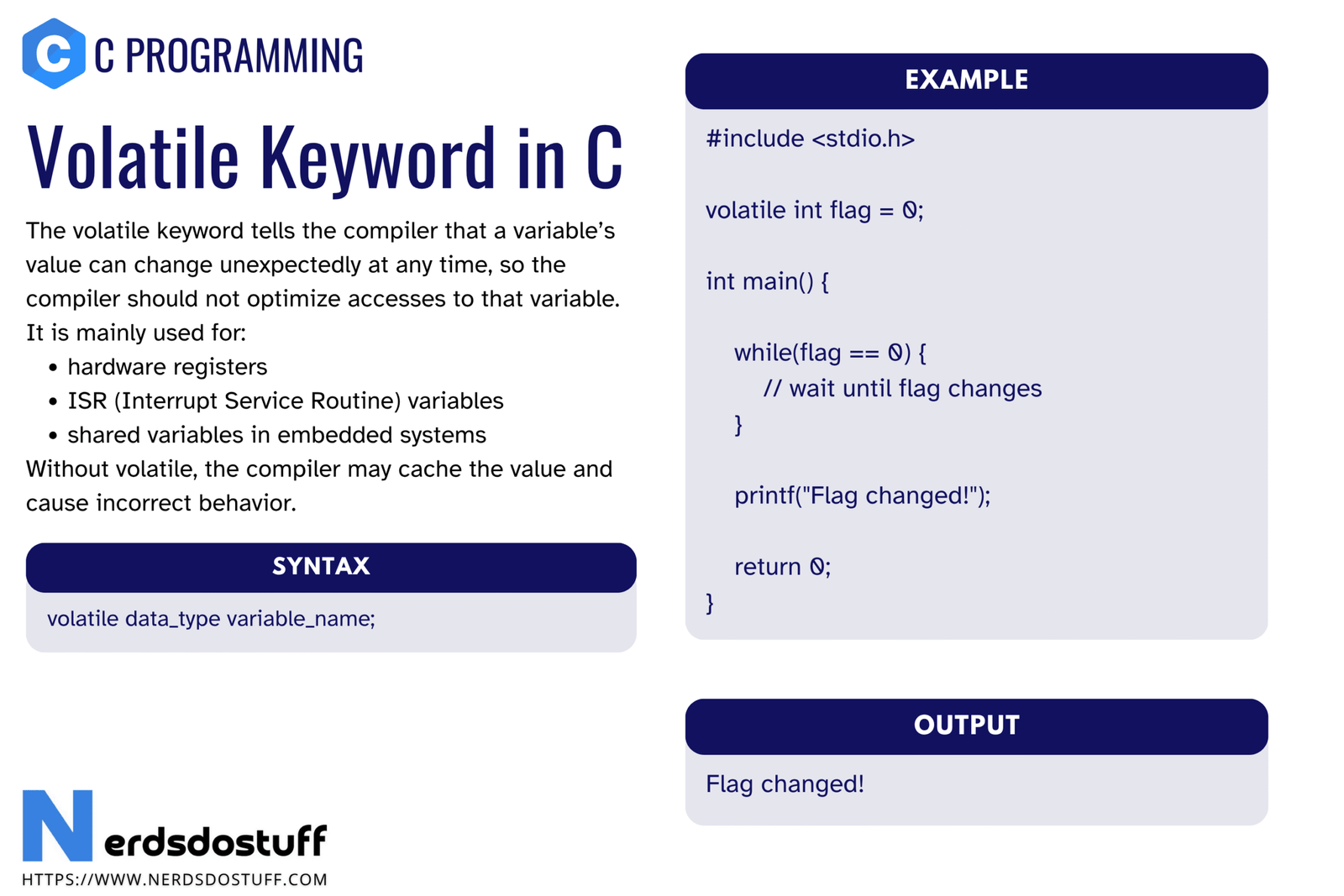
Volatile keyword in C is used to tell the compiler that the value of a variable can change unexpectedly at any time. This means the compiler should not make optimization assumptions based on the idea that the variable stays unchanged unless the current code modifies it. The keyword is especially important in embedded systems, hardware interfacing, interrupt-driven programs, and memory-mapped input/output.
Without volatile, the compiler may store a variable value in a register or reuse a previous value, assuming nothing outside the visible code changes it. That assumption is often useful for performance, but it becomes wrong when hardware, interrupts, or shared system state can modify a value independently. In this article, we will understand the volatile keyword in C, why it is needed, where it is used, common misconceptions, and best practices.
What is Volatile Keyword in C?
The volatile keyword in C is a type qualifier that tells the compiler a variable may change at any time for reasons outside the normal visible flow of the current code.
volatiletells the compiler: always read this value from memory when needed, and do not assume previous reads are still valid.
This does not mean the variable becomes special at runtime by itself. It mainly changes how the compiler treats reads and writes during optimization.
Syntax of Volatile Keyword in C
The keyword is usually written before the type name.
volatile int flag;
volatile unsigned int status;
volatile char data;
It can also appear together with pointers and other qualifiers such as const.
Why Volatile Keyword is Needed in C
Compilers try to optimize code by removing unnecessary repeated memory accesses. That is normally good. But if a value can change outside the compiler’s visible model, then aggressive optimization may produce wrong behavior.
- hardware registers can change without normal code assignment
- an interrupt service routine may update a variable
- memory-mapped device locations may change independently
- special system status flags may be modified by external events
In such cases, volatile tells the compiler not to trust a cached value.
Volatile Variable in C with Example
Consider a flag that is updated by an interrupt or external event.
volatile int flag = 0;
while (flag == 0)
{
    /* wait */
}
If flag is not marked as volatile, the compiler may assume it never changes inside the loop and optimize the code incorrectly. With volatile, the compiler keeps checking memory for updates.
Where Volatile Keyword is Used in C
- memory-mapped hardware registers
- variables shared with interrupt service routines
- device status flags in embedded systems
- special low-level system code where values can change externally
These are the most common and valid use cases.
Volatile with Hardware Register in C
Embedded programming often uses addresses mapped to hardware registers. Since hardware can update those registers independently, they are typically accessed through volatile-qualified pointers or variables.
#define STATUS_REG (*(volatile unsigned int *)0x40000000)
if (STATUS_REG & 0x01)
{
    /* device ready */
}
Here the compiler must read the register value each time because the hardware may change it at any moment.
Volatile with Interrupts in C
When a variable is modified inside an interrupt service routine and also read in normal program flow, volatile is usually needed.
volatile int data_ready = 0;
void isr(void)
{
    data_ready = 1;
}
int main(void)
{
    while (data_ready == 0)
    {
        /* wait for interrupt */
    }
    return 0;
}
This helps the compiler understand that data_ready may change outside the visible main flow.
Volatile Does Not Mean Thread Safe
This is a very important point. The volatile keyword does not make code atomic, synchronized, or thread safe by itself.
- it does not replace locks or mutexes
- it does not guarantee atomic read-modify-write behavior
- it does not solve race conditions by itself
Its main job is to control compiler optimization related to memory access visibility.
Volatile vs Const in C
const and volatile do very different things.
| Keyword | Main Meaning |
|---|---|
const | Program should not modify this value through that name |
volatile | Value may change unexpectedly, so compiler must not optimize away needed access |
A variable can even be both const and volatile. For example, a read-only hardware status register may be modified by hardware, not by normal program code.
Pointer Forms with Volatile in C
Like const, volatile can apply to the pointed data or to the pointer itself.
| Declaration | Meaning |
|---|---|
volatile int *ptr | Pointer to volatile int |
int * volatile ptr | Volatile pointer to int |
volatile int * volatile ptr | Volatile pointer to volatile int |
In embedded code, the most common pattern is a pointer to volatile data.
Common Mistakes with Volatile Keyword in C
- using
volatilefor ordinary variables without any external change reason - thinking
volatilemakes multithreaded code safe - forgetting
volatileon interrupt-shared flags or hardware registers - using
volatileeverywhere and reducing optimization unnecessarily - confusing
volatilewithconst
| Mistake | Problem | Better Practice |
|---|---|---|
Adding volatile everywhere | Unnecessary performance loss and unclear design | Use it only for real externally changing values |
Skipping volatile on register access | Compiler may reuse stale values | Mark hardware-facing access properly |
Using volatile as thread-safety tool | Race conditions still possible | Use correct synchronization tools where needed |
Best Practices for Volatile Keyword in C
- Use
volatileonly when a value can change outside normal program flow. - Use it for hardware registers, interrupt-shared flags, and similar low-level cases.
- Do not assume it provides thread safety or atomic behavior.
- Combine it with correct low-level design rather than treating it as a magic fix.
- Keep the volatile-qualified area as small and clear as possible.
FAQs
What is volatile keyword in C?
The volatile keyword in C tells the compiler that a variable may change unexpectedly, so it should not optimize away required memory accesses.
Why is volatile used in embedded C?
It is used because hardware registers and interrupt-updated values can change outside normal visible code flow.
Does volatile make code thread safe in C?
No. volatile does not provide thread safety, locking, or atomicity by itself.
Can a variable be both const and volatile in C?
Yes. A value may be read-only from program code but still change externally, such as a hardware status register.
When should volatile be avoided in C?
It should be avoided for normal ordinary variables that do not change unexpectedly from outside the visible code flow.
What is the main benefit of volatile in C?
Its main benefit is preventing the compiler from making unsafe optimization assumptions for externally changing values.
Continue learning C in order
Follow the topic sequence with the previous and next lesson.