
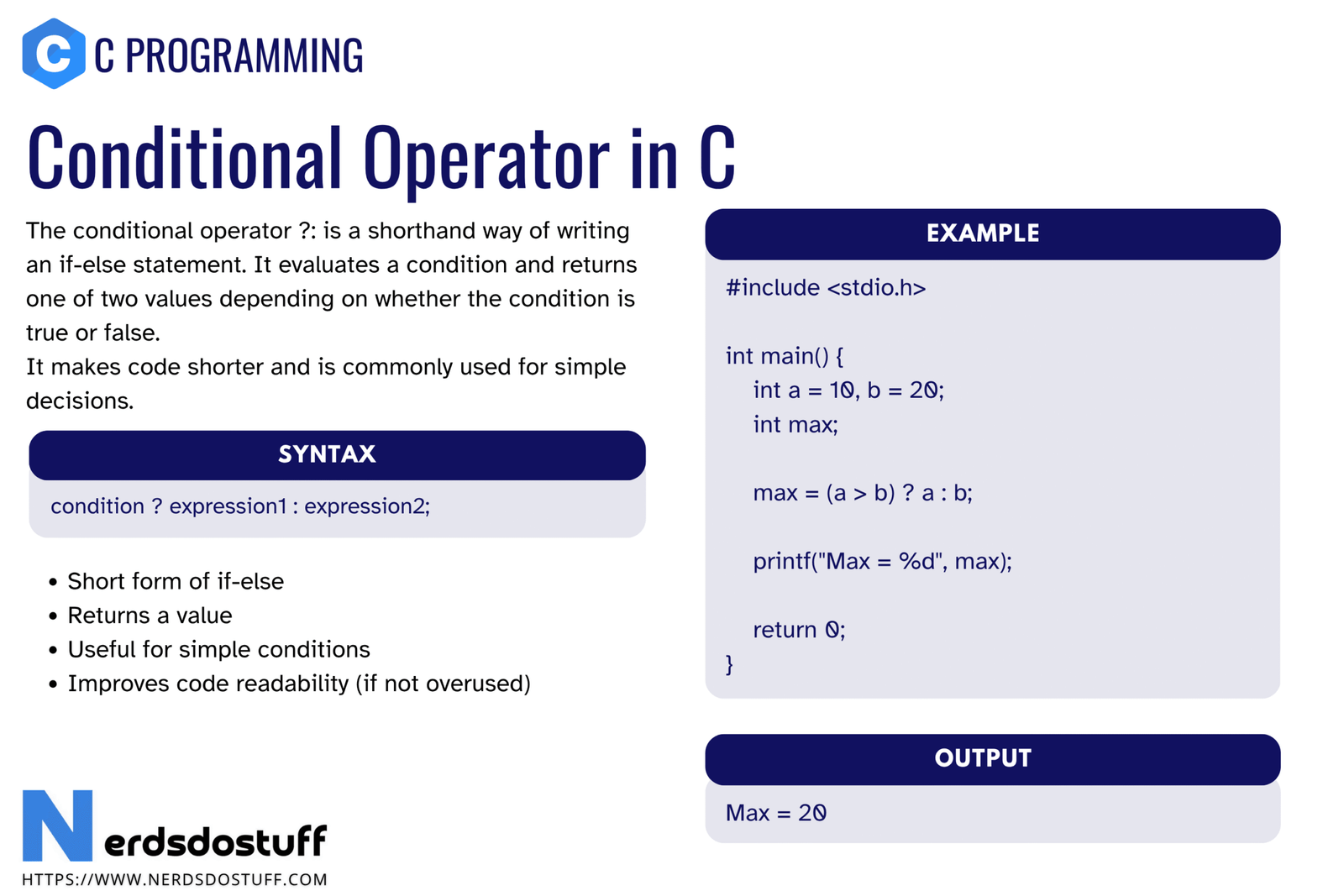
The conditional operator in C is a compact way to choose between two expressions based on a condition. It is often called the ternary operator because it works with three parts. Many beginners first learn decision-making using if else, but the conditional operator is also very important because it allows short decisions to be written directly inside an expression.
When used correctly, the conditional operator makes code shorter and clean. When used carelessly, especially in deeply nested form, it can make code difficult to read. So the real goal is not just to memorize the syntax, but to understand when the operator is useful and when normal if else is the better choice. In this article, we will understand the conditional operator in C, its syntax, working, examples, comparison with if else, common mistakes, and best practices.
What is Conditional Operator in C?
The conditional operator in C is an operator that selects one of two expressions depending on whether a condition is true or false. Its symbol is ?:.
It is called the ternary operator because it has three operands:
- a condition
- an expression used when the condition is true
- an expression used when the condition is false
The conditional operator is a short form of decision-making that returns one value if the condition is true and another value if the condition is false.
Syntax of Conditional Operator in C
The basic syntax is:
condition ? expression_if_true : expression_if_false;| Part | Meaning |
|---|---|
condition | Expression checked first |
expression_if_true | Used when the condition is true |
expression_if_false | Used when the condition is false |
If the condition evaluates to non-zero, the second expression is selected. If the condition evaluates to zero, the third expression is selected.
How Conditional Operator Works in C
- The condition is evaluated first.
- If the condition is true, the expression after
?is evaluated. - If the condition is false, the expression after
:is evaluated. - The selected expression becomes the value of the full conditional expression.
Only one of the two result expressions is evaluated. This is an important point. The conditional operator does not evaluate both branches.
Simple Example of Conditional Operator in C
The following example finds the greater of two numbers:
#include <stdio.h>
int main(void)
{
    int a = 10;
    int b = 25;
    int max;
    max = (a > b) ? a : b;
    printf("Maximum = %d\n", max);
    return 0;
}
If a > b is true, a becomes the value of the expression. Otherwise, b becomes the value.
Conditional Operator as Short Form of If Else
Many people describe the conditional operator as a short form of if else. That description is useful, but not complete. The important difference is that the conditional operator is an expression, while if else is a statement.
| Feature | Conditional Operator | If Else |
|---|---|---|
| Type | Expression | Statement |
| Best for | Short value selection | General decision-making |
| Readability | Good for small decisions | Better for large logic blocks |
| Can return a value directly | Yes | Not in the same direct way |
If the code only needs to select one value between two simple choices, the conditional operator is often cleaner. If the logic involves multiple statements or complex branches, if else is usually better.
Conditional Operator with Assignment in C
A very common use of the conditional operator is direct assignment.
status = (marks >= 40) ? 1 : 0;This kind of expression is short, readable, and practical when the result is a simple value.
Conditional Operator with printf in C
The conditional operator is also often used directly inside function arguments such as printf().
#include <stdio.h>
int main(void)
{
    int num = 7;
    printf("%s\n", (num % 2 == 0) ? "Even" : "Odd");
    return 0;
}
Here the operator selects one string literal, and that selected string is passed to printf().
Conditional Operator with Return Value in C
Since the conditional operator is an expression, it can be used directly in a return statement.
int absolute_value(int x)
{
    return (x >= 0) ? x : -x;
}
This is a clean use case because the selected result is simple and easy to understand.
Nested Conditional Operator in C
The conditional operator can be nested, meaning one ternary expression can contain another. This is valid in C, but it must be used carefully.
#include <stdio.h>
int main(void)
{
    int num = 0;
    printf("%s\n", (num > 0) ? "Positive" : (num < 0) ? "Negative" : "Zero");
    return 0;
}
This works, but nested ternary expressions can become hard to read very quickly. Parentheses should be used to make the grouping obvious.
Operator Precedence and Parentheses
The conditional operator has lower precedence than many arithmetic and relational operators. Because of that, parentheses are often a good idea when mixing it with other expressions.
Even when the compiler can understand the expression without extra parentheses, programmers may not. Clear code matters more than clever code.
| Style | Why It Matters |
|---|---|
| Use parentheses around the condition | Makes the expression easier to scan |
| Use parentheses in nested ternaries | Prevents confusion about grouping |
| Avoid overloading one line with too many operators | Improves readability and reduces bugs |
When to Use Conditional Operator in C
- when choosing one of two simple values
- when assigning a short result based on one condition
- when returning a compact value from a function
- when selecting a small string or numeric result for output
The conditional operator is best for short, value-based decisions. It should not replace every if else in a program.
When If Else is Better Than Conditional Operator
- when each branch contains multiple statements
- when the logic is long or complex
- when nested conditions reduce readability
- when debugging and maintenance matter more than compact syntax
If a ternary expression starts looking complicated, that is usually a sign that normal if else would communicate the idea better.
Common Mistakes in Conditional Operator in C
- forgetting the
:part - using the operator for very long expressions
- writing nested ternary expressions without parentheses
- assuming both result expressions are evaluated
- using it where a normal
if elsewould be clearer
| Mistake | Problem | Better Practice |
|---|---|---|
| Overusing nested ternary expressions | Code becomes hard to read | Use if else for complex decisions |
| Skipping parentheses in tricky cases | Can confuse readers and sometimes logic | Add parentheses for clarity |
| Using ternary for side-effect-heavy code | Makes intent unclear | Keep ternary expressions simple and value-focused |
Best Practices for Conditional Operator in C
- Use it for short and simple value selection.
- Prefer
if elsewhen logic becomes long or multi-step. - Add parentheses when readability benefits from them.
- Keep nested ternary expressions rare and well structured.
- Remember that only one result expression is evaluated.
FAQs
What is conditional operator in C?
The conditional operator in C is the ?: operator used to choose one of two expressions based on a condition.
Why is it called ternary operator?
It is called ternary because it works with three operands: a condition, a true expression, and a false expression.
What is the syntax of conditional operator in C?
The syntax is condition ? expression_if_true : expression_if_false.
What is the difference between conditional operator and if else in C?
The conditional operator is an expression mainly used for short value selection, while if else is a statement used for broader decision-making logic.
Can we use nested conditional operator in C?
Yes, nested conditional operators are allowed, but they should be used carefully because they can reduce readability.
Does conditional operator evaluate both expressions?
No. Only the selected expression is evaluated after the condition is checked.
Continue learning C in order
Follow the topic sequence with the previous and next lesson.