
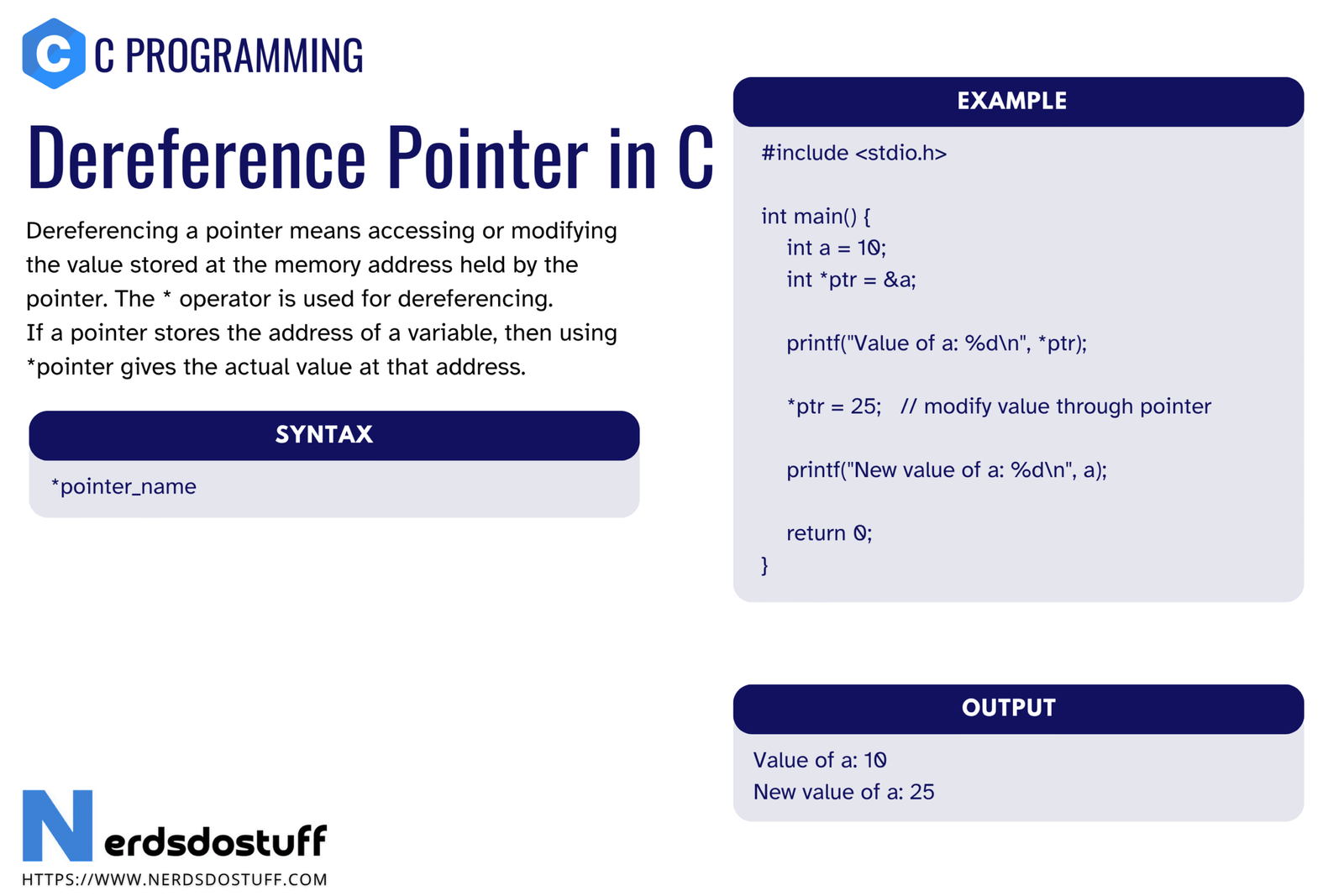
To dereference a pointer in C means to access the value stored at the memory address held by that pointer. This is one of the most fundamental operations in pointer programming. A pointer stores an address, but dereferencing is what lets the program reach the actual data located at that address.
Many beginners understand pointer declaration but get confused at the moment they see the * operator used again in expressions. That happens because the same symbol is used in both pointer declaration and pointer dereferencing, but the meaning depends on context. In this article, we will understand dereference pointer in C, how it works, examples, how it differs from the address operator, common errors, and best practices.
What Does It Mean to Dereference a Pointer in C?
Dereferencing a pointer in C means using the pointer to access the actual value stored at the memory location it points to. This is done using the * operator in an expression.
If a pointer contains an address, then dereferencing follows that address and reads or modifies the underlying value.
A pointer stores an address. Dereferencing a pointer accesses the value present at that address.
Syntax of Dereference Pointer in C
The dereference operator is the asterisk *.
*pointer_nameExample:
int x = 10;
int *ptr = &x;
printf("%d\n", *ptr);
Here, *ptr means “go to the address stored in ptr and fetch the value stored there.”
How Dereferencing Works in C
- A normal variable stores a value.
- A pointer stores the address of that variable.
- The dereference operator
*follows that address. - The program can then read or modify the value at that location.
So dereferencing is the operation that turns an address back into usable data.
Example of Dereference Pointer in C
The following example shows the most basic dereference operation.
#include <stdio.h>
int main(void)
{
    int x = 25;
    int *ptr = &x;
    printf("Value of x = %d\n", x);
    printf("Value using dereference = %d\n", *ptr);
    return 0;
}
Both outputs represent the same value. The first uses the variable directly, and the second uses pointer dereferencing.
Dereference Pointer to Modify a Value in C
Dereferencing is not only for reading data. It can also be used to modify the original variable through the pointer.
#include <stdio.h>
int main(void)
{
    int x = 10;
    int *ptr = &x;
    *ptr = 99;
    printf("%d\n", x);
    return 0;
}
After *ptr = 99;, the value of x becomes 99. This proves that dereferencing gives access to the original stored data, not a copy of it.
Difference Between Address Operator and Dereference Operator in C
Beginners often mix up & and *. They do opposite jobs.
| Operator | Name | Meaning |
|---|---|---|
& | Address-of operator | Gets the memory address of a variable |
* | Dereference operator | Gets the value stored at a pointer’s address |
If &x gives the address of x, then dereferencing that address through a pointer brings you back to the value.
Declaration * and Dereference * in C Are Not the Same
The same * symbol appears in both pointer declarations and dereference expressions, but its meaning depends on context.
| Code | Meaning |
|---|---|
int *ptr; | Declares ptr as a pointer to int |
*ptr | Dereferences ptr to access the value |
This is why context matters. In declarations, * helps define a pointer type. In expressions, * means dereference.
Dereferencing Different Pointer Types in C
Dereferencing depends on the pointer type because the compiler must know how to interpret the memory.
| Pointer type | Dereference result |
|---|---|
int * | Reads an integer value |
char * | Reads a character value |
float * | Reads a float value |
double * | Reads a double value |
This is why the pointer type must match the type of data actually stored at the address.
Dereference Pointer in Function Arguments
Dereferencing is very important in functions because it allows the function to work with original data through addresses.
#include <stdio.h>
void updateValue(int *p)
{
    *p = 500;
}
int main(void)
{
    int x = 10;
    updateValue(&x);
    printf("%d\n", x);
    return 0;
}
Inside the function, *p dereferences the pointer and updates the original variable.
What Happens If We Dereference an Invalid Pointer?
Dereferencing an invalid pointer is dangerous. If the pointer is null, wild, dangling, or otherwise invalid, dereferencing it can lead to undefined behavior, crashes, or corrupted output.
- dereferencing
NULLis invalid - dereferencing an uninitialized pointer is invalid
- dereferencing a dangling pointer is invalid
That is why pointer validity always matters before dereferencing.
Advantages of Understanding Dereference Pointer in C
- builds a strong pointer foundation
- helps in arrays, strings, and function-based memory work
- is essential for dynamic memory and advanced data structures
- improves understanding of low-level programming logic
Common Mistakes When Dereferencing Pointers in C
- dereferencing a null pointer
- dereferencing an uninitialized pointer
- confusing
*ptrwith&ptr - using the wrong pointer type for the actual data
- forgetting that dereference can both read and modify values
| Mistake | Problem | Safer idea |
|---|---|---|
| Dereferencing invalid pointer | Can crash program | Check validity first |
Mixing up * and & | Wrong logic | Track whether you need address or value |
| Using wrong pointer type | Wrong interpretation of memory | Match pointer type to stored data type |
Best Practices for Dereference Pointer in C
- Always know where the pointer is pointing before dereferencing.
- Initialize pointers properly.
- Check for
NULLwhen needed. - Use correct pointer types consistently.
- Practice with simple examples before moving to advanced pointer topics.
FAQs
What does it mean to dereference a pointer in C?
It means using the pointer to access the value stored at the memory address that the pointer holds.
Which operator is used to dereference a pointer in C?
The * operator is used to dereference a pointer.
Can dereferencing a pointer change the original value in C?
Yes. Dereferencing can be used to both read and modify the original value stored at the pointed address.
What is the difference between & and * in C?
& gives the address of a variable, while * dereferences a pointer to access the value at that address.
Can we dereference a null pointer in C?
No. Dereferencing a null pointer is invalid and leads to undefined behavior.
Why is pointer type important during dereferencing in C?
Because the compiler needs the correct type information to interpret the memory properly.
Continue learning C in order
Follow the topic sequence with the previous and next lesson.