
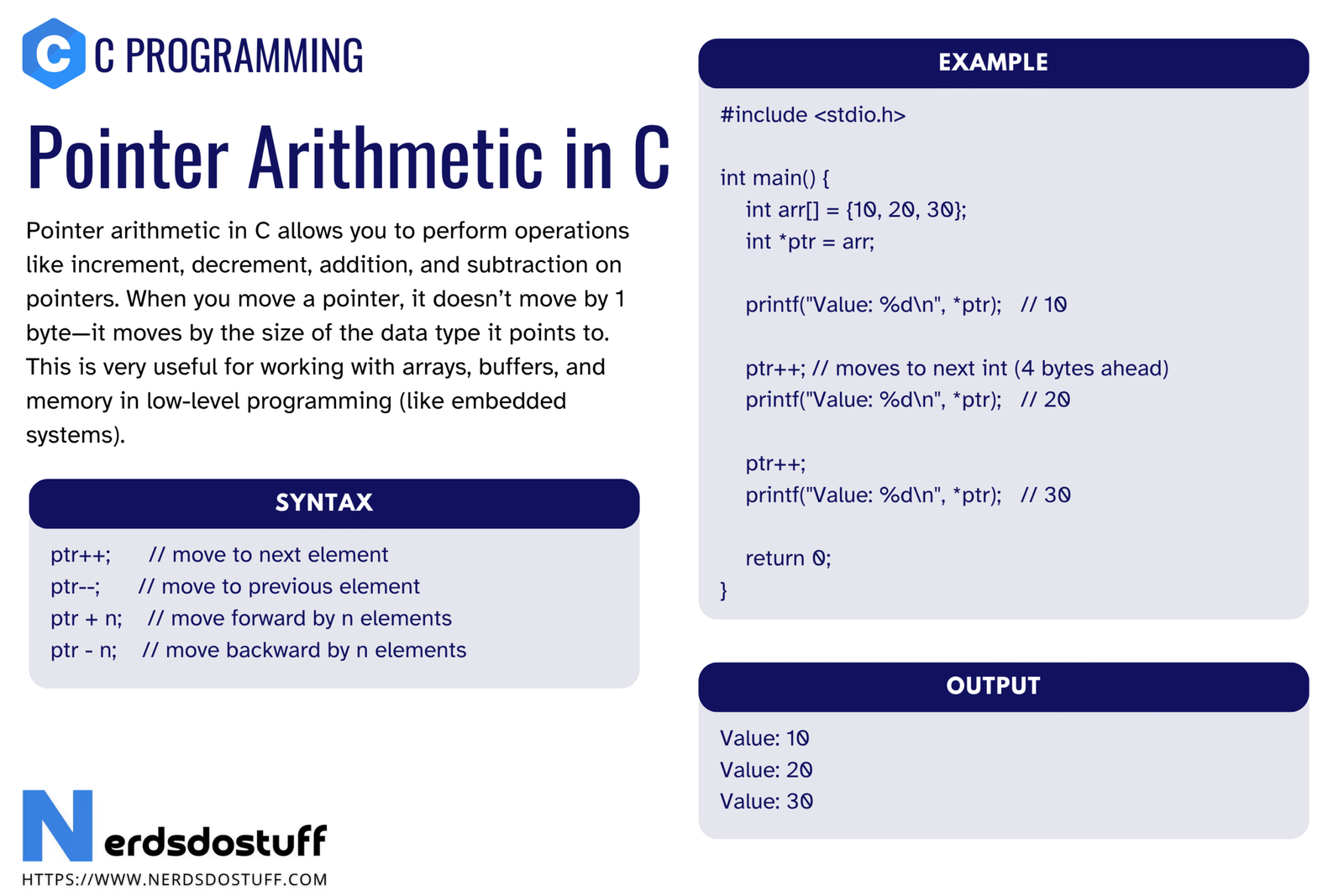
Pointer arithmetic in C is the process of performing arithmetic operations on pointers. This is possible because a pointer stores a memory address, and C allows certain controlled operations on that address. But pointer arithmetic does not behave like normal integer arithmetic. When you add 1 to a pointer, the address does not always increase by one byte. It increases by the size of the data type that the pointer points to.
This is one of the most important topics after learning basic pointers, because it explains how arrays, strings, and indexed memory access work internally in C. In this article, we will understand pointer arithmetic in C, valid operations, invalid operations, type-size stepping, array traversal, pointer subtraction, comparison, and common mistakes.
What is Pointer Arithmetic in C?
Pointer arithmetic in C means performing limited arithmetic operations on pointer variables. These operations let a pointer move across memory locations in units based on the pointer’s data type.
For example, if an int * pointer points to an integer and you add 1 to it, the pointer moves to the next integer location, not just the next byte.
In pointer arithmetic, adding or subtracting a number moves the pointer by that many elements, not by raw bytes in the way beginners often imagine.
Why Pointer Arithmetic is Needed in C
- to move through array elements efficiently
- to access sequential memory locations
- to process strings and character arrays
- to implement low-level memory-based logic
- to understand how array indexing works internally
Without pointer arithmetic, many common C operations involving arrays and memory traversal would be much harder to express.
How Pointer Arithmetic Works in C
The key rule is simple:
- adding
1moves the pointer to the next element of its type - subtracting
1moves the pointer to the previous element of its type - the actual byte movement depends on
sizeof(type)
| Pointer type | If 1 is added | Typical movement |
|---|---|---|
char * | Moves to next character | 1 byte |
int * | Moves to next integer | typically 4 bytes |
float * | Moves to next float | typically 4 bytes |
double * | Moves to next double | typically 8 bytes |
The exact byte size may depend on the system and compiler, but the idea remains the same: pointer arithmetic is scaled by the pointed data type.
Simple Example of Pointer Arithmetic in C
The following program shows how a pointer moves through integer memory locations.
#include <stdio.h>
int main(void)
{
    int arr[3] = {10, 20, 30};
    int *ptr = arr;
    printf("%d\n", *ptr);
    ptr = ptr + 1;
    printf("%d\n", *ptr);
    ptr = ptr + 1;
    printf("%d\n", *ptr);
    return 0;
}
Here, ptr first points to arr[0], then to arr[1], and then to arr[2]. The pointer moves by integer-sized steps.
Allowed Arithmetic Operations on Pointers in C
Not every arithmetic operation is allowed on pointers. The most common valid operations are:
- increment:
ptr++ - decrement:
ptr-- - addition with integer:
ptr + n - subtraction with integer:
ptr - n - subtraction of two compatible pointers within the same array
- comparison of compatible pointers
| Operation | Valid? | Meaning |
|---|---|---|
ptr + 1 | Yes | Move to next element |
ptr - 1 | Yes | Move to previous element |
ptr++ | Yes | Advance by one element |
ptr1 - ptr2 | Yes, if related | Get element distance |
ptr1 + ptr2 | No | Pointer addition is invalid |
ptr * 2 | No | Pointer multiplication is invalid |
Increment and Decrement in Pointer Arithmetic
The increment and decrement operators are very common with pointers.
ptr++;
ptr--;
These move the pointer forward or backward by one element of its type. If ptr is an int *, then ptr++ moves it to the next integer location.
Pointer Arithmetic with Arrays in C
Pointer arithmetic is most commonly seen with arrays because array elements are stored in contiguous memory.
#include <stdio.h>
int main(void)
{
    int arr[5] = {1, 2, 3, 4, 5};
    int *ptr = arr;
    for (int i = 0; i < 5; i++)
    {
        printf("%d ", *(ptr + i));
    }
    return 0;
}
This program prints all array values using pointer arithmetic instead of normal indexing.
In fact, array indexing and pointer arithmetic are closely related in C:
arr[i]is equivalent to*(arr + i)ptr[i]is equivalent to*(ptr + i)
Pointer Subtraction in C
Subtracting one pointer from another is allowed only when both pointers point into the same array or one past the same array. The result tells how many elements lie between them.
int arr[5] = {10, 20, 30, 40, 50};
int *p1 = &arr[4];
int *p2 = &arr[1];
printf("%td\n", p1 - p2);
The result is 3 because there are three integer positions between arr[1] and arr[4].
Pointer Comparison in C
Compatible pointers that refer to elements of the same array can also be compared using relational operators such as <, >, <=, and >=.
This is useful when iterating through memory ranges.
while (ptr < arr + 5)
{
    printf("%d ", *ptr);
    ptr++;
}
Invalid Pointer Arithmetic in C
Some pointer operations are invalid and should never be treated as legal C pointer arithmetic.
- adding two pointers together
- multiplying a pointer
- dividing a pointer
- subtracting unrelated pointers from different arrays or objects
- moving far beyond valid object bounds and then dereferencing
| Invalid expression | Why it is invalid |
|---|---|
ptr1 + ptr2 | C does not define pointer addition between two addresses |
ptr * 2 | Multiplication is not a valid pointer arithmetic operation |
ptr / 2 | Division is not defined for pointers |
| dereferencing unrelated moved address | Can produce undefined behavior |
Pointer Arithmetic and Data Type Size
The data type of the pointer controls how far it moves in memory.
char *cptr;
int *iptr;
double *dptr;
If you add 1 to each of these pointers, they move by different byte distances because sizeof(char), sizeof(int), and sizeof(double) are different.
This is why the pointer type must always match the kind of data being accessed.
Advantages of Pointer Arithmetic in C
- makes array traversal efficient
- helps in low-level memory operations
- supports string and buffer processing
- reveals how indexed access works internally
- is essential in some embedded and systems programming tasks
Common Mistakes in Pointer Arithmetic in C
- thinking
ptr + 1always means one byte forward - dereferencing a pointer after moving outside valid bounds
- subtracting pointers that do not belong to the same array
- mixing the wrong pointer type with the wrong data
- confusing pointer arithmetic with raw integer arithmetic
| Mistake | Problem | Better understanding |
|---|---|---|
ptr + 1 means 1 byte | Wrong mental model | It moves by one element of the pointed type |
| Moving beyond valid object range | Undefined behavior risk | Stay within the same array or valid object range |
| Subtracting unrelated pointers | Invalid result | Only subtract compatible related pointers |
Best Practices for Pointer Arithmetic in C
- Use pointer arithmetic mainly where it improves clarity or performance intent.
- Stay within array bounds and valid memory ranges.
- Understand the pointed data type before moving the pointer.
- Prefer clear code when normal indexing is easier to read.
- Do not dereference pointers after invalid movement.
FAQs
What is pointer arithmetic in C?
Pointer arithmetic in C means adding, subtracting, incrementing, decrementing, or comparing pointers in valid ways based on the size of the pointed data type.
Why does adding 1 to a pointer not always move by 1 byte?
Because pointer arithmetic is scaled by the size of the pointed type. An int * moves by the size of an integer, a double * moves by the size of a double, and so on.
Can we add two pointers in C?
No. Adding two pointers is not a valid pointer arithmetic operation in C.
Can we subtract two pointers in C?
Yes, but only when both pointers refer to elements within the same array or related valid range.
What is the relation between array indexing and pointer arithmetic?
Array indexing is closely related to pointer arithmetic because arr[i] is equivalent to *(arr + i).
Is pointer arithmetic dangerous in C?
It can be dangerous if used carelessly, especially when pointers move outside valid memory bounds or are dereferenced incorrectly.
Continue learning C in order
Follow the topic sequence with the previous and next lesson.